Acalymma trivittatum
Western Striped Cucumber Beetle
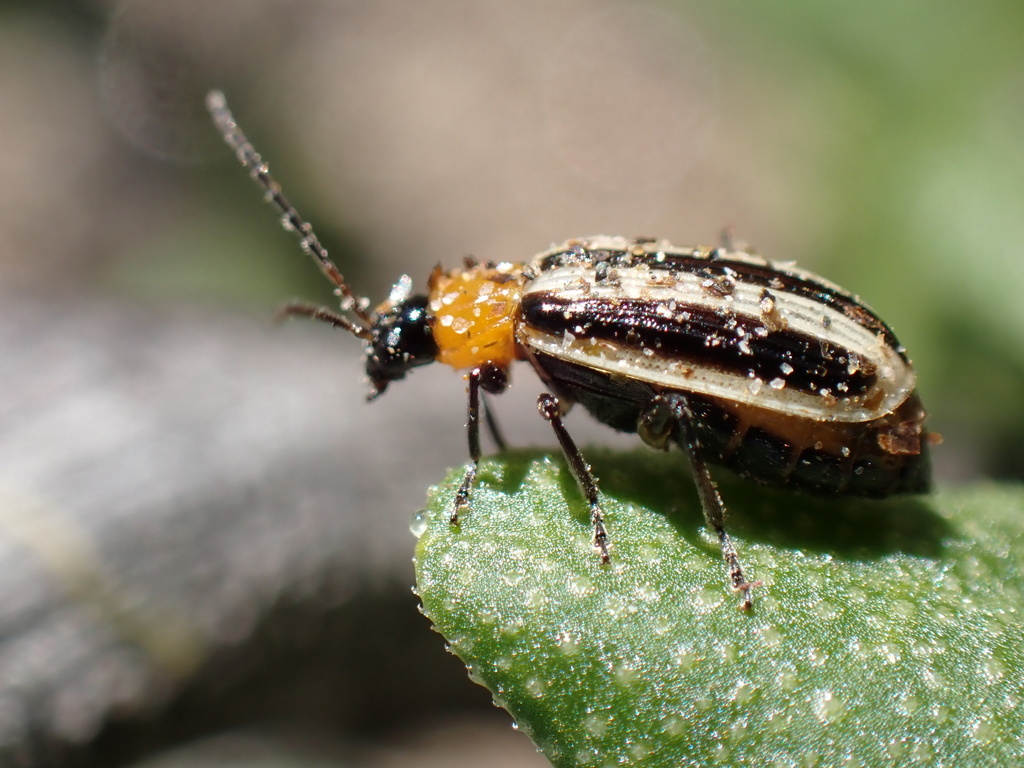
(c) W Rao, some rights reserved (CC BY) · licence
Family: Chrysomelidae · Class: Insecta · Order: Coleoptera
Acalymma trivittatum (Western Striped Cucumber Beetle) is a California animal in the Chrysomelidae family.
The Western Striped Cucumber Beetle is a small leaf beetle measuring approximately 5-7 mm in length. Adults display a distinctive yellow to pale green body with three prominent black longitudinal stripes running along the elytra (wing covers). The underside is characteristically black, which helps distinguish this species from the closely related pale-bellied A. blandulum (BugGuide). The head and thorax are yellowish-green, and the antennae are dark-colored and filiform. This species occurs throughout the western United States, with its range extending from Washington and California eastward to Utah and Texas, and continuing south into Central America (BugGuide). The distribution is concentrated primarily in the corridor from Washington through California to Texas. Within California, the species can be found in various regions where suitable host plants and climatic conditions exist. Western Striped Cucumber Beetles inhabit areas where plants of the family Cucurbitaceae are present, including agricultural zones, gardens, and natural areas supporting wild cucumber and gourd species. Adults are commonly found on the foliage of their host plants, while larvae develop in the soil around the root systems. The species shows a preference for areas with moderate moisture and can be found from low elevations to foothill regions. Both larval and adult stages feed exclusively on plants in the Cucurbitaceae family (BugGuide). Adults feed on leaves, flowers, and fruit surfaces, creating characteristic feeding holes and damage patterns. Larvae are root feeders, developing in the soil where they consume root systems and underground portions of host plants. This feeding behavior can make them significant agricultural pests of cultivated cucurbits including cucumbers, melons, squash, and pumpkins. Adults are most active during warmer months and can be observed feeding and mating on host plants throughout the growing season. The species undergoes complete metamorphosis, with eggs laid in soil near host plant bases. The Western Striped Cucumber Beetle is not federally or state listed as threatened or endangered. As an agricultural pest species, it is generally considered common to abundant throughout its range where suitable host plants occur. The species benefits from agricultural expansion of cucurbit crops, which has likely expanded available habitat in many regions. However, intensive pesticide use in agricultural systems can impact local populations. The beetle's close association with Cucurbitaceae means its distribution closely follows both wild and cultivated members of this plant family. The species was originally described by Mannerheim in 1843 and belongs to the subfamily Galerucinae within the leaf beetle family Chrysomelidae. It is classified in the tribe Luperini, subtribe Diabroticina, representing part of a complex of cucumber beetle species that share similar ecological roles as cucurbit specialists across North America.
Classification
Class: Insecta · Order: Coleoptera · Family: Chrysomelidae
Frequently asked questions
How is Acalymma trivittatum classified?
Acalymma trivittatum belongs to class Insecta, order Coleoptera, family Chrysomelidae.
What family does Acalymma trivittatum belong to?
Acalymma trivittatum is in the Chrysomelidae family.
What is Acalymma trivittatum?
The Western Striped Cucumber Beetle is a small leaf beetle measuring approximately 5-7 mm in length.
Is Acalymma trivittatum found in California?
Yes. Acalymma trivittatum is recorded in California in The California Species Project's catalogue.
Related species
Other California species in the same genus, family, or bioregion.
Data from The California Species Project — 14,000+ California species with verified data from CNPS, CDFW, USFWS, and more.