Acanthancora cyanocrypta
Cobalt sponge
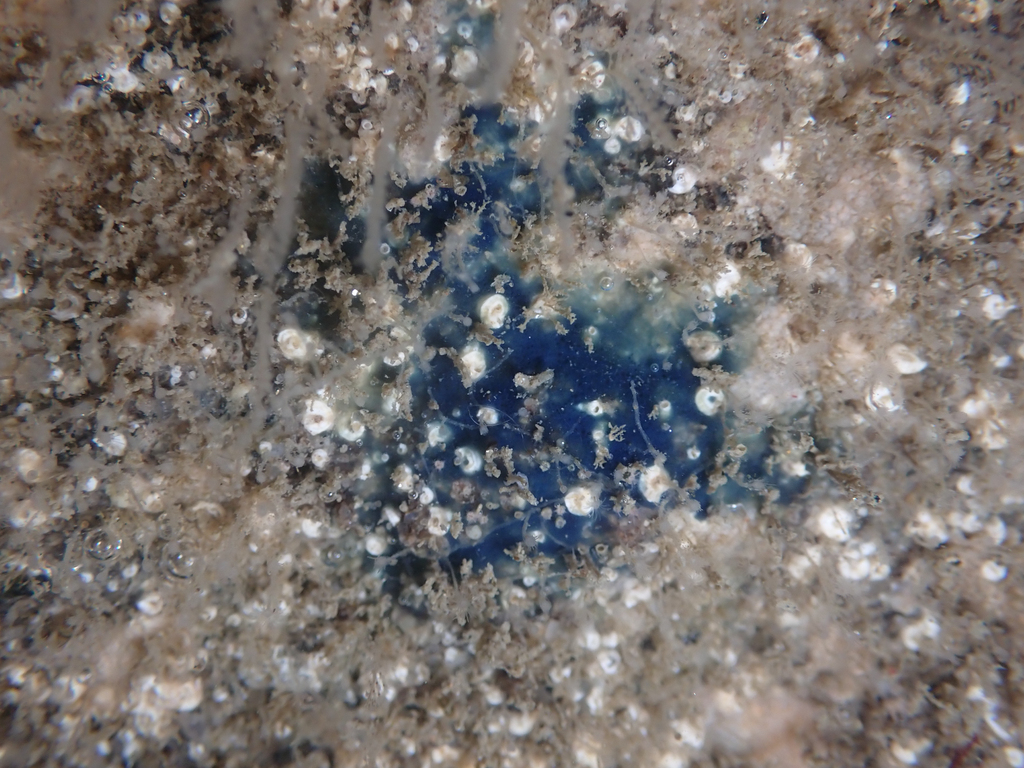
(c) Trevor Van Loon, some rights reserved (CC BY) · licence
Family: Hymedesmiidae · Class: Demospongiae · Order: Poecilosclerida
Acanthancora cyanocrypta (Cobalt sponge) is a California animal in the Hymedesmiidae family.
Acanthancora cyanocrypta, commonly known as the cobalt sponge, is a marine demosponge belonging to the order Poecilosclerida and family Hymedesmiidae. This species represents one of the numerous sponge taxa found in North American marine ecosystems, though detailed scientific documentation remains extremely limited in publicly available literature. As a member of the class Demospongiae, the cobalt sponge likely exhibits the typical body plan of this group, consisting of a porous structure supported by siliceous spicules and organic spongin fibers. The common name suggests distinctive blue coloration, though specific morphological characteristics, size parameters, and distinguishing features have not been thoroughly documented in accessible scientific literature. Demosponges typically range from small encrusting forms to large barrel or vase-shaped structures, but the specific growth form of A. cyanocrypta requires further documentation. The geographic range and distribution of the cobalt sponge have not been well established in available sources. Marine sponges of the family Hymedesmiidae are generally found in various ocean environments, from shallow coastal waters to deeper continental shelf areas, but the specific depth preferences and geographic limits of A. cyanocrypta remain undocumented. California's diverse marine ecosystems, including rocky intertidal zones, kelp forests, and deeper offshore waters, provide habitat for numerous sponge species, though the precise coastal or offshore locations where this species occurs require verification. Habitat requirements for A. cyanocrypta have not been specifically characterized. Members of Hymedesmiidae typically inhabit hard substrates such as rocky surfaces, shells, or other stable surfaces where they can establish their filtering apparatus. Many marine sponges prefer areas with moderate to strong water flow that facilitates their filter-feeding lifestyle, but the specific substrate preferences, depth range, and water quality requirements for the cobalt sponge need scientific documentation. The ecological role and behavior of A. cyanocrypta follow the general pattern of demosponges as filter feeders. These organisms pump water through their porous body structure, capturing bacteria, phytoplankton, and dissolved organic matter from the water column. Reproductive strategies, seasonal patterns, growth rates, and interactions with other marine organisms have not been specifically studied for this species. The timing of reproductive cycles, larval development, and settlement preferences remain undocumented. No federal or state conservation listing status has been identified for the cobalt sponge, and population trends are unknown. Marine sponges face various threats including water quality degradation, ocean acidification, temperature changes, and physical disturbance from human activities, but the specific vulnerability of A. cyanocrypta to these factors has not been assessed. The species' conservation needs and population status require scientific evaluation. Scientific documentation for this species remains extremely limited. The information presented here represents available taxonomic classification and general demosponge biology. We welcome contributions of verified scientific data, photographs, or field observations to enhance this species account.
Classification
Class: Demospongiae · Order: Poecilosclerida · Family: Hymedesmiidae
Frequently asked questions
How is Acanthancora cyanocrypta classified?
Acanthancora cyanocrypta belongs to class Demospongiae, order Poecilosclerida, family Hymedesmiidae.
What family does Acanthancora cyanocrypta belong to?
Acanthancora cyanocrypta is in the Hymedesmiidae family.
What is Acanthancora cyanocrypta?
Acanthancora cyanocrypta, commonly known as the cobalt sponge, is a marine demosponge belonging to the order Poecilosclerida and family Hymedesmiidae.
Is Acanthancora cyanocrypta found in California?
Yes. Acanthancora cyanocrypta is recorded in California in The California Species Project's catalogue.
More California species
This species has no close relatives in our California data — here are other species to explore.
Data from The California Species Project — 14,000+ California species with verified data from CNPS, CDFW, USFWS, and more.