Acanthis flammea
Common Redpoll
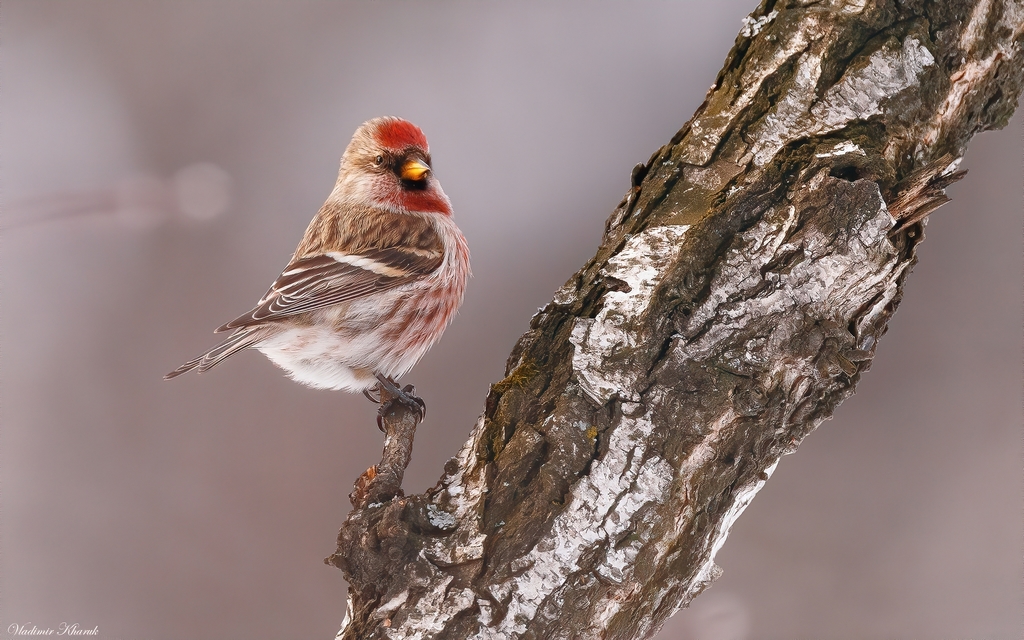
(c) Vladimir Kharuk, some rights reserved (CC BY) · licence
Family: Fringillidae · Class: Aves · Order: Passeriformes
Acanthis flammea (Common Redpoll) is a California animal in the Fringillidae family.
The Common Redpoll is a small finch measuring 11.5 to 14 cm (4.5 to 5.5 inches) in length with a wingspan of 19 to 22 cm (7.5 to 8.7 inches). Adults weigh between 11 to 20 grams. The species is characterized by a distinctive red cap on the forehead and crown, from which it derives its common name. Both sexes display this red patch, though it may be more prominent in males. The upperparts are brown with dark streaking, while the underparts are pale with dark streaks on the flanks. Adult males develop a pink or rosy wash on the breast and rump during breeding season. The bill is small, conical, and yellow with a dark tip, adapted for seed consumption. Common Redpolls breed in the circumpolar Arctic and subarctic regions, including northern Canada, Alaska, Greenland, and northern Eurasia. In North America, their breeding range extends from Alaska across northern Canada to Labrador. The species is highly nomadic and irruptive, with winter distribution varying dramatically between years based on food availability. During winter, Common Redpolls may appear throughout much of the northern United States and southern Canada. In California, the species is considered a rare vagrant, with sporadic records primarily from northern counties during winter months. The breeding habitat consists of open woodlands, forest edges, and shrublands in the boreal and Arctic zones. Common Redpolls favor areas with birch, alder, and willow trees, particularly where these species form dense thickets. During winter, the species occupies a broader range of habitats including open fields, meadows, suburban areas with bird feeders, and forest edges. The species shows a strong preference for areas with abundant seed sources, particularly from birch and alder trees. Common Redpolls are highly social throughout most of the year, forming flocks that may number in the hundreds during winter. Their diet consists primarily of small seeds, particularly from birch, alder, and grasses. The species has specialized adaptations for cold weather survival, including the ability to store seeds in an expandable esophageal pouch for later consumption. Breeding occurs from May to July, with females constructing cup-shaped nests in low shrubs or trees. Clutch size ranges from 3 to 6 eggs, with an incubation period of 10 to 13 days. The species may produce two broods per season in favorable conditions. The Common Redpoll is not federally listed under the Endangered Species Act and is classified as Least Concern by the International Union for Conservation of Nature. However, long-term population trends show significant declines in some regions. According to the North American Breeding Bird Survey, populations have declined by approximately 65% since 1970. Climate change poses potential threats through habitat shifts in Arctic breeding areas and altered precipitation patterns affecting seed production. The species' nomadic nature and dependence on irregular food sources make population monitoring challenging, but continued habitat loss in boreal forests represents an ongoing conservation concern.
Classification
Class: Aves · Order: Passeriformes · Family: Fringillidae
Frequently asked questions
How is Acanthis flammea classified?
Acanthis flammea belongs to class Aves, order Passeriformes, family Fringillidae.
What family does Acanthis flammea belong to?
Acanthis flammea is in the Fringillidae family.
What is Acanthis flammea?
The Common Redpoll is a small finch measuring 11.5 to 14 cm (4.5 to 5.5 inches) in length with a wingspan of 19 to 22 cm (7.5 to 8.7 inches).
Is Acanthis flammea found in California?
Yes. Acanthis flammea is recorded in California in The California Species Project's catalogue.
Related species
Other California species in the same genus, family, or bioregion.
Data from The California Species Project — 14,000+ California species with verified data from CNPS, CDFW, USFWS, and more.