Accipiter atricapillus
American Goshawk
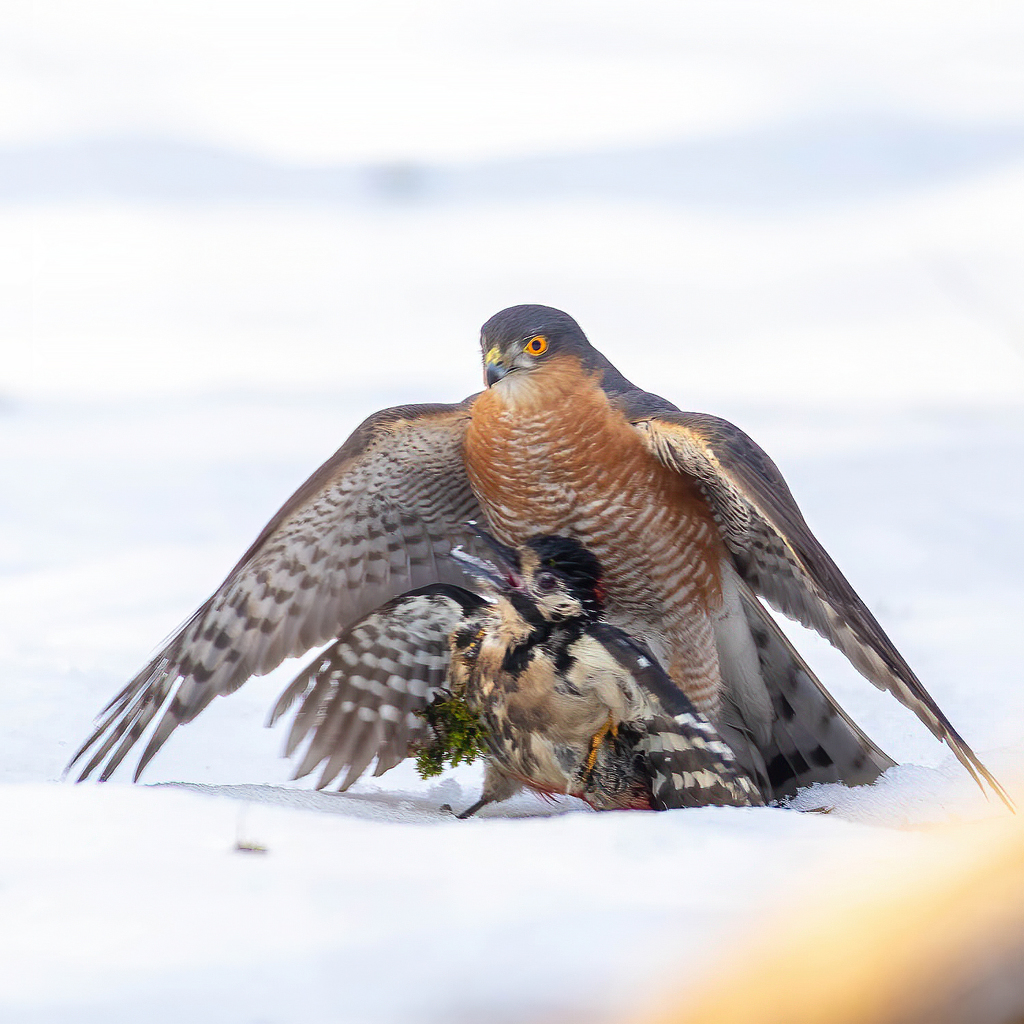
(c) egorbirder, some rights reserved (CC BY) · licence
Family: Accipitridae · Class: Aves · Order: Accipitriformes
Conservation status: G5 S3
Accipiter atricapillus (American Goshawk) is a California animal in the Accipitridae family.
The American Goshawk is the largest member of the Accipiter genus in North America, measuring 55-61 cm (21.7-24.0 inches) in length with females significantly larger than males. Adults display slate-gray upperparts and pale gray underparts with fine dark barring. The species exhibits a distinctive white eyebrow stripe above bright red or orange eyes, with a dark crown and nape. Juveniles show brown upperparts with heavy streaking on white underparts and yellow eyes that transition to red with maturity. The American Goshawk breeds across boreal and montane forests of North America, with populations extending from Alaska and northern Canada south through the western United States. In California, breeding occurs in the Siskiyou Mountains, North Coast Range, Warner Mountains, and throughout the Cascade and Sierra Nevada ranges (Birds of the World). The species inhabits elevations from sea level to alpine zones, adapting to diverse forest types throughout its geographic range. This species demonstrates broad habitat flexibility, nesting in forest types ranging from willow stands along Arctic rivers to massive old-growth forests. In breeding areas, goshawks prefer mature forests with relatively open understories that facilitate hunting flight paths. The species constructs large stick nests typically placed in the main fork of large trees, often reusing and rebuilding nests over multiple seasons. Nest sites are usually located 15-25 meters above ground in dominant or co-dominant trees. American Goshawks are powerful predators specializing in medium-sized prey. Their diet consists primarily of ground and tree squirrels, rabbits and hares, large passerines, woodpeckers, game birds, and corvids, with occasional consumption of reptiles and insects (Birds of the World). The species employs an ambush hunting strategy, using forest cover to approach prey before executing rapid pursuit flights through dense vegetation. Territory sizes vary considerably by region and prey availability, with California pairs utilizing territories averaging 2,425 hectares for males and 3,774 hectares for females. Breeding occurs from April through July, with females laying 2-4 bluish-white eggs in a large stick nest lined with bark strips and green vegetation. Incubation lasts approximately 36-38 days, performed primarily by the female while the male provides food. Nestlings remain in the nest for 35-42 days, with parents continuing to provide food for several weeks after fledging. Young goshawks typically disperse from natal territories in late summer or early fall. The species holds a global conservation rank of G5 (secure) but is considered S3 (vulnerable) in California, reflecting concern over population trends and habitat availability. Primary conservation challenges include forest management practices that reduce suitable nesting habitat, human disturbance during breeding seasons, and climate change impacts on prey species distributions. The species serves as an important indicator of mature forest ecosystem health due to its requirement for large territories and sensitivity to habitat modification. Taxonomically, North American populations are classified as the subspecies Accipiter gentilis atricapillus, distinguished from Eurasian populations by subtle differences in size and plumage characteristics. The scientific name provided in the database (Accipiter atricapillus) represents an alternative taxonomic treatment where the North American form is considered a separate species rather than a subspecies of the Eurasian Northern Goshawk.
Classification
Class: Aves · Order: Accipitriformes · Family: Accipitridae
Conservation status
G5 S3
Frequently asked questions
How is Accipiter atricapillus classified?
Accipiter atricapillus belongs to class Aves, order Accipitriformes, family Accipitridae.
What family does Accipiter atricapillus belong to?
Accipiter atricapillus is in the Accipitridae family.
Is Accipiter atricapillus protected or of conservation concern?
Accipiter atricapillus carries the following status: G5 S3.
What is Accipiter atricapillus?
The American Goshawk is the largest member of the Accipiter genus in North America, measuring 55-61 cm (21.7-24.0 inches) in length with females significantly larger than males.
Is Accipiter atricapillus found in California?
Yes. Accipiter atricapillus is recorded in California in The California Species Project's catalogue.
Related species
Other California species in the same genus, family, or bioregion.
Data from The California Species Project — 14,000+ California species with verified data from CNPS, CDFW, USFWS, and more.