Accipiter gentilis
Northern Goshawk
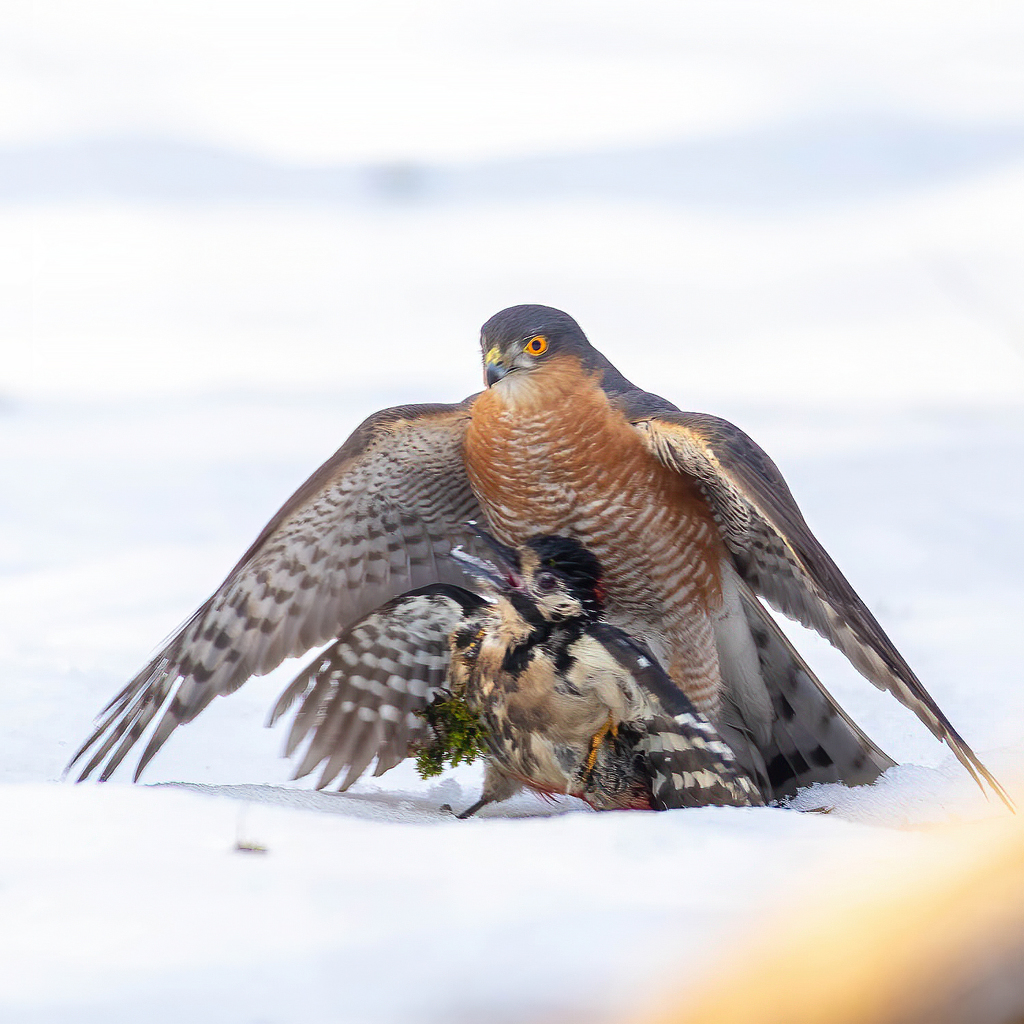
(c) egorbirder, some rights reserved (CC BY) · licence
Family: Accipitridae · Class: Aves · Order: Accipitriformes
Conservation status: G5 S3
Accipiter gentilis (Northern Goshawk) is a California animal in the Accipitridae family.
The Northern Goshawk (Accipiter gentilis) is a large forest raptor and the largest member of the genus Accipiter in North America. Adults measure 46-69 cm (18-27 inches) in length with a wingspan of 89-127 cm (35-50 inches). Females are notably larger than males, weighing 860-2,200 grams compared to males at 630-1,360 grams. Adult birds display blue-gray upperparts and white underparts with fine gray barring. The species exhibits distinctive white eyebrows above red or orange eyes, and a dark crown. Juveniles are brown above with heavy brown streaking on buff-colored underparts and yellow eyes. The tail shows four to five dark bands and a white terminal band. Northern Goshawks have a circumpolar distribution across boreal and montane forests of North America and Eurasia. In California, the species occurs primarily in mountainous regions including the Sierra Nevada, Cascade Range, Klamath Mountains, and northern Coast Ranges. The California population is considered non-migratory, though some altitudinal movement occurs seasonally. Historical range likely included more extensive forest areas before widespread habitat conversion. The species inhabits mature and old-growth coniferous and mixed forests, typically at elevations from 300-3,000 meters (1,000-10,000 feet) in California. Preferred habitat includes dense forest with 60-80% canopy closure and minimal understory development. Nesting sites require large trees, typically 38-64 cm (15-25 inches) in diameter at breast height. Important tree species include Douglas fir, ponderosa pine, white fir, and red fir. The species also utilizes forest edges and openings within 0.5 km of dense forest cover for hunting. Northern Goshawks are specialized predators of medium-sized birds and mammals. Primary prey includes grouse, woodpeckers, jays, and squirrels, though diet varies seasonally and geographically. The species employs short, powerful flights through dense forest to capture prey. Breeding occurs from March through August, with peak egg-laying in April and May. Females typically lay 2-4 eggs in large stick nests built in main trunk forks or on large horizontal branches. Incubation lasts 35-38 days, and young fledge after 34-41 days. Pairs are generally monogamous and may reuse nest sites for multiple years. The Northern Goshawk holds a Global rank of G5 (globally secure) but a California State rank of S3 (vulnerable), indicating population concerns at the state level. The species is not federally listed but is considered a sensitive species by the U.S. Forest Service. Primary threats include habitat loss and fragmentation from logging, fire suppression altering forest structure, and development in montane areas. Forest management practices that create even-aged stands and reduce canopy closure negatively impact breeding success. Climate change may affect prey availability and suitable habitat distribution. Population monitoring through breeding bird surveys and forest inventory data indicates stable to declining trends in some regions, though comprehensive population estimates for California remain limited.
Classification
Class: Aves · Order: Accipitriformes · Family: Accipitridae
Conservation status
G5 S3
Frequently asked questions
How is Accipiter gentilis classified?
Accipiter gentilis belongs to class Aves, order Accipitriformes, family Accipitridae.
What family does Accipiter gentilis belong to?
Accipiter gentilis is in the Accipitridae family.
Is Accipiter gentilis protected or of conservation concern?
Accipiter gentilis carries the following status: G5 S3.
What is Accipiter gentilis?
The Northern Goshawk (Accipiter gentilis) is a large forest raptor and the largest member of the genus Accipiter in North America.
Is Accipiter gentilis found in California?
Yes. Accipiter gentilis is recorded in California in The California Species Project's catalogue.
Related species
Other California species in the same genus, family, or bioregion.
Data from The California Species Project — 14,000+ California species with verified data from CNPS, CDFW, USFWS, and more.