Aceria brachytarsa
California Black Walnut Pouch Gall Mite
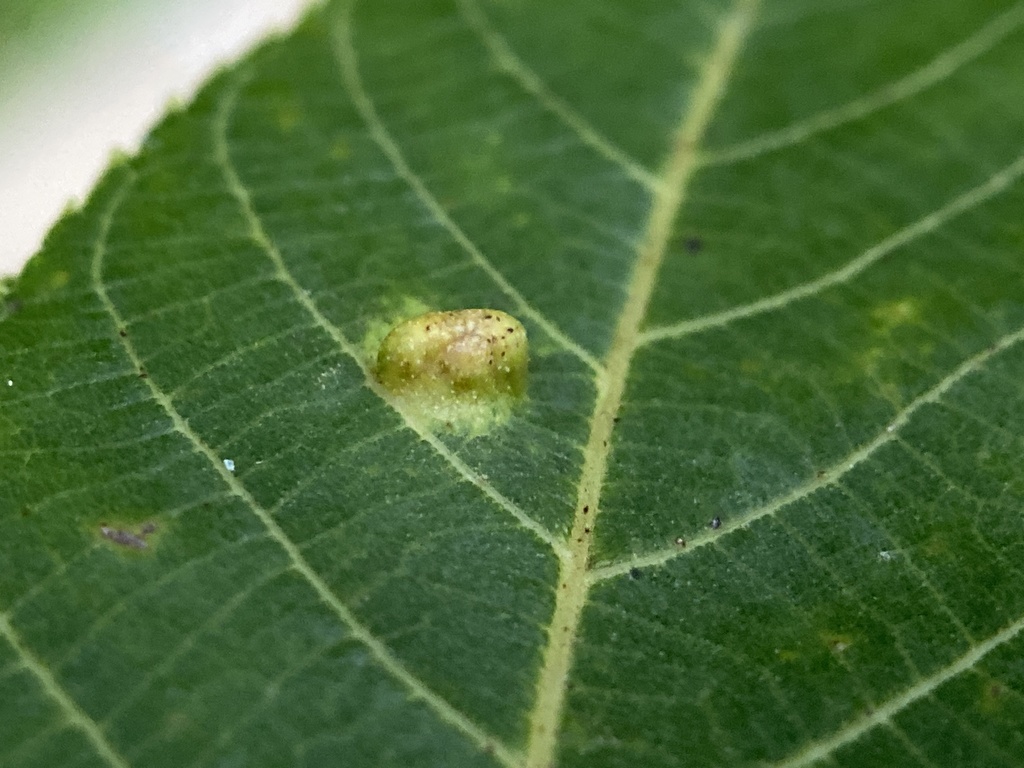
(c) Emily Summerbell, some rights reserved (CC BY) · licence
Family: Eriophyidae · Class: Arachnida · Order: Trombidiformes
Aceria brachytarsa (California Black Walnut Pouch Gall Mite) is a California animal in the Eriophyidae family.
Aceria brachytarsa is a microscopic eriophyid mite that creates distinctive pouch galls on California black walnut (Juglans californica) leaves. Like other members of the Eriophyidae family, this species is extremely small, typically measuring 150-250 micrometers in length, with an elongated, worm-like body that lacks the segmentation visible in other mite families. The body is whitish to translucent, with two pairs of legs located near the anterior end and distinctive feathery claws adapted for gripping plant surfaces. This species is endemic to California, with its distribution closely tied to the range of its host plant, California black walnut. The mite occurs primarily in southern California counties where native walnut groves persist, including areas of Los Angeles, Orange, Riverside, San Bernardino, and Ventura counties. According to habitat information from Hopper Mountain National Wildlife Refuge, California black walnut woodlands cover approximately 673 acres or 27% of that refuge alone, representing some of the largest remaining stands of this vegetation type. Aceria brachytarsa inhabits California black walnut woodlands, a plant community endemic to southern California. These woodlands typically occur at elevations ranging from sea level to approximately 1,200 meters in foothills and canyon areas. The mites are found specifically on walnut leaves where they induce gall formation. California black walnut groves often associate with blue elderberry (Sambucus nigra ssp. cerulea) in open-canopy areas, and may include hollyleaf redberry (Rhamnus ilicifolia) and California flowering ash (Fraxinus dipetala) in the understory. The mites feed by inserting their needle-like stylets into leaf tissue and consuming cell contents. Their feeding activity stimulates the formation of characteristic pouch galls on the leaf surface. These galls appear as small, pocket-like structures that provide shelter and nutrition for developing mites. The species likely has multiple generations per year, with peak activity during the growing season when new walnut foliage is available. Reproduction occurs within the galls, where females lay eggs that develop through several molts before reaching maturity. While Aceria brachytarsa has no formal conservation listing status, its dependence on California black walnut makes it vulnerable to habitat loss. California black walnut (Juglans californica var. californica) is state-listed as vulnerable, and the walnut woodland habitat type has experienced significant reduction due to urban development, agriculture, and fire suppression. The California Wildlife Habitat Relationships System recognizes Valley Oak Woodland, which includes California walnut associations, as one of 59 wildlife habitats tracked in California. Conservation of remaining walnut groves, such as those protected at Hopper Mountain National Wildlife Refuge, is essential for maintaining populations of specialized species like A. brachytarsa. The mite's specialized relationship with a single host plant species makes it particularly susceptible to habitat fragmentation and loss of genetic connectivity between walnut populations.
Classification
Class: Arachnida · Order: Trombidiformes · Family: Eriophyidae
Frequently asked questions
How is Aceria brachytarsa classified?
Aceria brachytarsa belongs to class Arachnida, order Trombidiformes, family Eriophyidae.
What family does Aceria brachytarsa belong to?
Aceria brachytarsa is in the Eriophyidae family.
What is Aceria brachytarsa?
Aceria brachytarsa is a microscopic eriophyid mite that creates distinctive pouch galls on California black walnut (Juglans californica) leaves.
Is Aceria brachytarsa found in California?
Yes. Aceria brachytarsa is recorded in California in The California Species Project's catalogue.
Related species
Other California species in the same genus, family, or bioregion.
Data from The California Species Project — 14,000+ California species with verified data from CNPS, CDFW, USFWS, and more.