Aceria calaceris
Rocky Mountain Maple Felt Mite
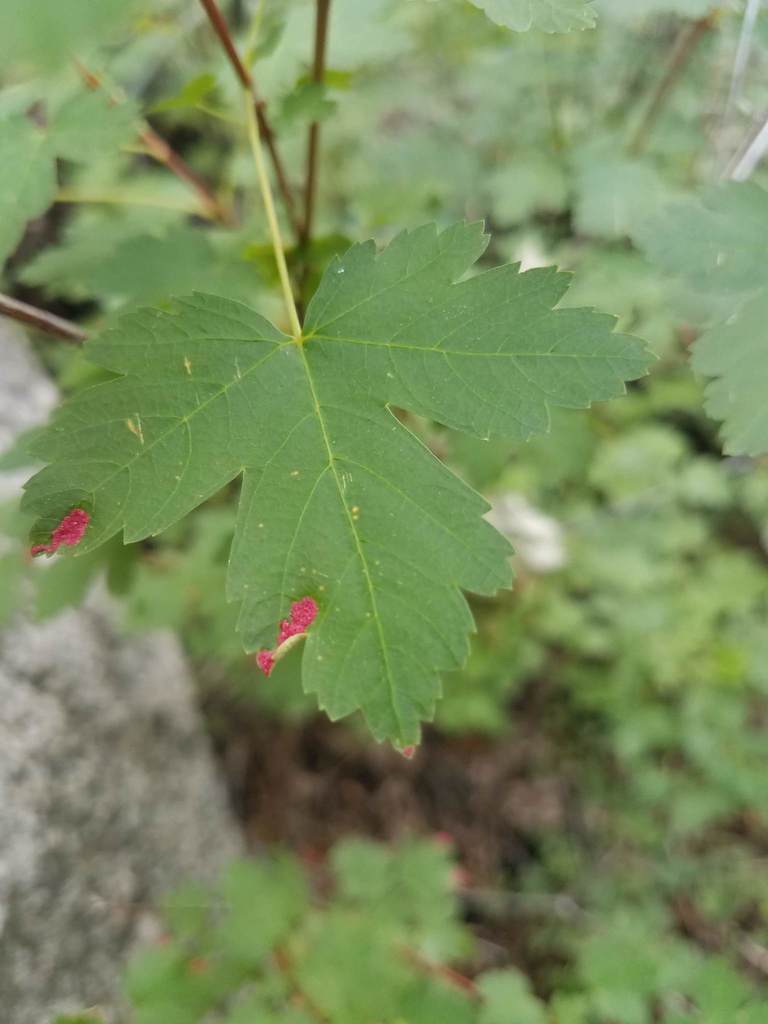
(c) Nature Newt, some rights reserved (CC BY) · licence
Family: Eriophyidae · Class: Arachnida · Order: Trombidiformes
Aceria calaceris (Rocky Mountain Maple Felt Mite) is a California animal in the Eriophyidae family.
Aceria calaceris is a microscopic eriophyid mite in the family Eriophyidae, order Trombidiformes. As a member of the felt mites, this species exhibits the characteristic elongated, vermiform body shape typical of eriophyids, measuring approximately 100-200 micrometers in length. The body is translucent to pale yellow, with the distinctive four-legged condition found in all eriophyid mites, having lost the posterior pair of legs during evolution. The body is segmented into a cephalothorax bearing the mouthparts and legs, and an elongated opisthosoma marked by numerous ring-like annuli. The distribution and range of A. calaceris remains poorly documented in the scientific literature. The common name "Rocky Mountain Maple Felt Mite" suggests an association with montane regions of western North America, though specific distributional records are limited. Like other eriophyid mites, this species likely has a restricted range tied to the distribution of its host plant species. As indicated by its common name, A. calaceris appears to be associated with maple species (Acer), though the specific host plant relationships have not been well documented in available literature. Eriophyid mites are typically highly host-specific, often restricted to a single plant species or closely related group of species. The species likely inhabits the leaf surfaces, buds, or other plant tissues of its maple host, creating characteristic felt-like galls or causing other plant tissue modifications typical of eriophyid feeding. Like other eriophyid mites, A. calaceris likely exhibits a complex life cycle involving egg, two nymphal stages, and adult phases. These mites are plant parasites that feed by piercing plant cells with their needle-like chelicerae and consuming cell contents. Their feeding activity often stimulates abnormal plant growth, resulting in galls, erinea (felt-like hair growths), or other plant deformations. Reproduction is typically sexual, though parthenogenesis may occur in some populations. Seasonal activity patterns are generally tied to host plant phenology, with peak populations often occurring during active plant growth periods. No federal or state conservation listing status has been assigned to A. calaceris. The conservation status of most eriophyid mites remains undetermined due to their microscopic size, taxonomic complexity, and limited ecological study. Many eriophyid species may be naturally rare or have restricted distributions tied to specific microhabitats or host plants, but distinguishing truly rare species from those that are simply understudied presents significant challenges. Climate change and habitat modification could potentially impact specialized mites like A. calaceris, particularly if their host plants face distributional shifts or population declines. Scientific documentation for this species remains extremely limited. The information presented here synthesizes general eriophyid biology with the limited available data specific to A. calaceris. Detailed ecological studies, host plant verification, and distributional surveys are needed to better understand this species' biology, habitat requirements, and conservation needs.
Classification
Class: Arachnida · Order: Trombidiformes · Family: Eriophyidae
Frequently asked questions
How is Aceria calaceris classified?
Aceria calaceris belongs to class Arachnida, order Trombidiformes, family Eriophyidae.
What family does Aceria calaceris belong to?
Aceria calaceris is in the Eriophyidae family.
What is Aceria calaceris?
Aceria calaceris is a microscopic eriophyid mite in the family Eriophyidae, order Trombidiformes.
Is Aceria calaceris found in California?
Yes. Aceria calaceris is recorded in California in The California Species Project's catalogue.
Related species
Other California species in the same genus, family, or bioregion.
Data from The California Species Project — 14,000+ California species with verified data from CNPS, CDFW, USFWS, and more.