Aceria mackiei
Live Oak Erineum Mite
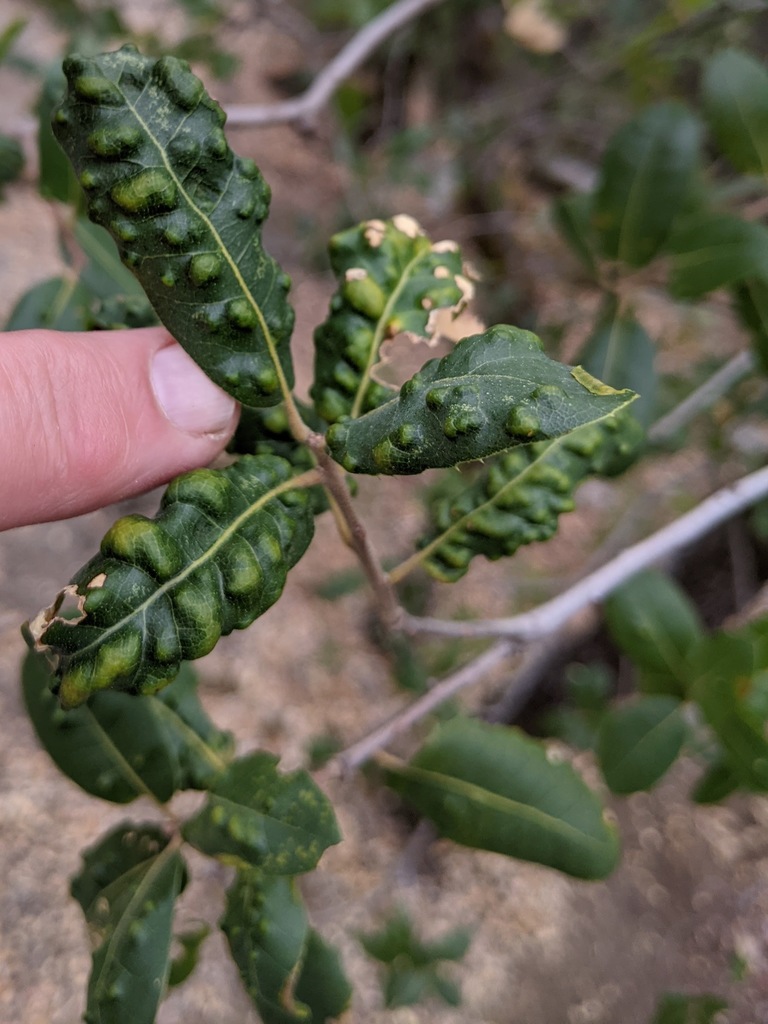
(c) Justin, some rights reserved (CC BY) · licence
Family: Eriophyidae · Class: Arachnida · Order: Trombidiformes
Aceria mackiei (Live Oak Erineum Mite) is a California animal in the Eriophyidae family.
The Live Oak Erineum Mite (Aceria mackiei) is a microscopic eriophyid mite in the family Eriophyidae, order Trombidiformes. Like other eriophyid mites, A. mackiei is extremely small, typically measuring 100-300 micrometers in length, with an elongated, vermiform body shape characteristic of the family. The species possesses only two pairs of legs positioned at the anterior end of the body, distinguishing it from other arachnids that typically have four pairs of legs. The body appears translucent to pale yellow under magnification, with a segmented abdomen that can extend and contract. Aceria mackiei is associated with live oak trees (Quercus species) in California, though specific distributional records and county-level occurrence data are not well documented in the scientific literature. The species' range likely corresponds with the distribution of its host plants, which include various live oak species found throughout California's oak woodlands and mixed forests. This mite inhabits the leaf surfaces of live oak trees, where it creates characteristic erinea - small, pouch-like galls or felt-like patches of modified plant tissue. These structures appear as dense mats of abnormal plant hairs (trichomes) on the undersides of oak leaves, typically appearing white, tan, or reddish-brown in color. The mites live and reproduce within these protected microenvironments, which provide shelter from environmental extremes and natural enemies. As a plant-parasitic mite, A. mackiei feeds by inserting its needle-like stylets into leaf cells and extracting cellular contents. The feeding activity stimulates the host plant to produce the erineum structures that serve as both feeding sites and protective shelters. The species likely has multiple generations per year, with populations building throughout the growing season. Reproduction occurs within the erinea, where eggs are laid and development from egg to adult takes place. Dispersal to new leaves or trees occurs primarily through wind transport, as the mites are small enough to become airborne. The conservation status of Aceria mackiei has not been formally assessed at federal or state levels. Like many arthropod species, particularly microscopic mites, this species lacks comprehensive population monitoring or conservation evaluation. The species does not appear on current endangered or threatened species lists maintained by the U.S. Fish and Wildlife Service or California Department of Fish and Wildlife as of December 2025. Specific threats to this species have not been documented, though general threats to oak woodland ecosystems in California could potentially affect eriophyid mite populations. These may include habitat fragmentation, urban development, altered fire regimes, and climate change impacts on oak tree health and distribution. The species' survival is likely closely tied to the conservation of California's oak woodlands and the health of its live oak host trees. Scientific documentation for this species remains limited. Detailed ecological studies, population assessments, and comprehensive distributional surveys are lacking. If you have additional verified information about this species' biology, distribution, or ecology, please contact us to help improve this species account.
Classification
Class: Arachnida · Order: Trombidiformes · Family: Eriophyidae
Frequently asked questions
How is Aceria mackiei classified?
Aceria mackiei belongs to class Arachnida, order Trombidiformes, family Eriophyidae.
What family does Aceria mackiei belong to?
Aceria mackiei is in the Eriophyidae family.
What is Aceria mackiei?
The Live Oak Erineum Mite (Aceria mackiei) is a microscopic eriophyid mite in the family Eriophyidae, order Trombidiformes.
Is Aceria mackiei found in California?
Yes. Aceria mackiei is recorded in California in The California Species Project's catalogue.
Related species
Other California species in the same genus, family, or bioregion.
Data from The California Species Project — 14,000+ California species with verified data from CNPS, CDFW, USFWS, and more.