Acheta domesticus
House Cricket
no rights reserved · CC0
Family: Gryllidae · Class: Insecta · Order: Orthoptera
Acheta domesticus (House Cricket) is a California animal in the Gryllidae family.
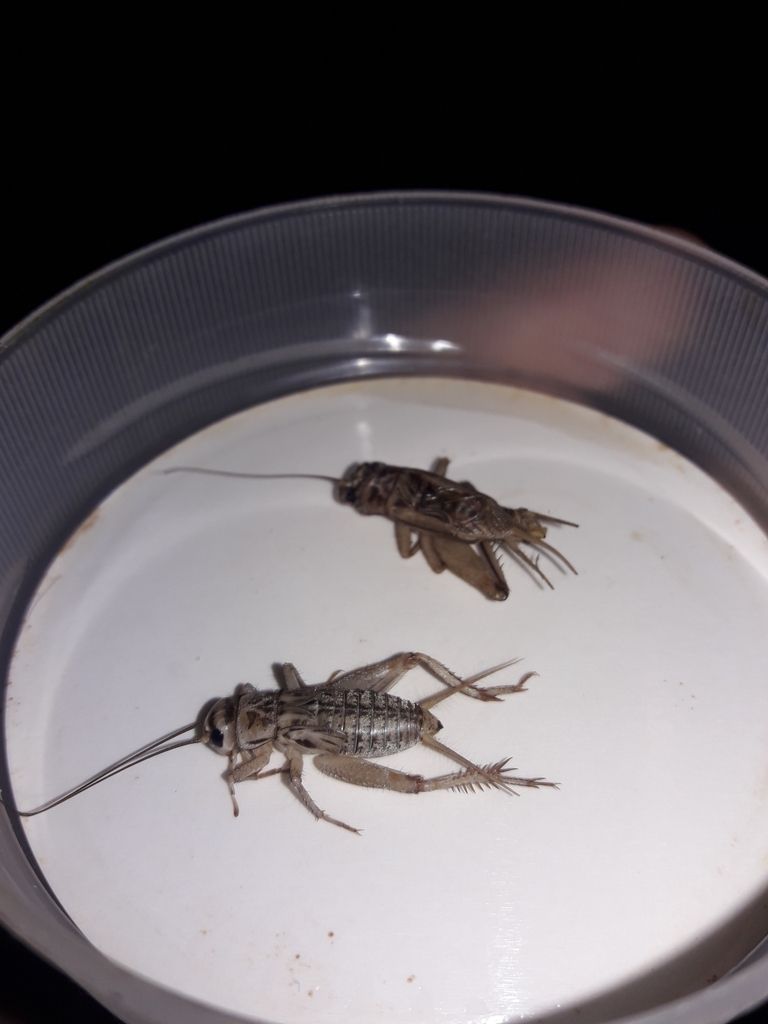
The house cricket is a medium-sized insect measuring 16 to 21 millimeters (0.6 to 0.8 inches) in length. Adults display light yellowish-brown to tan coloration with darker brown banding across the head and thorax. The species exhibits sexual dimorphism, with females possessing a prominent needle-like ovipositor extending from the rear of the abdomen (Weaver 1988). Males lack this structure but feature specialized sound-producing organs on their forewings that produce the characteristic chirping calls through stridulation (Alexander 1961). Both sexes have long, thread-like antennae that can exceed body length and powerful hind legs adapted for jumping. Originally native to southwestern Asia and the eastern Mediterranean region (Resh & Cardé 2003), house crickets have achieved a cosmopolitan distribution through human activity and are now established on every continent except Antarctica. In California, populations occur throughout the state, particularly in urban and suburban environments. The species has become fully naturalized across North America, with established populations from sea level to moderate elevations. House crickets inhabit a diverse range of environments but show strong associations with human-modified habitats. They commonly occur in buildings, basements, garages, and outdoor areas around structures. The species prefers warm, humid conditions and seeks shelter in cracks, crevices, and debris piles. In natural settings, they occupy areas under rocks, logs, and vegetation, particularly in disturbed soils and edge habitats between developed and natural areas. This omnivorous species feeds on a wide variety of organic matter including plant material, dead insects, food scraps, and fabric. House crickets are primarily nocturnal, becoming active after sunset to forage and mate. Males produce distinctive chirping calls by rubbing specialized wing structures together, with calling frequency directly correlated to ambient temperature following Dolbear's Law (Walker 1962). Mating occurs throughout the warmer months, with females depositing 150 to 400 eggs in soil, cracks, or soft substrates using their elongated ovipositor (Clifford et al. 1977). Eggs hatch after 14 to 25 days depending on temperature, and nymphs undergo 8 to 10 molts over 60 to 90 days before reaching adulthood (Ghouri & McFarlane 1958). Adults typically live 60 to 90 days under optimal conditions. House crickets hold no conservation status designations and are not listed under state or federal endangered species legislation. As an introduced species, they are considered ecologically neutral to slightly beneficial in their adopted range. The species serves as prey for various predators including spiders, birds, and small mammals, and has become an important food source in commercial insect farming operations. Their adaptability to human environments and broad temperature tolerance suggest continued population stability across their introduced range. Climate change may expand suitable habitat northward, potentially increasing their distribution in cooler regions of North America.
Classification
Class: Insecta · Order: Orthoptera · Family: Gryllidae
Frequently asked questions
How is Acheta domesticus classified?
Acheta domesticus belongs to class Insecta, order Orthoptera, family Gryllidae.
What family does Acheta domesticus belong to?
Acheta domesticus is in the Gryllidae family.
What is Acheta domesticus?
The house cricket is a medium-sized insect measuring 16 to 21 millimeters (0.6 to 0.8 inches) in length.
Is Acheta domesticus found in California?
Yes. Acheta domesticus is recorded in California in The California Species Project's catalogue.
Related species
Other California species in the same genus, family, or bioregion.
Data from The California Species Project — 14,000+ California species with verified data from CNPS, CDFW, USFWS, and more.