Achyra rantalis
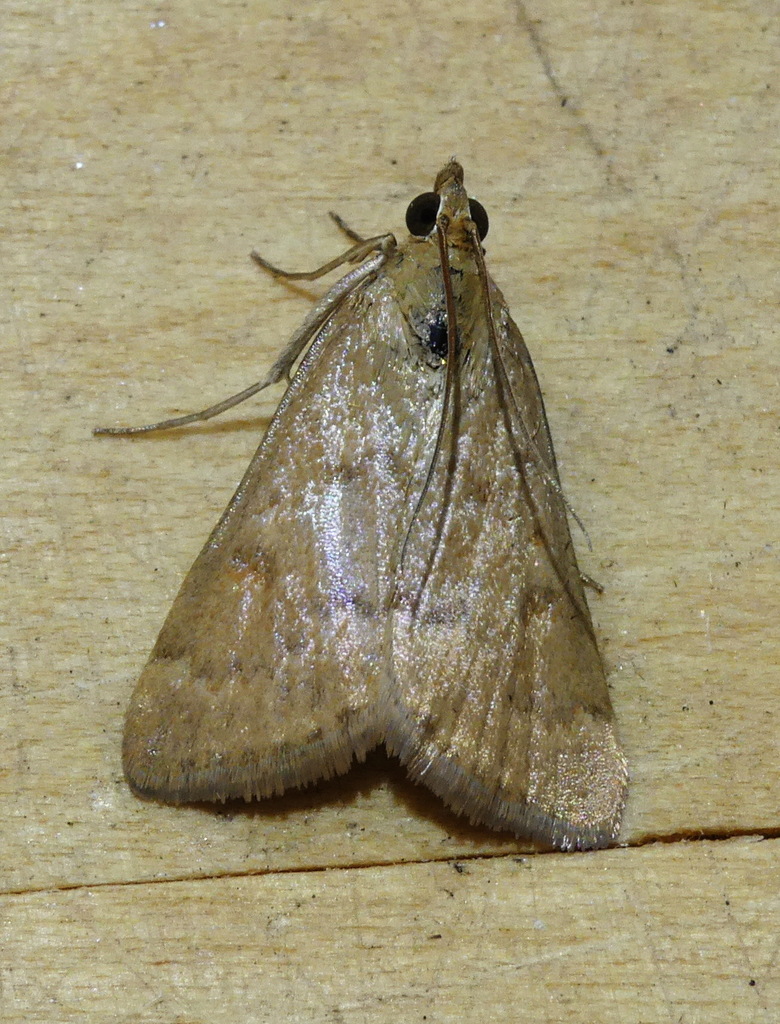
(c) Susan Blayney, some rights reserved (CC BY) · licence
Family: Crambidae · Class: Insecta · Order: Lepidoptera
Achyra rantalis is a California animal in the Crambidae family.
The garden webworm moth (Achyra rantalis) is a small pyraloid moth in the family Crambidae. Adults typically measure 15 to 20 mm in wingspan, with forewings displaying a distinctive pattern of golden-brown to tan coloration marked by darker transverse lines and pale yellowish patches. The hindwings are lighter, often appearing whitish to pale yellow with darker marginal bands. This species has an extensive range across North America, occurring from Maine to southern Quebec and Ontario, south to Florida and Mexico (iNaturalist). In the western United States, it has been documented in Iowa, Colorado, and California, with additional records from the West Indies. The species exhibits a broad distribution pattern typical of agricultural pest species, following human cultivation practices across diverse climatic zones. The garden webworm moth inhabits a variety of open habitats, with a strong preference for agricultural areas, gardens, and disturbed sites (iNaturalist). Adults are commonly found in fields, cultivated areas, and suburban gardens where host plants are abundant. The species shows considerable ecological flexibility, adapting to both natural and human-modified environments from sea level to moderate elevations. Larvae, known as garden webworms, are polyphagous feeders that construct characteristic silken webs on their host plants. They feed on a wide variety of herbaceous plants, including cultivated crops such as alfalfa, beans, corn, and various garden vegetables, as well as native forbs and weeds. The caterpillars are typically pale green to yellowish with dark spots and sparse setae, reaching approximately 25 mm in length when fully developed. Adults are primarily nocturnal and are attracted to artificial lights. The species is multivoltine in warmer regions, producing multiple generations per year, with overwintering typically occurring in the pupal stage in plant debris or soil. Development time varies with temperature and latitude, with southern populations completing development more rapidly than northern ones. Mating occurs shortly after adult emergence, with females depositing eggs singly or in small clusters on host plant leaves. The species exhibits strong dispersal capabilities, with adults capable of long-distance flight. Achyra rantalis is not federally or state-listed and appears to maintain stable populations throughout its range. As an agricultural pest species, it is more likely to benefit from human activities than to be threatened by them. The species' broad host plant range, high reproductive capacity, and dispersal ability contribute to its widespread distribution and population stability. Climate change may potentially expand its range northward, as warmer temperatures could allow for additional generations in previously marginal habitats. Current conservation status reflects a species well-adapted to anthropogenic landscapes with no immediate conservation concerns.
Classification
Class: Insecta · Order: Lepidoptera · Family: Crambidae
Frequently asked questions
How is Achyra rantalis classified?
Achyra rantalis belongs to class Insecta, order Lepidoptera, family Crambidae.
What family does Achyra rantalis belong to?
Achyra rantalis is in the Crambidae family.
What is Achyra rantalis?
The garden webworm moth (Achyra rantalis) is a small pyraloid moth in the family Crambidae.
Is Achyra rantalis found in California?
Yes. Achyra rantalis is recorded in California in The California Species Project's catalogue.
Related species
Other California species in the same genus, family, or bioregion.
Data from The California Species Project — 14,000+ California species with verified data from CNPS, CDFW, USFWS, and more.