Acipenser medirostris
Green Sturgeon
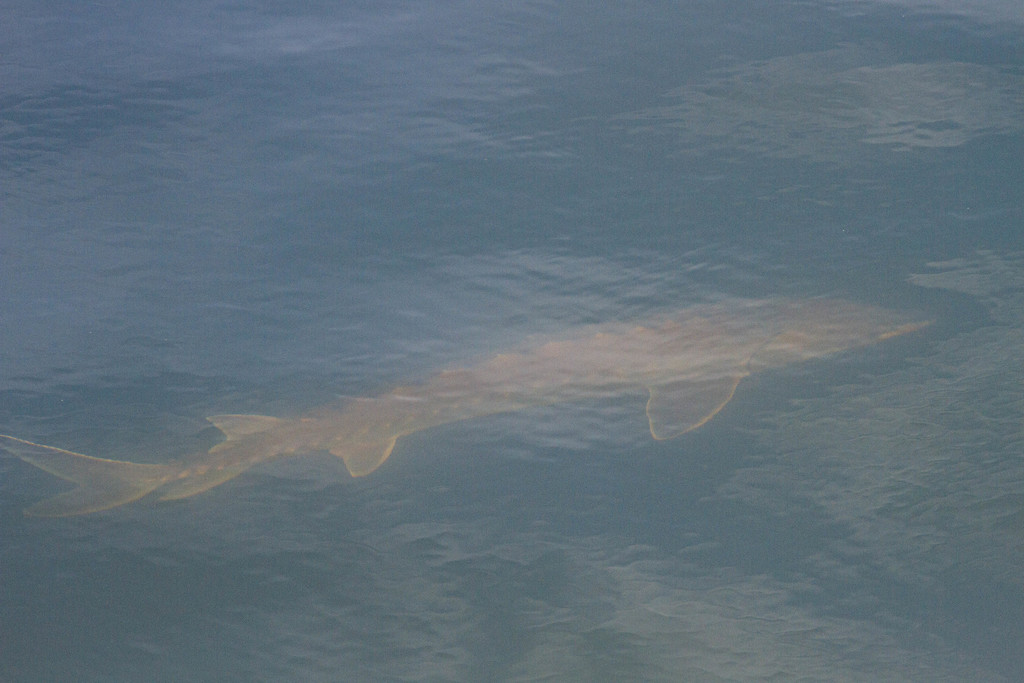
(c) Doug Suitor, some rights reserved (CC BY) · licence
Family: Acipenseridae · Class: Actinopterygii · Order: Acipenseriformes
Conservation status: Threatened · G3 S1S2
Acipenser medirostris (Green Sturgeon) is a California animal in the Acipenseridae family.
The green sturgeon is a large anadromous fish distinguished by its olive-green to dark green coloration on the dorsal surface, fading to pale yellow or white ventrally. Adults typically measure 1.0 to 2.0 meters (3.3 to 6.6 feet) in length and weigh 40 to 80 kilograms (88 to 176 pounds), though some individuals can exceed 2.1 meters and 160 kilograms. The species has five rows of prominent bony scutes: one dorsal row, two lateral rows, and two ventral rows. The snout is moderately pointed and elongated, shorter relative to body length than white sturgeon. Four barbels are positioned anterior to the mouth, which is located on the ventral surface. Green sturgeon inhabit coastal waters and rivers from Baja California, Mexico, to the Bering Sea in Alaska. The species comprises two distinct population segments: the Northern DPS ranging from British Columbia to Northern California, and the Southern DPS occurring from Monterey Bay south to San Francisco Bay and associated river systems. In California, the Southern DPS spawns primarily in the Sacramento River system, with historical spawning documented in the Klamath River. Adult green sturgeon spend most of their lives in marine and estuarine environments at depths ranging from nearshore waters to 110 meters. Spawning occurs in freshwater rivers over rocky or gravel substrates in areas with strong currents and water temperatures between 8 and 14 degrees Celsius. Juvenile green sturgeon remain in freshwater for 1 to 4 years before migrating to the ocean, utilizing estuarine areas as nursery habitat. Green sturgeon are slow-growing and late-maturing, with females reaching sexual maturity at 16 to 30 years of age. Spawning frequency ranges from 2 to 5 years for females. During spring and early summer spawning runs, females can produce 60,000 to 140,000 eggs. The species feeds opportunistically on benthic invertebrates including polychaete worms, mollusks, crustaceans, and small fish. Green sturgeon undertake extensive marine migrations, with satellite tagging studies documenting movements along the entire Pacific Coast. The Southern Distinct Population Segment of green sturgeon was listed as federally threatened in 2006 under the Endangered Species Act. Population estimates suggest fewer than 1,000 spawning adults remain in the Southern DPS. Primary threats include habitat loss and modification from dam construction and water diversions, reduced freshwater flows, dredging activities, water pollution, and climate change effects on ocean conditions. The species faces additional pressure from bycatch in commercial fisheries and ship strikes. Recovery efforts focus on habitat restoration, improved water management, and reduction of anthropogenic mortality sources.
Classification
Class: Actinopterygii · Order: Acipenseriformes · Family: Acipenseridae
Conservation status
Threatened · G3 S1S2
Frequently asked questions
How is Acipenser medirostris classified?
Acipenser medirostris belongs to class Actinopterygii, order Acipenseriformes, family Acipenseridae.
What family does Acipenser medirostris belong to?
Acipenser medirostris is in the Acipenseridae family.
Is Acipenser medirostris protected or of conservation concern?
Acipenser medirostris carries the following status: Threatened · G3 S1S2.
What is Acipenser medirostris?
The green sturgeon is a large anadromous fish distinguished by its olive-green to dark green coloration on the dorsal surface, fading to pale yellow or white ventrally.
Is Acipenser medirostris found in California?
Yes. Acipenser medirostris is recorded in California in The California Species Project's catalogue.
Related species
Other California species in the same genus, family, or bioregion.
Data from The California Species Project — 14,000+ California species with verified data from CNPS, CDFW, USFWS, and more.