Acipenser medirostris pop. 1
Green sturgeon - southern DPS
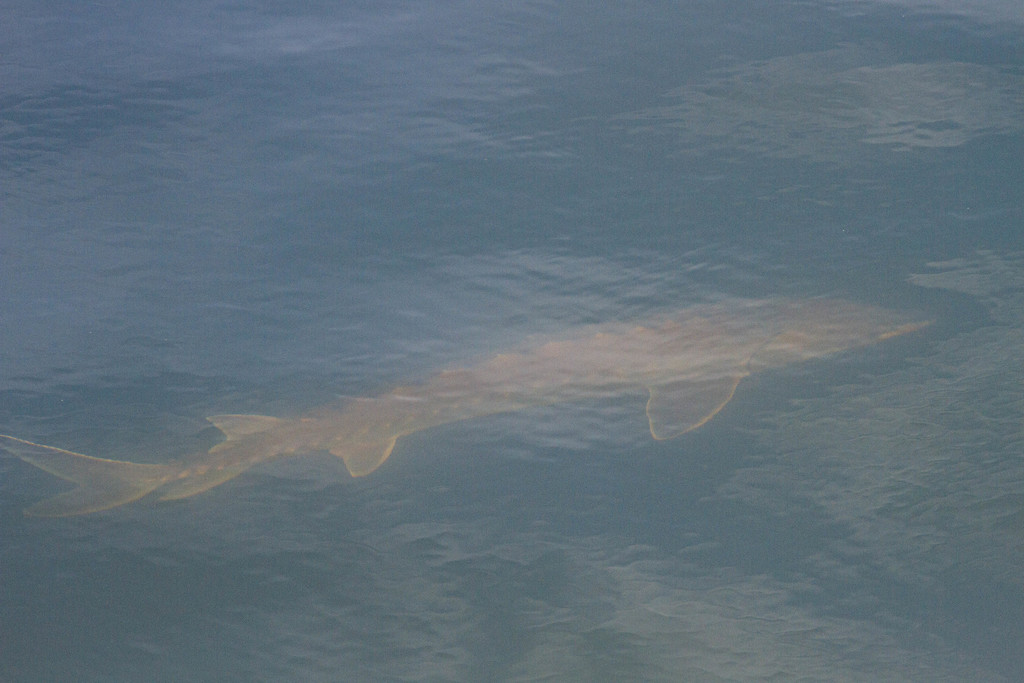
(c) Doug Suitor, some rights reserved (CC BY) · licence
Family: Acipenseridae · Class: Actinopterygii · Order: Acipenseriformes
Conservation status: Threatened · G2T1 S1
Acipenser medirostris pop. 1 (Green sturgeon - southern DPS) is a California animal in the Acipenseridae family.
The green sturgeon southern distinct population segment (DPS) is a large anadromous fish that can reach lengths of up to 2.4 meters (8 feet), though individuals of 1.2 to 1.5 meters (4 to 5 feet) are more common. This ancient species possesses the characteristic sturgeon features including five rows of bony scutes along the body, a heterocercal tail, and four barbels anterior to a protrusible mouth. Green sturgeon are distinguished from white sturgeon by their more pointed snout, olive-green coloration on the dorsal surface, and smaller maximum size. The southern DPS includes all spawning populations south of the Eel River, as defined by the California Department of Fish and Wildlife. Historically, this DPS included spawning populations in the Sacramento River system, San Joaquin River, Eel River, and South Fork Trinity River. However, presumed spawning populations have been lost from the Eel River, South Fork Trinity River, and San Joaquin River since the 1960s and 1970s. Currently, the primary remaining spawning population occurs in the Sacramento River basin, with spawning documented upstream of Red Bluff. Adults undertake extensive marine migrations along the Pacific Coast from California to Alaska, utilizing estuarine and nearshore marine environments. Green sturgeon inhabit a variety of aquatic environments throughout their complex life cycle. Adults spawn in freshwater rivers with gravel or rocky substrates and moderate to swift currents. Juveniles rear in freshwater for 1-4 years before migrating to estuarine and marine waters. In the Sacramento-San Joaquin Delta, they utilize areas where fresh and saltwater mix. Marine-phase adults are found in continental shelf waters along the Pacific Coast, typically at depths less than 110 meters (360 feet). Green sturgeon are long-lived fish, with females reaching sexual maturity at 16-30 years and males at 11-17 years. Spawning occurs every 2-5 years for individuals, typically from April through July in the Sacramento River system. Females can live over 70 years and produce between 60,000 to 140,000 eggs. The species is anadromous, spending most of its adult life in marine waters but returning to freshwater to spawn. Juveniles feed on benthic invertebrates including amphipods, mysids, and polychaete worms, while adults consume fish, crabs, clams, and other benthic organisms. The U.S. Fish and Wildlife Service listed the southern DPS as threatened under the Endangered Species Act on June 2, 2006. The species faces multiple threats including habitat loss and modification from dam construction and water diversions, reduced river flows, water quality degradation, and entrainment at water diversions. Historical commercial fishing also contributed to population declines. The species' late maturation, infrequent spawning, and dependence on specific spawning habitats make it particularly vulnerable to these threats. Critical habitat was designated in 2010, encompassing freshwater spawning areas in the Sacramento River system and estuarine rearing areas in the Sacramento-San Joaquin Delta and San Francisco Bay.
Classification
Class: Actinopterygii · Order: Acipenseriformes · Family: Acipenseridae
Conservation status
Threatened · G2T1 S1
Frequently asked questions
How is Acipenser medirostris pop. 1 classified?
Acipenser medirostris pop. 1 belongs to class Actinopterygii, order Acipenseriformes, family Acipenseridae.
What family does Acipenser medirostris pop. 1 belong to?
Acipenser medirostris pop. 1 is in the Acipenseridae family.
Is Acipenser medirostris pop. 1 protected or of conservation concern?
Acipenser medirostris pop. 1 carries the following status: Threatened · G2T1 S1.
What is Acipenser medirostris pop. 1?
The green sturgeon southern distinct population segment (DPS) is a large anadromous fish that can reach lengths of up to 2.4 meters (8 feet), though individuals of 1.2 to 1.5 meters (4 to 5 feet) are more common.
Is Acipenser medirostris pop. 1 found in California?
Yes. Acipenser medirostris pop. 1 is recorded in California in The California Species Project's catalogue.
Related species
Other California species in the same genus, family, or bioregion.
Data from The California Species Project — 14,000+ California species with verified data from CNPS, CDFW, USFWS, and more.