Acipenser medirostris pop. 2
Green Sturgeon - Northern Dps
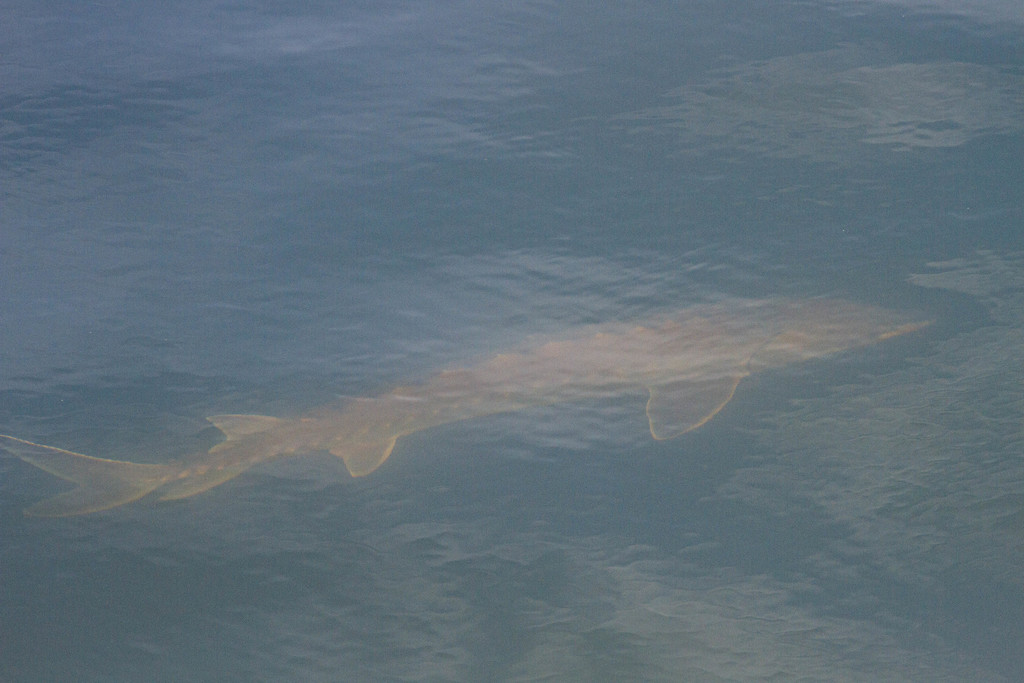
(c) Doug Suitor, some rights reserved (CC BY) · licence
Family: Acipenseridae · Class: Actinopterygii · Order: Acipenseriformes
Conservation status: G2T1 S1
Acipenser medirostris pop. 2 (Green Sturgeon - Northern Dps) is a California animal in the Acipenseridae family.
The Northern Distinct Population Segment (DPS) of green sturgeon is a large, anadromous fish that represents one of North America's most primitive fish lineages. Adults can reach substantial sizes, with individuals weighing up to 350 pounds and living up to 70 years, making them among the largest and longest-lived freshwater species (USFWS ECOS). Green sturgeon are characterized by their elongated body, five rows of bony plates (scutes), and a distinctive heterocercal tail. The species displays olive-green to dark green coloration dorsally, with lighter sides and a pale ventral surface. The Northern DPS occurs along the Pacific Coast from the Olympic Peninsula southward through the Coastal Range ecoregion. This population spawns primarily in the Klamath River system in California and the Rogue River in Oregon (CDFW). Tagged individuals from northern populations have been documented in coastal and estuarine waters throughout much of their range, demonstrating extensive marine migrations. The Northern DPS is genetically and geographically distinct from the Southern DPS, which spawns in California's Sacramento River system. Green sturgeon are anadromous, spending most of their adult lives in marine and estuarine environments while returning to freshwater rivers to spawn. Adults inhabit nearshore marine waters, bays, and estuaries along the Pacific Coast. Spawning occurs in freshwater reaches of natal rivers, typically in areas with gravel substrates and moderate to swift currents. Juveniles remain in freshwater for 1-4 years before migrating to marine environments. The species demonstrates strong site fidelity, with individuals returning to their natal rivers to reproduce. Reproduction in green sturgeon is characterized by late maturation and infrequent spawning. Females typically reach sexual maturity between 16-35 years of age, while males mature earlier at 11-24 years. Spawning does not occur annually; females may spawn only every 2-11 years. Adults migrate from marine environments into freshwater rivers during spring and summer months to spawn. Females deposit eggs over gravel substrates in river channels, with fertilized eggs developing over several months before hatching. The Northern DPS of green sturgeon holds a Global/State Rank of G2T1 S1, indicating it is critically imperiled both globally and in California. While this DPS is not currently listed under the federal Endangered Species Act, it faces significant conservation challenges. Primary threats include habitat modification, dam construction that blocks access to spawning grounds, water diversions, pollution, and potential bycatch in commercial fisheries. Climate change poses additional risks through altered river flows and ocean conditions. The species' late maturation, infrequent spawning, and long generation times make populations particularly vulnerable to decline and slow to recover from impacts. Conservation efforts focus on maintaining access to spawning habitats, protecting water quality in natal rivers, and reducing anthropogenic mortality sources.
Classification
Class: Actinopterygii · Order: Acipenseriformes · Family: Acipenseridae
Conservation status
G2T1 S1
Frequently asked questions
How is Acipenser medirostris pop. 2 classified?
Acipenser medirostris pop. 2 belongs to class Actinopterygii, order Acipenseriformes, family Acipenseridae.
What family does Acipenser medirostris pop. 2 belong to?
Acipenser medirostris pop. 2 is in the Acipenseridae family.
Is Acipenser medirostris pop. 2 protected or of conservation concern?
Acipenser medirostris pop. 2 carries the following status: G2T1 S1.
What is Acipenser medirostris pop. 2?
The Northern Distinct Population Segment (DPS) of green sturgeon is a large, anadromous fish that represents one of North America's most primitive fish lineages.
Is Acipenser medirostris pop. 2 found in California?
Yes. Acipenser medirostris pop. 2 is recorded in California in The California Species Project's catalogue.
Related species
Other California species in the same genus, family, or bioregion.
Data from The California Species Project — 14,000+ California species with verified data from CNPS, CDFW, USFWS, and more.