Acipenser transmontanus
White sturgeon
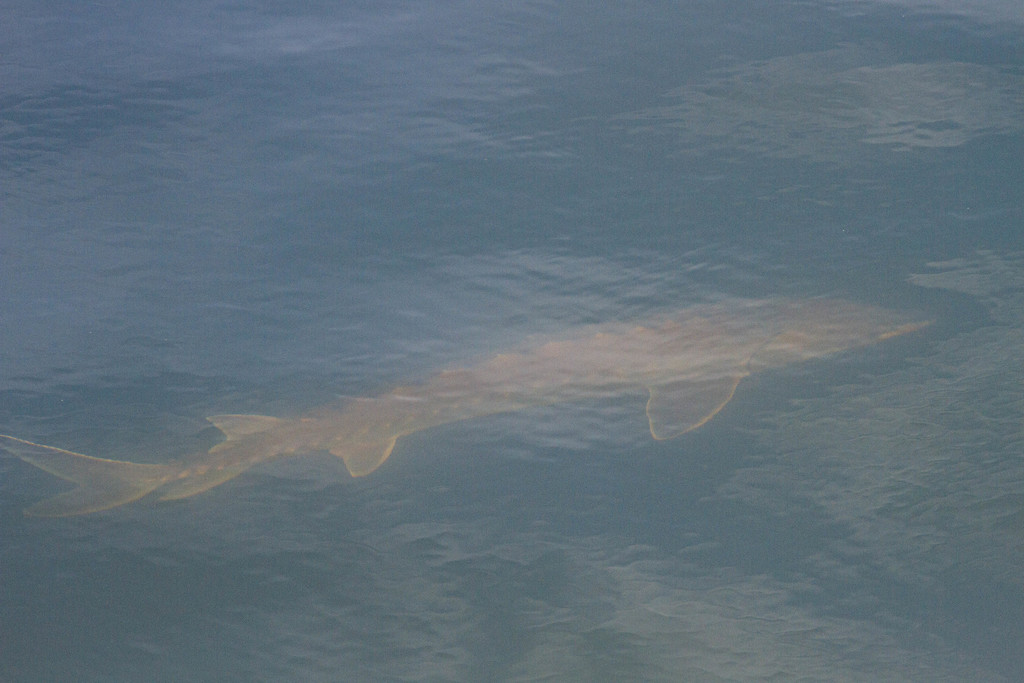
(c) Doug Suitor, some rights reserved (CC BY) · licence
Family: Acipenseridae · Class: Actinopterygii · Order: Acipenseriformes
Conservation status: Endangered · G4 S2
Acipenser transmontanus (White sturgeon) is a California animal in the Acipenseridae family.
The white sturgeon (Acipenser transmontanus) is North America's largest freshwater fish, capable of reaching weights up to 630 kilograms (1,389 pounds) and lengths exceeding 6 meters (20 feet). This ancient species exhibits the characteristic sturgeon body plan with five rows of bony plates called scutes running along the body, a heterocercal tail, and four barbels anterior to a ventral, protrusible mouth. The body is typically grayish-green to brown dorsally, fading to white ventrally, with coloration varying ontogenetically through development. White sturgeon occur throughout western North America, ranging from California's Central Valley north through Oregon and Washington to British Columbia, Canada, and extending inland to Idaho and Montana. In California, populations inhabit the Sacramento-San Joaquin Delta system and associated estuaries. The species includes both anadromous coastal populations and several landlocked populations, including the federally endangered Kootenai River population, which is restricted to approximately 167.7 river miles of the Kootenai River system from Kootenai Falls, Montana, downstream through Kootenay Lake to Corra Linn Dam in British Columbia (USFWS). White sturgeon primarily inhabit estuaries of large rivers and move into freshwater to spawn, though some individuals may venture into nearshore marine waters. The species demonstrates considerable habitat flexibility, utilizing deep pools, channels, and shallow areas depending on life stage and season. Spawning occurs in freshwater riverine environments over rocky or gravel substrates with swift currents. As opportunistic bottom feeders, white sturgeon consume a varied diet including fish, crustaceans, mollusks, worms, and other benthic invertebrates. The species exhibits slow growth and late maturation, with females not reaching sexual maturity until 10-30 years of age. Spawning is intermittent, occurring every 2-11 years for individual females. Males mature earlier, typically between 8-16 years. Spawning occurs during spring freshets, with females broadcasting eggs over suitable substrate where they adhere until hatching. The Kootenai River population of white sturgeon was federally listed as endangered in 1994 due to severe population decline and recruitment failure. This population declined from approximately 7,000 individuals in the late 1970s to 760 fish in 2000, representing a catastrophic demographic collapse (USFWS). Annual survival rates of wild populations are estimated at approximately 96 percent, but natural reproduction has been severely compromised. Primary threats include habitat modification from dam construction and operation, altered flow regimes, water temperature changes, and recruitment failure. The U.S. Fish and Wildlife Service has implemented conservation hatchery programs and habitat restoration efforts as part of recovery planning for the endangered Kootenai River population, while other populations remain stable and support recreational and commercial fisheries throughout their range.
Classification
Class: Actinopterygii · Order: Acipenseriformes · Family: Acipenseridae
Conservation status
Endangered · G4 S2
Frequently asked questions
How is Acipenser transmontanus classified?
Acipenser transmontanus belongs to class Actinopterygii, order Acipenseriformes, family Acipenseridae.
What family does Acipenser transmontanus belong to?
Acipenser transmontanus is in the Acipenseridae family.
Is Acipenser transmontanus protected or of conservation concern?
Acipenser transmontanus carries the following status: Endangered · G4 S2.
What is Acipenser transmontanus?
The white sturgeon (Acipenser transmontanus) is North America's largest freshwater fish, capable of reaching weights up to 630 kilograms (1,389 pounds) and lengths exceeding 6 meters (20 feet).
Is Acipenser transmontanus found in California?
Yes. Acipenser transmontanus is recorded in California in The California Species Project's catalogue.
Related species
Other California species in the same genus, family, or bioregion.
Data from The California Species Project — 14,000+ California species with verified data from CNPS, CDFW, USFWS, and more.