Acmaeodera bacchariphaga
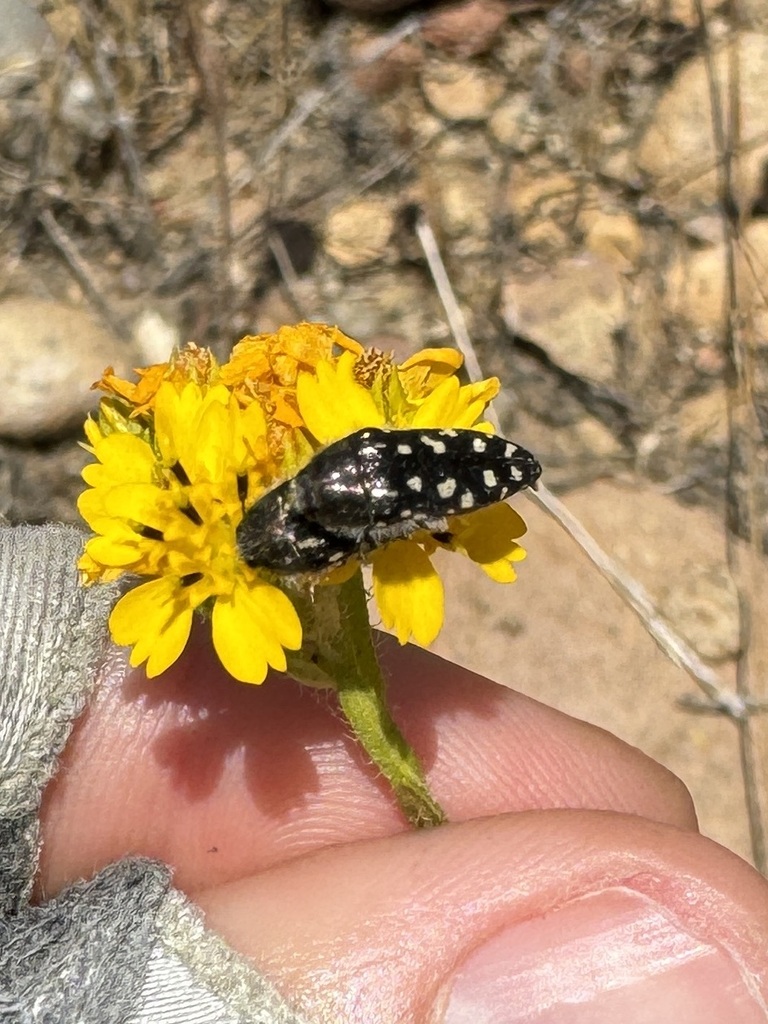
(c) Jess Mullins, some rights reserved (CC BY) · licence
Family: Buprestidae · Class: Insecta · Order: Coleoptera
Acmaeodera bacchariphaga is a California animal in the Buprestidae family.
Acmaeodera bacchariphaga is a beetle species belonging to the family Buprestidae, commonly known as jewel beetles or metallic wood-boring beetles. This species represents one of numerous members within the genus Acmaeodera, which comprises small to medium-sized beetles typically measuring 3 to 15 millimeters in length. Buprestidae beetles are characterized by their metallic luster and elongated, somewhat flattened body form, though specific morphological details for A. bacchariphaga have not been comprehensively documented in readily available literature. The range and distribution of Acmaeodera bacchariphaga appears to be centered in California, based on available taxonomic records. However, detailed distributional data including specific counties, elevational ranges, and habitat boundaries remain poorly documented in current scientific literature. The species may occur in additional western states, as many Acmaeodera species have ranges extending beyond California into neighboring regions, but verified occurrence records are limited. As suggested by its specific epithet "bacchariphaga," this beetle likely has an association with plants in the genus Baccharis, commonly known as baccharis or coyote brush. Baccharis species are shrubs in the sunflower family (Asteraceae) that are widespread in western North America, typically occurring in chaparral, coastal sage scrub, and riparian habitats. If this host plant relationship is confirmed, A. bacchariphaga would likely inhabit areas where Baccharis species are abundant, potentially including coastal scrublands, chaparral communities, and disturbed areas where these shrubs commonly establish. Like other members of the Buprestidae family, A. bacchariphaga larvae are likely wood-boring insects that develop within the stems, branches, or roots of their host plants. Adult beetles typically emerge during warmer months and may be active during daylight hours, feeding on foliage or flowers of their host plants. The life cycle probably spans one to two years, with larvae overwintering within plant tissues. Adults are likely attracted to stressed or damaged host plants, as is common among wood-boring beetles. The conservation status of Acmaeodera bacchariphaga has not been formally assessed by state or federal agencies. The species does not appear on current endangered species lists or state species of special concern designations. However, like many specialized herbivorous insects, potential threats could include habitat loss due to urban development, changes in fire regimes that affect chaparral and scrub communities, and the widespread use of herbicides that impact native plant communities. Climate change may also pose long-term challenges if it alters the distribution or abundance of Baccharis host plants. Detailed ecological studies of this species are lacking. The information presented here synthesizes available taxonomic records and inferences based on related species biology. We welcome contributions of verified scientific data, photographs, or field observations to enhance this species account.
Classification
Class: Insecta · Order: Coleoptera · Family: Buprestidae
Frequently asked questions
How is Acmaeodera bacchariphaga classified?
Acmaeodera bacchariphaga belongs to class Insecta, order Coleoptera, family Buprestidae.
What family does Acmaeodera bacchariphaga belong to?
Acmaeodera bacchariphaga is in the Buprestidae family.
What is Acmaeodera bacchariphaga?
Acmaeodera bacchariphaga is a beetle species belonging to the family Buprestidae, commonly known as jewel beetles or metallic wood-boring beetles.
Is Acmaeodera bacchariphaga found in California?
Yes. Acmaeodera bacchariphaga is recorded in California in The California Species Project's catalogue.
Related species
Other California species in the same genus, family, or bioregion.
Data from The California Species Project — 14,000+ California species with verified data from CNPS, CDFW, USFWS, and more.