Acmaeodera hepburnii
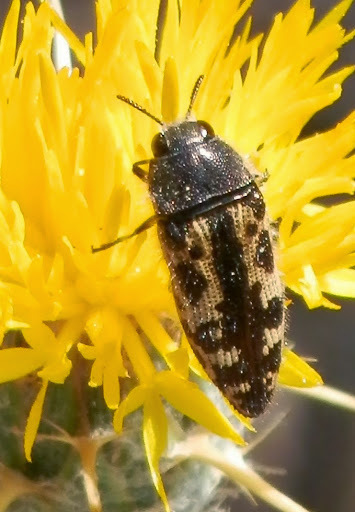
(c) 101595408250610106310, some rights reserved (CC BY) · licence
Family: Buprestidae · Class: Insecta · Order: Coleoptera
Acmaeodera hepburnii is a California animal in the Buprestidae family.
Acmaeodera hepburnii is a metallic wood-boring beetle in the family Buprestidae, first described by LeConte in 1860. This species belongs to the subfamily Polycestinae, tribe Acmaeoderini, and represents one of numerous Acmaeodera species found in western North America. Adults are small, metallic beetles typical of the buprestid family, displaying the characteristic elongated oval body shape and lustrous surface that gives metallic wood-borers their common name. The species occurs in California and Oregon, extending south into Mexico (BugGuide.Net). In California, A. hepburnii is distributed throughout suitable habitat areas, though specific county-level distribution data requires further documentation. The species appears to be most commonly encountered in areas with appropriate host plant communities and flowering resources. Acmaeodera hepburnii inhabits areas where its larval host plants and adult nectar sources occur together. Like other Acmaeodera species, larvae likely develop as wood borers in the stems or roots of specific plant hosts, though detailed host plant relationships for this species remain incompletely documented. Adults require access to flowering plants for nectar feeding, particularly members of the sunflower family (Asteraceae). Adult beetles are active flower visitors, with documented feeding records on several taxa within the Asteraceae family. According to BugGuide.Net, adults have been recorded feeding at flowers of Baeria species. This flower-visiting behavior is typical for adult buprestids, which commonly feed on nectar and pollen while larvae develop as internal plant feeders. The timing of adult emergence and peak activity periods corresponds with flowering seasons of preferred nectar plants, though specific phenology data for A. hepburnii requires additional study. Like other wood-boring beetles, larvae presumably tunnel within plant tissues, creating galleries as they feed and develop. Adult females likely select appropriate host plants for egg-laying based on plant species, condition, and environmental factors. The complete life cycle duration and number of generations per year have not been well documented for this species. Acmaeodera hepburnii currently holds no federal or state conservation listing status. Population trends and conservation concerns for this species are not well documented in available literature. The species' distribution across California and Oregon suggests it may be relatively widespread within appropriate habitat, though habitat loss and fragmentation could potentially impact local populations. Climate change effects on host plant distributions and flowering phenology may influence future population stability. Detailed ecological studies of A. hepburnii remain limited compared to more economically significant buprestid species. Current knowledge is based primarily on taxonomic literature and observational records from entomological collections and citizen science platforms. Additional research on host plant relationships, population dynamics, and habitat requirements would enhance understanding of this species' ecological role and conservation needs.
Classification
Class: Insecta · Order: Coleoptera · Family: Buprestidae
Frequently asked questions
How is Acmaeodera hepburnii classified?
Acmaeodera hepburnii belongs to class Insecta, order Coleoptera, family Buprestidae.
What family does Acmaeodera hepburnii belong to?
Acmaeodera hepburnii is in the Buprestidae family.
What is Acmaeodera hepburnii?
Acmaeodera hepburnii is a metallic wood-boring beetle in the family Buprestidae, first described by LeConte in 1860.
Is Acmaeodera hepburnii found in California?
Yes. Acmaeodera hepburnii is recorded in California in The California Species Project's catalogue.
Related species
Other California species in the same genus, family, or bioregion.
Data from The California Species Project — 14,000+ California species with verified data from CNPS, CDFW, USFWS, and more.