Acossus populi
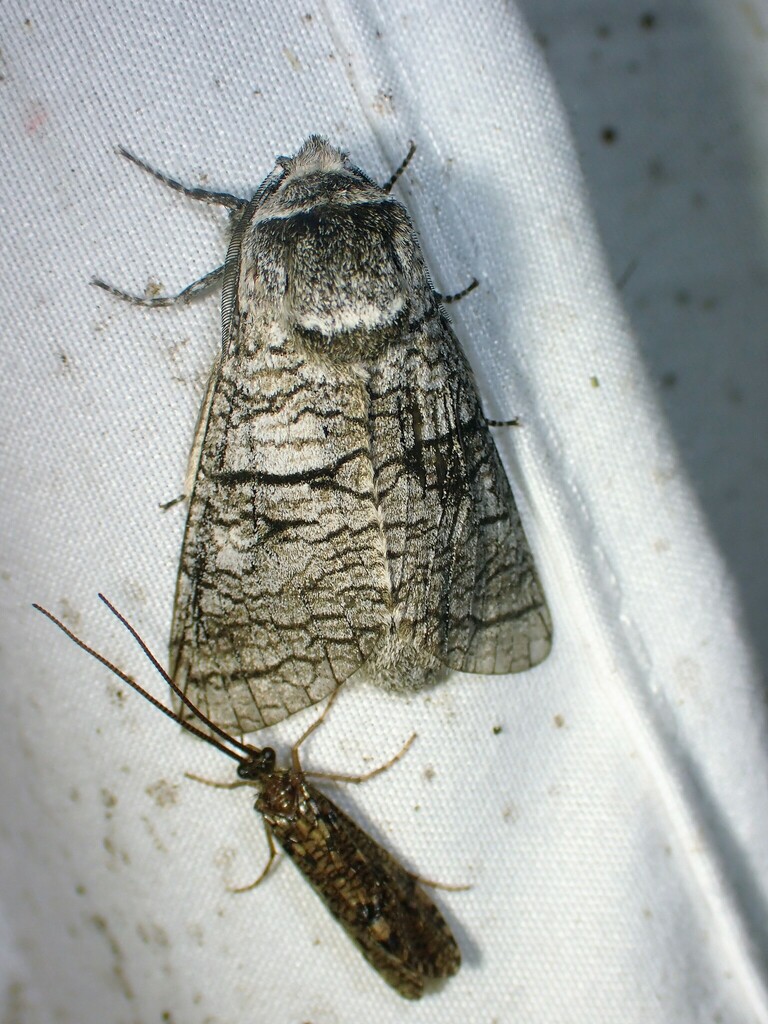
(c) Louis Imbeau, some rights reserved (CC BY) · licence
Family: Cossidae · Class: Insecta · Order: Lepidoptera
Acossus populi is a California animal in the Cossidae family.
Acossus populi, commonly known as the poplar goat moth or poplar cossid, is a large wood-boring moth in the family Cossidae. Adults are robust moths with forewings measuring 35-50 mm in length, displaying a mottled gray-brown coloration with darker streaks and spots that provide effective camouflage against tree bark. The forewings show distinctive white or pale markings arranged in irregular patterns. Males are typically smaller than females, with more feathered antennae. The species exhibits sexual dimorphism, with females possessing a more elongated abdomen adapted for deep egg-laying into wood. The species has a Holarctic distribution, occurring across temperate regions of North America, Europe, and Asia. In North America, Acossus populi is found from southern Canada through the northern United States, including California. The California population represents the southernmost extent of the species' North American range, though specific distribution data within the state remains limited. Historical records suggest the species was more widespread but may have experienced range contractions in some areas. Acossus populi larvae are obligate wood borers that develop exclusively in living poplar and aspen trees (Populus species), with occasional records from willow (Salix species). The species shows strong host specificity, requiring trees with sufficient trunk diameter to accommodate the larvae's extensive tunneling behavior. Adults are typically found in riparian woodlands, urban areas with ornamental poplars, and mixed forests where Populus species occur naturally. The species can tolerate a range of elevations from near sea level to montane environments. The life cycle is univoltine, requiring two to three years for complete development. Adults emerge during summer months, typically from June through August, and are primarily nocturnal. Females deposit eggs individually in bark crevices of host trees, using their elongated ovipositor to insert eggs deep into bark furrows. Newly hatched larvae bore into the cambium layer, creating characteristic tunnels that spiral around the trunk as larvae grow. Mature larvae can reach 80-100 mm in length and are pale yellow-white with dark head capsules. The extensive larval galleries can girdle branches or trunks, potentially killing host trees. Pupation occurs within the larval tunnel, with the pupa positioned near the bark surface to facilitate adult emergence. The conservation status of Acossus populi in California has not been formally assessed. The species faces potential threats from habitat loss due to removal of riparian vegetation and urban development. Climate change may affect the species through altered precipitation patterns that impact host tree health and distribution. Introduced diseases affecting Populus species, such as various canker pathogens, could indirectly impact populations by reducing host tree availability. The species' apparent rarity in California may reflect natural range limits rather than population decline, though insufficient survey data prevents definitive assessment.
Classification
Class: Insecta · Order: Lepidoptera · Family: Cossidae
Frequently asked questions
How is Acossus populi classified?
Acossus populi belongs to class Insecta, order Lepidoptera, family Cossidae.
What family does Acossus populi belong to?
Acossus populi is in the Cossidae family.
What is Acossus populi?
Acossus populi, commonly known as the poplar goat moth or poplar cossid, is a large wood-boring moth in the family Cossidae.
Is Acossus populi found in California?
Yes. Acossus populi is recorded in California in The California Species Project's catalogue.
Related species
Other California species in the same genus, family, or bioregion.
Data from The California Species Project — 14,000+ California species with verified data from CNPS, CDFW, USFWS, and more.