Acronicta brumosa
Charred Dagger Moth
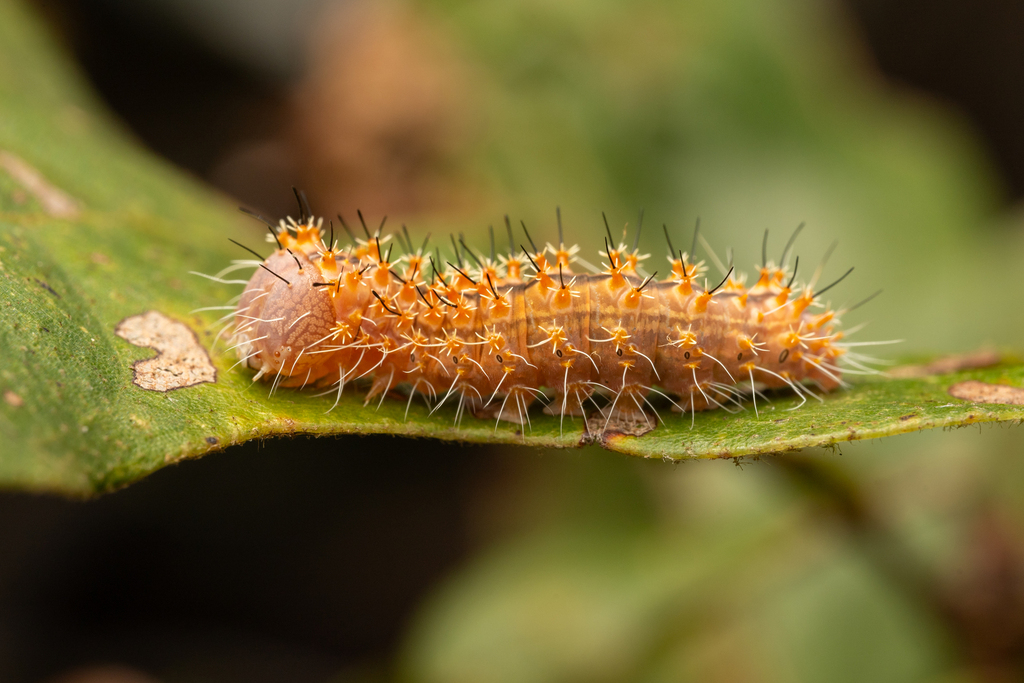
(c) DiegoH, some rights reserved (CC BY) · licence
Family: Noctuidae · Class: Insecta · Order: Lepidoptera
Acronicta brumosa (Charred Dagger Moth) is a California animal in the Noctuidae family.
The charred dagger moth (Acronicta brumosa) is a medium-sized nocturid moth with a wingspan typically measuring 32 to 42 mm (1.3 to 1.7 inches). Adults display mottled gray and brown forewings with distinctive dark markings that create a charred or burnt appearance, giving the species its common name. The forewings feature a prominent dark basal dash and a series of wavy transverse lines, with the reniform and orbicular spots often obscured by the dark scaling. The hindwings are pale gray to whitish with darker marginal areas. When at rest, the moth holds its wings in a tent-like position over the body, with the forewings concealing the lighter hindwings. The charred dagger moth has a broad distribution across North America, ranging from New York south to Florida and extending westward through the southern states to California, with populations documented north to Utah. In California, the species occurs primarily in oak woodlands and mixed forests where suitable host plants are present. The transcontinental range reflects the moth's association with widespread oak species across different biogeographic regions. This species inhabits oak woodlands, mixed deciduous forests, and riparian areas where oak trees are present. The moth shows a preference for areas with mature oak canopies that provide both larval food sources and adult shelter. Elevation preferences vary across the range, but California populations are typically found from near sea level to approximately 1,500 meters (4,900 feet) in foothill oak woodlands and lower montane forests. Charred dagger moth larvae are specialized feeders on oak species (Quercus), with different oak species serving as hosts across the moth's range. In California, larvae likely utilize coast live oak, interior live oak, blue oak, and valley oak among others. The larvae are distinctive caterpillars that feed primarily at night, consuming oak leaves during their development through five instars. Adults are nocturnal and attracted to artificial lights. The species typically produces one generation per year in most of its range, with adults emerging in late spring to early summer. Females deposit eggs singly or in small clusters on oak foliage, and larvae complete development by late summer before pupating in soil or leaf litter. The charred dagger moth does not appear on federal or state threatened and endangered species lists, suggesting stable populations across its range. However, like many oak-dependent species, local populations may face pressure from habitat loss due to urban development, oak woodland conversion, and forest management practices that reduce oak density. Climate change may affect the species through impacts on oak phenology and distribution. The moth's broad host plant range and extensive geographic distribution likely provide some resilience against localized threats, though specific population monitoring data are limited.
Classification
Class: Insecta · Order: Lepidoptera · Family: Noctuidae
Frequently asked questions
How is Acronicta brumosa classified?
Acronicta brumosa belongs to class Insecta, order Lepidoptera, family Noctuidae.
What family does Acronicta brumosa belong to?
Acronicta brumosa is in the Noctuidae family.
What is Acronicta brumosa?
The charred dagger moth (Acronicta brumosa) is a medium-sized nocturid moth with a wingspan typically measuring 32 to 42 mm (1.3 to 1.7 inches).
Is Acronicta brumosa found in California?
Yes. Acronicta brumosa is recorded in California in The California Species Project's catalogue.
Related species
Other California species in the same genus, family, or bioregion.
Data from The California Species Project — 14,000+ California species with verified data from CNPS, CDFW, USFWS, and more.