Acronicta impleta
Yellow-haired Dagger Moth
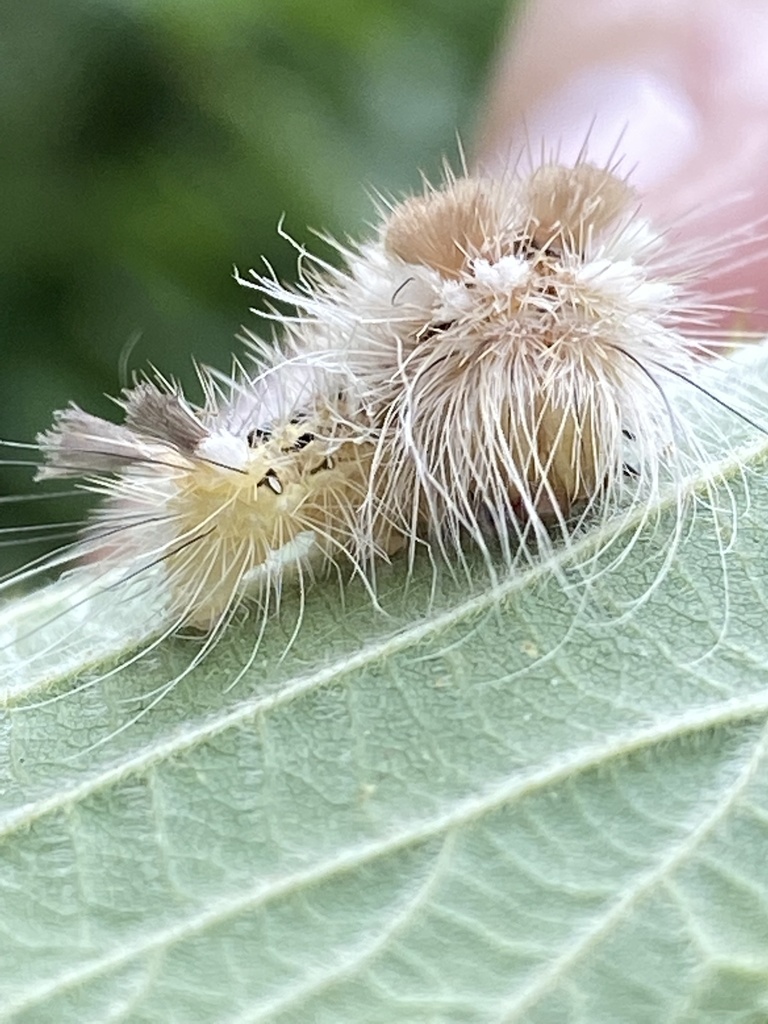
(c) David George, some rights reserved (CC BY) · licence
Family: Noctuidae · Class: Insecta · Order: Lepidoptera
Acronicta impleta (Yellow-haired Dagger Moth) is a California animal in the Noctuidae family.
The Yellow-haired Dagger Moth (Acronicta impleta) is a medium-sized nocturid moth in the dagger moth genus Acronicta. Adults have a wingspan of approximately 35-45 mm (1.4-1.8 inches), with forewings displaying a complex pattern of gray, brown, and whitish markings. The forewings feature characteristic dagger-like marks that give the genus its common name, along with wavy crosslines and reniform spots typical of noctuids. The hindwings are pale gray to whitish with darker marginal bands. The thorax and head are covered in dense, yellowish-gray scales that contribute to the species' common name. Acronyicta impleta occurs across much of North America, with populations documented from southern Canada south to the Gulf Coast states. In California, the species has been recorded primarily in northern and central regions, including the Sierra Nevada foothills and coastal ranges. Historical records indicate presence in mixed coniferous and deciduous forests at elevations ranging from near sea level to approximately 1,500 meters (4,900 feet). This species inhabits mature forests and woodland edges where host plants are abundant. Adults are typically found in areas supporting populations of willow (Salix species), poplar (Populus species), and other deciduous trees in the Salicaceae family. The moth shows preference for riparian corridors and forest openings where these host trees receive adequate sunlight for optimal growth. Yellow-haired Dagger Moths are univoltine, producing one generation per year in most of their range. Adults emerge in late spring through early summer, typically from May through July depending on elevation and latitude. Females deposit eggs singly on host plant foliage, and larvae feed on leaves during summer months. The distinctive caterpillars are densely covered with long, pale yellow setae and reach lengths of 40-50 mm (1.6-2.0 inches) when mature. Larvae pupate in cocoons constructed in bark crevices or leaf litter, overwintering in this stage before adult emergence the following spring. Adults are nocturnal and attracted to artificial lights, with peak activity occurring during the first few hours after sunset. The conservation status of Acronicta impleta in California remains poorly documented, with no formal state or federal listing designations. Limited recent survey data suggests the species may have experienced population declines in some areas, potentially related to habitat loss from urban development and forest management practices. Riparian habitat degradation poses a particular concern given the species' dependence on willow and poplar host plants. Climate change effects on forest composition and phenology may also impact population stability. The species would benefit from comprehensive surveys to establish current distribution patterns and population trends throughout its California range. Forest management practices that maintain diverse age classes of deciduous trees, particularly in riparian zones, support habitat requirements for this and other forest-dependent lepidoptera species.
Classification
Class: Insecta · Order: Lepidoptera · Family: Noctuidae
Frequently asked questions
How is Acronicta impleta classified?
Acronicta impleta belongs to class Insecta, order Lepidoptera, family Noctuidae.
What family does Acronicta impleta belong to?
Acronicta impleta is in the Noctuidae family.
What is Acronicta impleta?
The Yellow-haired Dagger Moth (Acronicta impleta) is a medium-sized nocturid moth in the dagger moth genus Acronicta.
Is Acronicta impleta found in California?
Yes. Acronicta impleta is recorded in California in The California Species Project's catalogue.
Related species
Other California species in the same genus, family, or bioregion.
Data from The California Species Project — 14,000+ California species with verified data from CNPS, CDFW, USFWS, and more.