Actinemys marmorata
Northwestern pond turtle
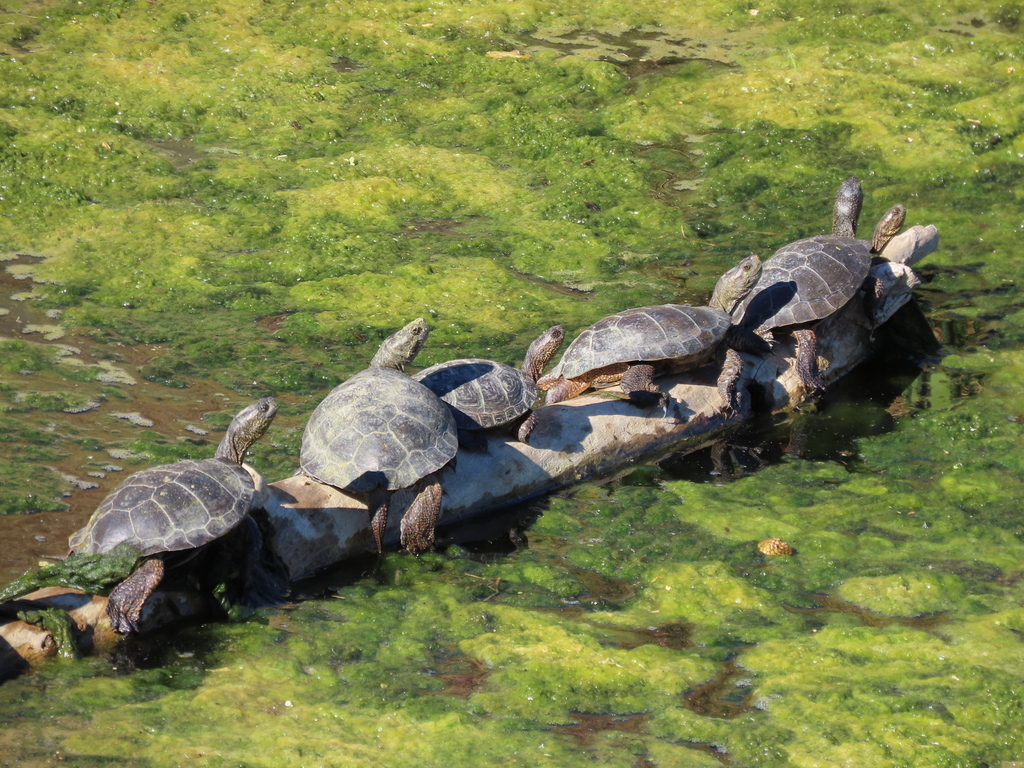
(c) John Hibbard, some rights reserved (CC BY) · licence
Family: Emydidae · Class: Reptilia · Order: Testudines
Conservation status: Proposed Threatened · G2 SNR
Actinemys marmorata (Northwestern pond turtle) is a California animal in the Emydidae family.
The northwestern pond turtle is California's only native freshwater turtle, measuring 90 to 210 millimeters (3.5 to 8.3 inches) in carapace length. Adults typically weigh 300 to 650 grams (0.7 to 1.4 pounds). The carapace is relatively low-domed and ranges from dark brown to olive green, often with radiating patterns of darker lines or blotches on each scute. The plastron is yellowish with dark blotch patterns along the seams. Head and neck coloration varies from dark brown to olive, frequently marked with yellow or cream-colored flecking. Males are distinguished by a concave plastron, longer and thicker tail, and yellow coloration on the throat and underside of the head. Historically, the northwestern pond turtle ranged from Baja California, Mexico, north to Puget Sound, Washington. In California, the species occurred in suitable aquatic habitats throughout the Central Valley, Coast Range, Sierra Nevada foothills, and southern California mountains. Current distribution has been severely fragmented, with extirpations documented across much of the historical range. Remnant populations persist in scattered locations including parts of the Sacramento Valley, San Francisco Bay Area, Central Coast, and isolated sites in southern California. The species inhabits permanent and semi-permanent aquatic systems including ponds, lakes, reservoirs, slow-moving streams, and marshes. Optimal habitat features include basking sites such as logs, rocks, or emergent vegetation, adjacent upland areas for nesting and overwintering, and aquatic vegetation for foraging and cover. Elevations range from sea level to approximately 1,400 meters (4,600 feet). Water bodies with muddy or sandy substrates and minimal flow are preferred for hibernation sites. Northwestern pond turtles are omnivorous, consuming aquatic invertebrates, fish, frogs, carrion, and aquatic plants. Juveniles tend to be more carnivorous while adults incorporate more plant material. The species exhibits temperature-dependent activity patterns, becoming active when water temperatures exceed 14 degrees Celsius (57 degrees Fahrenheit). Mating occurs from April through August. Females nest from May through August, typically traveling 50 to 400 meters from water to dig nests in exposed soil or sparse vegetation. Clutch size ranges from 1 to 13 eggs, with incubation lasting 80 to 120 days depending on temperature. The U.S. Fish and Wildlife Service proposed listing the northwestern pond turtle as threatened under the Endangered Species Act in 2023, citing habitat loss, predation by non-native species, and collection as primary threats. According to USFWS, the species has experienced population declines of 75 to 95 percent across its range. Major threats include habitat destruction from urban development and agriculture, water diversions, predation by introduced bullfrogs and non-native fish, nest predation by subsidized predators, and illegal collection. Climate change poses additional risks through altered precipitation patterns and increased frequency of drought conditions.
Classification
Class: Reptilia · Order: Testudines · Family: Emydidae
Conservation status
Proposed Threatened · G2 SNR
Frequently asked questions
How is Actinemys marmorata classified?
Actinemys marmorata belongs to class Reptilia, order Testudines, family Emydidae.
What family does Actinemys marmorata belong to?
Actinemys marmorata is in the Emydidae family.
Is Actinemys marmorata protected or of conservation concern?
Actinemys marmorata carries the following status: Proposed Threatened · G2 SNR.
What is Actinemys marmorata?
The northwestern pond turtle is California's only native freshwater turtle, measuring 90 to 210 millimeters (3.5 to 8.3 inches) in carapace length.
Is Actinemys marmorata found in California?
Yes. Actinemys marmorata is recorded in California in The California Species Project's catalogue.
Related species
Other California species in the same genus, family, or bioregion.
Data from The California Species Project — 14,000+ California species with verified data from CNPS, CDFW, USFWS, and more.