Adela flammeusella
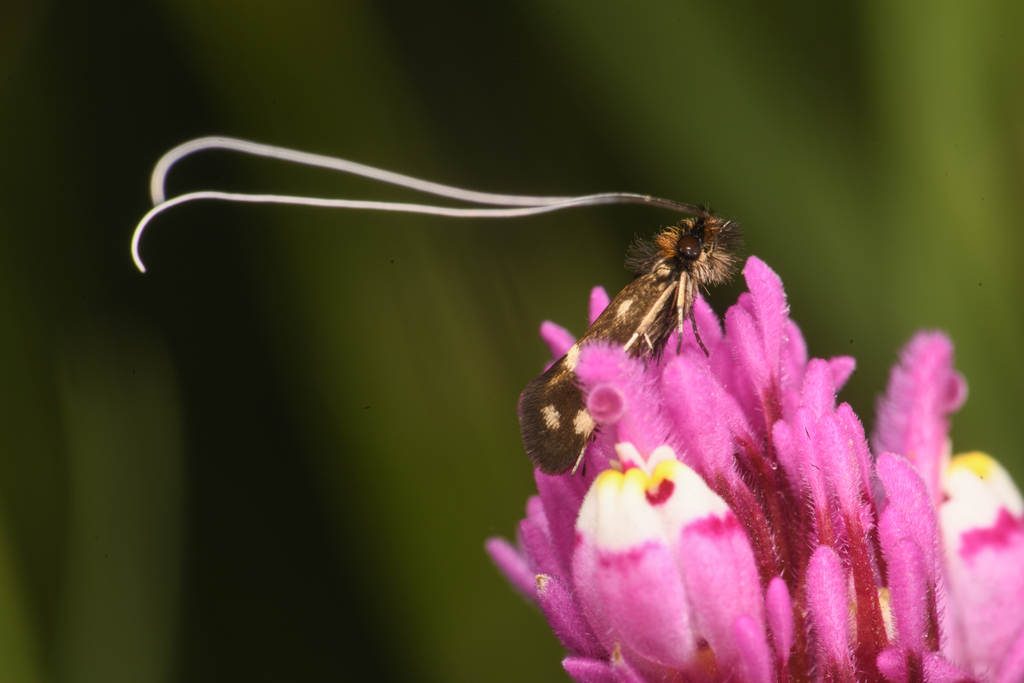
(c) Trevor Van Loon, some rights reserved (CC BY) · licence
Family: Adelidae · Class: Insecta · Order: Lepidoptera
Adela flammeusella is a California animal in the Adelidae family.
Adela flammeusella is a small moth in the fairy moth family Adelidae, known for its association with owl's clover (Orthocarpus species). This species represents one of the lesser-studied members of the genus Adela in North America, with limited documented information about its basic biology and distribution patterns. Adult Adela flammeusella moths are small, typically measuring 6 to 10 mm in forewing length, consistent with other members of the genus. The forewings display metallic bronze or golden-brown coloration with distinctive white markings that create flame-like patterns, reflecting the species' Latin name 'flammeusella' meaning 'little flame.' Males possess characteristically long antennae that can extend well beyond the forewing length, a diagnostic feature of the Adelidae family. The hindwings are narrow and fringed, typical of fairy moths. The geographic range of Adela flammeusella in California remains poorly documented in scientific literature. The species appears to be associated with areas where its host plant, owl's clover (Orthocarpus), occurs naturally. Orthocarpus species are native to western North America and found in grasslands, meadows, and open areas throughout much of California, suggesting the moth may have a broader distribution than currently recorded. Habitat requirements for Adela flammeusella are closely tied to the presence of Orthocarpus host plants. Owl's clover species typically grow in grasslands, vernal pools, meadows, and disturbed areas from sea level to moderate elevations. These annual herbs prefer well-drained soils and areas with winter moisture followed by dry summers. The moth likely inhabits similar open habitats where its host plants are abundant during the spring flowering period. The life cycle of Adela flammeusella follows the typical adelid pattern, though specific details for this species are not well documented. Adults likely emerge during spring months, coinciding with the blooming period of Orthocarpus host plants. Larvae presumably feed on the flowers, seeds, or developing seed pods of owl's clover, as observed in related Adela species. The species likely overwinters in the pupal stage, emerging as adults when host plants begin flowering. Adult moths are probably active during daylight hours, another characteristic behavior of fairy moths. The conservation status of Adela flammeusella is not formally assessed at federal or state levels, reflecting the limited scientific attention this species has received. The moth's dependence on Orthocarpus host plants may make it vulnerable to habitat loss, particularly the conversion of native grasslands to agriculture or development. Many California grassland habitats have experienced significant alteration since European settlement, potentially affecting specialized herbivores like this moth. Climate change and altered precipitation patterns could also impact the timing and abundance of annual host plants, potentially disrupting the moth's reproductive cycle. Further research is needed to assess population status, distribution, and specific conservation needs for this understudied species.
Classification
Class: Insecta · Order: Lepidoptera · Family: Adelidae
Frequently asked questions
How is Adela flammeusella classified?
Adela flammeusella belongs to class Insecta, order Lepidoptera, family Adelidae.
What family does Adela flammeusella belong to?
Adela flammeusella is in the Adelidae family.
What is Adela flammeusella?
Adela flammeusella is a small moth in the fairy moth family Adelidae, known for its association with owl's clover (Orthocarpus species).
Is Adela flammeusella found in California?
Yes. Adela flammeusella is recorded in California in The California Species Project's catalogue.
Related species
Other California species in the same genus, family, or bioregion.
Data from The California Species Project — 14,000+ California species with verified data from CNPS, CDFW, USFWS, and more.