Adela septentrionella
ocean spray fairy moth
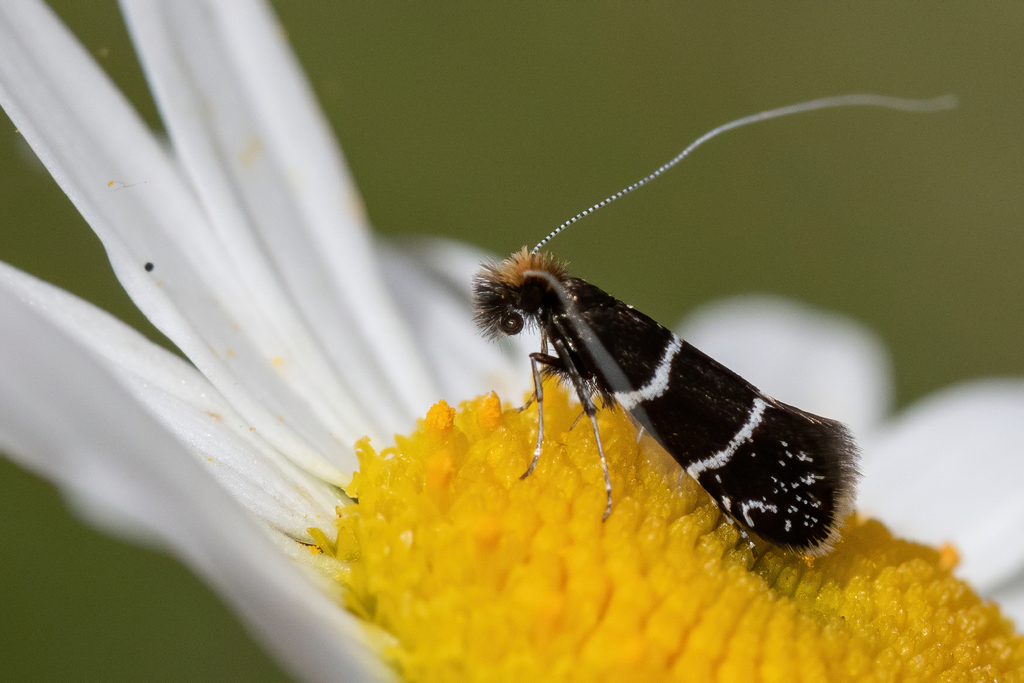
(c) Blair Dudeck, some rights reserved (CC BY) · licence
Family: Adelidae · Class: Insecta · Order: Lepidoptera
Adela septentrionella (ocean spray fairy moth) is a California animal in the Adelidae family.
The ocean spray fairy moth (Adela septentrionella) is a small member of the fairy moth family Adelidae. Adults have a forewing length of 4.5 to 5.7 mm with a wingspan of approximately 11 mm (Powell & Opler 2009). The forewings are dark with distinctive white bands, though the white markings can be reduced in some individuals. Males possess notably longer antennae than females, measuring 2.5 to 3 times the forewing length in males compared to approximately 2 times in females (Powell 1969). The hindwing is uniformly dark with a wide fringe. Males have relatively smaller eyes compared to the related A. trigrapha, with eye diameter about 1.25 times the distance between eyes at the top of the head (BugGuide). This species ranges from southern British Columbia south to central California north of the Transverse Ranges. The type locality is Mendocino, California, and the species extends through southern Oregon (Powell 1969). Distribution follows a more boreal pattern than other West Coast Adela species, occurring from coast to interior montane areas. A. septentrionella inhabits diverse environments from coastal areas to boreal forests. In California's Sierra Nevada, the species occurs at elevations from 6,000 to 8,000 feet, reaching near timberline at 6,000 feet in the Trinity Alps and 8,000 feet in the southern Sierra Nevada (Powell 1969). This elevation tolerance distinguishes it from A. trigrapha, which generally occurs at lower elevations below 2,000 feet in the Sierra Nevada and below 4,000 feet in the California coast ranges. Adults fly from May through June, extending into July at higher elevations. Flight timing coincides with the bud stage of their host plant, ocean spray (Holodiscus) (BugGuide). The larvae are case-bearing and feed on fallen leaves under Holodiscus plants (CNPS Fremontia). This host plant association follows the species' distribution pattern, as ocean spray occurs from canyon transition zones near the coast to high elevation sites approaching timberline. The specific epithet 'septentrionella' derives from the Latin 'septentrio,' meaning 'northern' or 'Ursa Major,' reflecting the species' more northerly and high-elevation distribution compared to related fairy moths (BugGuide). The species exhibits the characteristic fairy moth behavior of males forming small dancing groups, though this is more commonly documented in the related A. trigrapha. No federal or state conservation listings have been documented for A. septentrionella. The species appears to maintain stable populations throughout its range, though specific population data are not available. Its association with ocean spray, a widespread native shrub in Pacific Coast montane environments, suggests the species is not immediately threatened. However, like many specialized herbivorous insects, populations could be vulnerable to habitat modification or climate-induced changes in host plant distribution, particularly at high-elevation sites where the species reaches its upper elevational limits.
Classification
Class: Insecta · Order: Lepidoptera · Family: Adelidae
Frequently asked questions
How is Adela septentrionella classified?
Adela septentrionella belongs to class Insecta, order Lepidoptera, family Adelidae.
What family does Adela septentrionella belong to?
Adela septentrionella is in the Adelidae family.
What is Adela septentrionella?
The ocean spray fairy moth (Adela septentrionella) is a small member of the fairy moth family Adelidae.
Is Adela septentrionella found in California?
Yes. Adela septentrionella is recorded in California in The California Species Project's catalogue.
Related species
Other California species in the same genus, family, or bioregion.
Data from The California Species Project — 14,000+ California species with verified data from CNPS, CDFW, USFWS, and more.