Adela trigrapha
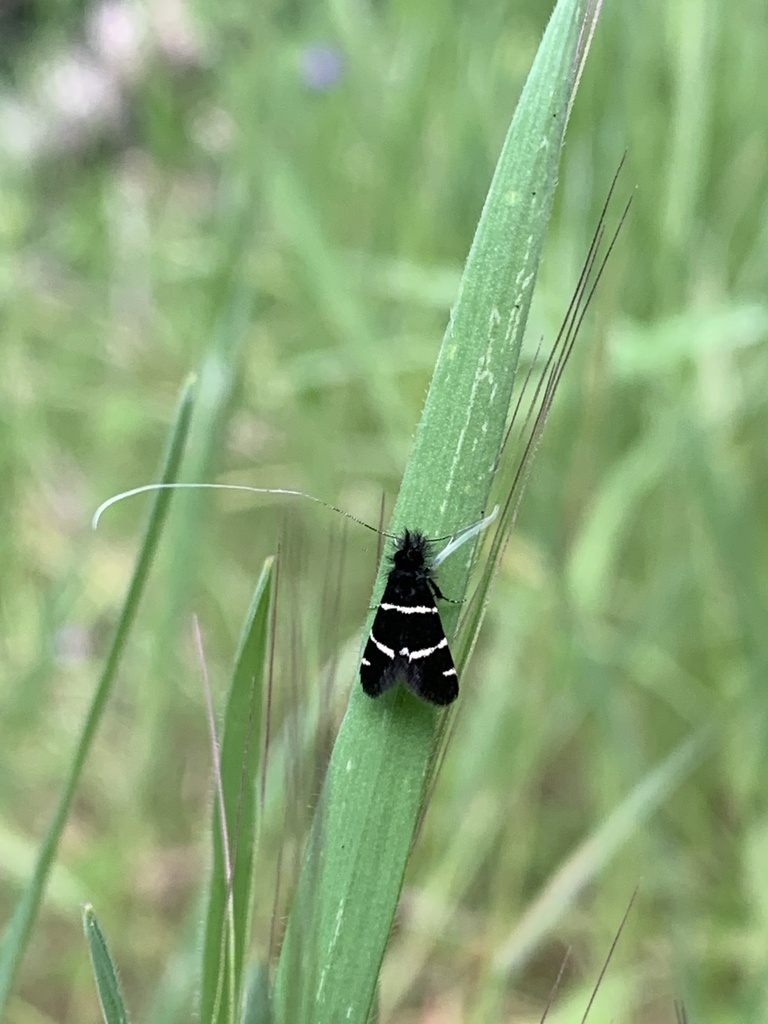
no rights reserved · CC0
Family: Adelidae · Class: Insecta · Order: Lepidoptera
Adela trigrapha is a California animal in the Adelidae family.
Adela trigrapha is a small moth in the family Adelidae, commonly known as fairy moths or longhorn moths. Adults are characterized by exceptionally long antennae that can exceed twice the length of their forewings. The forewings typically measure 4 to 6 millimeters in length, with the moth displaying a wingspan of approximately 8 to 12 millimeters. The forewings are metallic bronze or coppery-brown with distinctive pale markings, including three characteristic stripes or bands that give the species its name 'trigrapha,' meaning three-written. The hindwings are narrow and fringed, appearing almost feathery in structure. Adela trigrapha occurs along the Pacific Coast from Vancouver Island in British Columbia south through Washington, Oregon, and California to southern California. The species' range extends to the California Channel Islands, specifically documented on Santa Rosa and Santa Cruz Islands. This distribution pattern suggests the moth is well-adapted to coastal and near-coastal environments throughout the Pacific Northwest and California. The species inhabits areas where its host plants occur, primarily in coastal sage scrub, chaparral, and oak woodland communities. Host plant associations are specific to Leptosiphon androsaceus (formerly Linanthus androsaceus), commonly called false babystars, and L. bicolor. These annual herbs in the phlox family (Polemoniaceae) grow in sandy or rocky soils, often in open areas or clearings within shrubland communities. The moth's distribution closely follows that of these host plants, which typically occur at elevations from sea level to approximately 1,500 meters. Adult Adela trigrapha are active during daylight hours, typically flying in spring and early summer when host plants are in bloom. Males engage in characteristic swarming behavior, forming dancing swarms around prominent objects such as shrubs or trees. Mating occurs during these aerial displays, with females subsequently seeking appropriate oviposition sites on or near host plants. Larvae are leaf miners, creating distinctive serpentine mines in the leaves of Leptosiphon species. The mining activity creates visible trails as larvae feed on leaf tissue between the upper and lower epidermis. Development from egg to adult typically requires one year, with larvae overwintering and pupating in spring. Like many specialized herbivorous insects, Adela trigrapha faces potential threats from habitat loss and fragmentation, particularly in coastal California where development pressure is intense. The species' dependence on specific host plants makes it vulnerable to changes in plant community composition caused by invasive species, altered fire regimes, or climate change. However, the moth's broad geographic range from British Columbia to southern California, including island populations, suggests some resilience to local disturbances. No specific conservation status has been assigned to this species, and population trends are not well documented. The presence on Channel Islands indicates the species can persist in relatively isolated habitats, though island populations may face unique conservation challenges related to small population sizes and limited dispersal opportunities.
Classification
Class: Insecta · Order: Lepidoptera · Family: Adelidae
Frequently asked questions
How is Adela trigrapha classified?
Adela trigrapha belongs to class Insecta, order Lepidoptera, family Adelidae.
What family does Adela trigrapha belong to?
Adela trigrapha is in the Adelidae family.
What is Adela trigrapha?
Adela trigrapha is a small moth in the family Adelidae, commonly known as fairy moths or longhorn moths.
Is Adela trigrapha found in California?
Yes. Adela trigrapha is recorded in California in The California Species Project's catalogue.
Related species
Other California species in the same genus, family, or bioregion.
Data from The California Species Project — 14,000+ California species with verified data from CNPS, CDFW, USFWS, and more.