Aechmophorus clarkii
Clark's Grebe
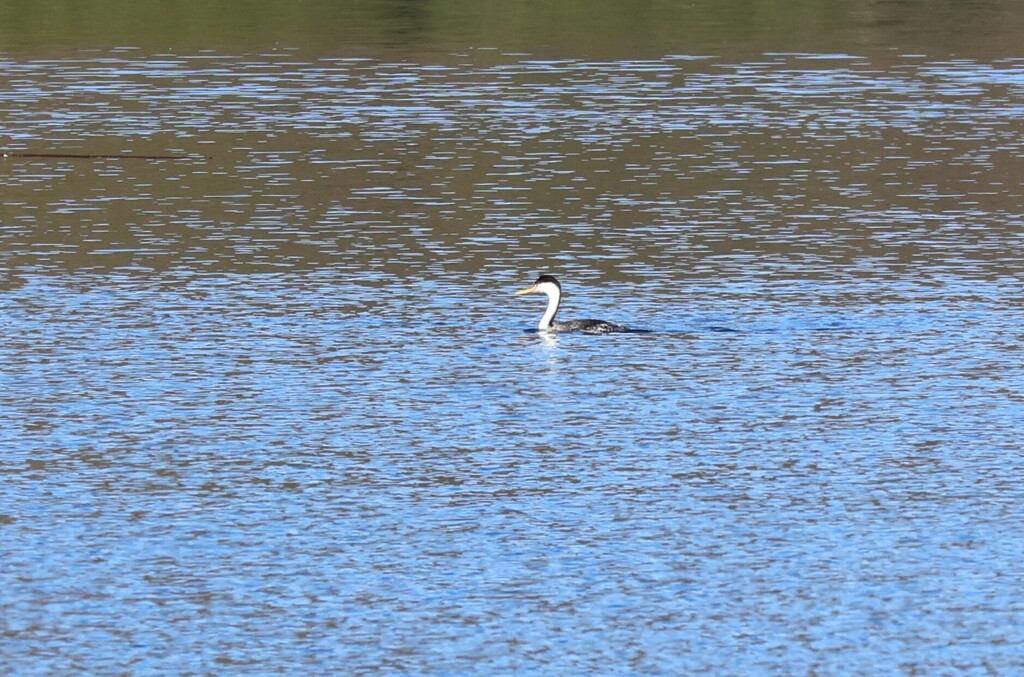
(c) Millie Basden, some rights reserved (CC BY) · licence
Family: Podicipedidae · Class: Aves · Order: Podicipediformes
Aechmophorus clarkii (Clark's Grebe) is a California animal in the Podicipedidae family.
Clark's Grebe is a large waterbird in the family Podicipedidae, closely related to and often considered conspecific with the Western Grebe. Adults measure 55 to 75 cm (22 to 30 inches) in length with a wingspan of 80 cm (31 inches) and weigh between 1 to 1.8 kg (2.2 to 4.0 pounds). During breeding season, adults display a distinctive black cap that does not extend below the eye, contrasting with bright white cheeks and throat. The bill is bright yellow-orange and slightly upturned. Non-breeding plumage shows similar patterns but with duller coloration. The species is distinguished from Western Grebe by the lighter-colored bill, less extensive black on the head, and white feathering around the eye. Clark's Grebe breeds across western North America from British Columbia south through California and east to the Great Plains. In California, the species nests primarily in the Central Valley, northeastern California, and the Salton Sea region. Historical breeding sites included Tulare Lake before its drainage. Current breeding populations are concentrated at Clear Lake in Lake County, Salton Sea, and various reservoirs throughout the Central Valley including Los Banos Reservoir and San Luis Reservoir. Winter distribution extends along the Pacific Coast from southern California to Baja California. The species requires large, relatively deep freshwater lakes and reservoirs with emergent vegetation for nesting. Breeding habitat consists of lakes with extensive tule (Scirpus species) and cattail (Typha species) marshes in water depths of 0.6 to 3 meters (2 to 10 feet). Nests are constructed as floating platforms anchored to emergent vegetation, typically in colonies of 10 to 100 pairs. During winter, Clark's Grebes move to marine environments including bays, estuaries, and nearshore coastal waters. Clark's Grebes are piscivorous, diving to depths of 8 meters (26 feet) to capture fish using their spear-like bills. Primary prey includes carp, suckers, and various minnow species in freshwater environments, and anchovies, sardines, and herring in marine habitats. The species exhibits elaborate courtship displays including synchronized swimming, head shaking, and the distinctive "rushing" behavior where pairs run across the water surface together. Breeding occurs from April through August, with females laying 2 to 4 bluish-white eggs. Incubation lasts 23 days, and young remain dependent on parents for 9 to 10 weeks. Clark's Grebe is not federally or state-listed in California, though populations face ongoing conservation challenges. The North American Breeding Bird Survey indicates stable to slightly declining trends across the species' range since 1966. Primary threats include habitat loss from water diversions, drought impacts on breeding lakes, and degradation of wetland ecosystems. The species' dependence on large, stable water bodies makes it vulnerable to water management practices and climate variability. Salton Sea populations face particular challenges from declining water levels and increasing salinity, while Central Valley populations are affected by agricultural water demands and periodic droughts.
Classification
Class: Aves · Order: Podicipediformes · Family: Podicipedidae
Frequently asked questions
How is Aechmophorus clarkii classified?
Aechmophorus clarkii belongs to class Aves, order Podicipediformes, family Podicipedidae.
What family does Aechmophorus clarkii belong to?
Aechmophorus clarkii is in the Podicipedidae family.
What is Aechmophorus clarkii?
Clark's Grebe is a large waterbird in the family Podicipedidae, closely related to and often considered conspecific with the Western Grebe.
Is Aechmophorus clarkii found in California?
Yes. Aechmophorus clarkii is recorded in California in The California Species Project's catalogue.
Related species
Other California species in the same genus, family, or bioregion.
Data from The California Species Project — 14,000+ California species with verified data from CNPS, CDFW, USFWS, and more.