Aechmophorus occidentalis
Western Grebe
(c) Dan Vickers, some rights reserved (CC BY) · licence
Family: Podicipedidae · Class: Aves · Order: Podicipediformes
Aechmophorus occidentalis (Western Grebe) is a California animal in the Podicipedidae family.
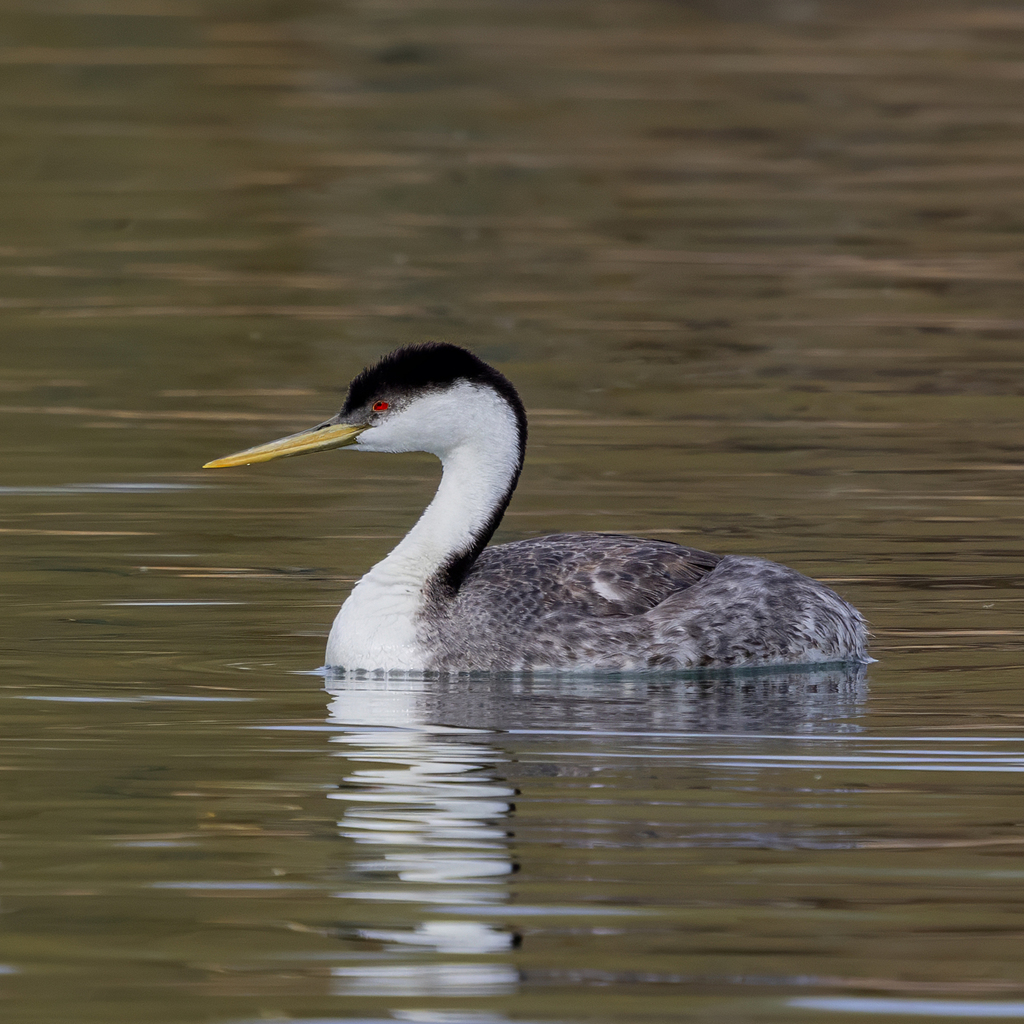
The Western Grebe is a large, distinctive waterbird characterized by its elongated neck, pointed bill, and striking black-and-white plumage pattern. Adults measure 55 to 75 cm (22 to 30 inches) in length with a wingspan of 79 to 102 cm (31 to 40 inches), making them one of North America's largest grebes. Body weight ranges from 1,000 to 1,800 grams (2.2 to 4.0 pounds). The species displays a sharp contrast between dark gray-black upperparts and bright white underparts. During breeding season, adults develop a distinctive black cap extending below the eye, separated from white cheeks and throat by a clear demarcation line. The long, thin neck appears swan-like, and the dagger-shaped yellow bill is well-adapted for fish capture. Legs are positioned far back on the body, an adaptation for underwater propulsion but making terrestrial movement awkward. Western Grebes breed across western North America from central Canada south to central Mexico. In California, breeding populations occur in the Central Valley, Klamath Basin, Modoc Plateau, and scattered locations in the Great Basin region. Major breeding sites include Clear Lake in Lake County, the San Francisco Bay Delta, Salton Sea, and various reservoirs throughout the Central Valley. Winter distribution extends along the Pacific Coast from British Columbia to Baja California, with significant concentrations in San Francisco Bay, Monterey Bay, and coastal waters from Morro Bay to San Diego County. The species inhabits large, open freshwater bodies during breeding season, including natural lakes, reservoirs, and managed wetlands. Optimal breeding habitat features water depths exceeding 2 meters (6.6 feet) with emergent vegetation such as cattails (Typha species) and tule (Schoenoplectus species) for nest placement. Breeding colonies require relatively stable water levels and minimal human disturbance. During winter and migration, Western Grebes utilize marine environments including protected bays, estuaries, and nearshore coastal waters typically within 10 kilometers (6 miles) of shore. Western Grebes are primarily piscivorous, diving to depths of 3 to 6 meters (10 to 20 feet) to capture small fish, particularly those measuring 5 to 15 cm (2 to 6 inches) in length. Diet includes threadfin shad, anchovies, sardines, and various cyprinids depending on location and season. The species is renowned for its elaborate courtship displays, including synchronized swimming and the distinctive "rushing" behavior where pairs race across the water surface in unison. Breeding occurs from April through August, with peak nesting in May and June. Nests are floating platforms constructed of aquatic vegetation anchored to emergent plants. Females typically lay 2 to 4 pale blue eggs, with both parents sharing incubation duties for 23 to 24 days. Western Grebe populations have experienced significant declines in some regions, particularly in California's Central Valley where habitat loss and degradation have reduced breeding opportunities. The North American Breeding Bird Survey indicates population declines of approximately 2.2% annually since 1966. Primary threats include loss of breeding habitat through wetland conversion, water level fluctuations affecting nest success, pollution, and entanglement in fishing gear. Climate change poses additional risks through altered precipitation patterns and temperature increases affecting prey availability.
Classification
Class: Aves · Order: Podicipediformes · Family: Podicipedidae
Frequently asked questions
How is Aechmophorus occidentalis classified?
Aechmophorus occidentalis belongs to class Aves, order Podicipediformes, family Podicipedidae.
What family does Aechmophorus occidentalis belong to?
Aechmophorus occidentalis is in the Podicipedidae family.
What is Aechmophorus occidentalis?
The Western Grebe is a large, distinctive waterbird characterized by its elongated neck, pointed bill, and striking black-and-white plumage pattern.
Is Aechmophorus occidentalis found in California?
Yes. Aechmophorus occidentalis is recorded in California in The California Species Project's catalogue.
Related species
Other California species in the same genus, family, or bioregion.
Data from The California Species Project — 14,000+ California species with verified data from CNPS, CDFW, USFWS, and more.