Aedes aegypti
Yellow Fever Mosquito
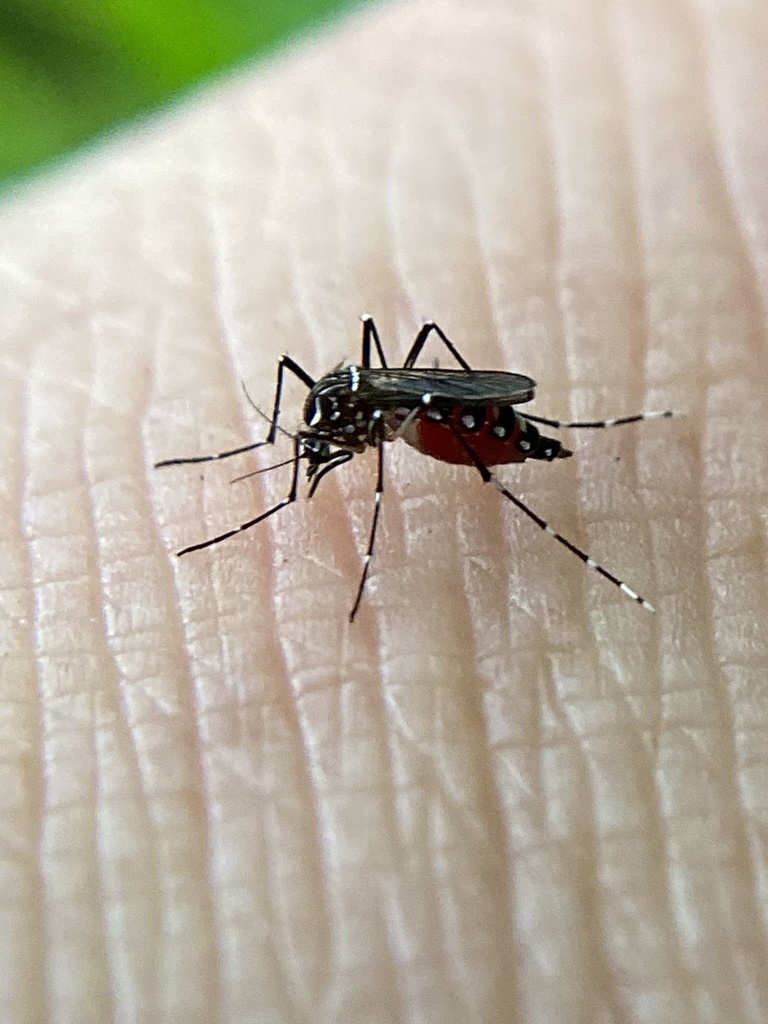
(c) Sandra H Statner, some rights reserved (CC BY) · licence
Family: Culicidae · Class: Insecta · Order: Diptera
Aedes aegypti (Yellow Fever Mosquito) is a California animal in the Culicidae family.
The yellow fever mosquito is a small, dark-colored mosquito with distinctive white markings on its legs and thorax. Adults measure approximately 4 to 7 millimeters (0.16 to 0.28 inches) in length. The species exhibits characteristic white banding on the legs and a lyre-shaped pattern of white scales on the dorsal surface of the thorax. Females are slightly larger than males and possess a pointed proboscis adapted for blood feeding, while males have feathery antennae and feed primarily on nectar. Originally native to Africa, Aedes aegypti has established populations across tropical and subtropical regions worldwide, including parts of the southern United States. In California, the species was first detected in 2013 and has since been found in multiple counties including Los Angeles, Orange, Riverside, San Bernardino, Fresno, Kern, Imperial, Tulare, and Ventura counties. The species continues to expand its range northward as climate conditions become more suitable. Yellow fever mosquitoes thrive in urban and suburban environments, preferring artificial containers that hold water for breeding. Common breeding sites include flower pots, buckets, tires, bird baths, and any vessel that can collect and retain water for several days. Unlike many native mosquito species that breed in natural water bodies, A. aegypti is highly adapted to human-modified environments and can complete development in very small volumes of water. This species exhibits distinct behavioral patterns that enhance its role as a disease vector. Females are aggressive daytime biters, most active during dawn and dusk periods. They preferentially feed on humans and will often take multiple blood meals from different hosts during a single reproductive cycle. After blood feeding, females seek protected resting sites in dark, humid areas such as closets, under furniture, or in vegetation near human dwellings. The species completes its life cycle in 7 to 10 days under optimal conditions, with females capable of producing multiple egg batches throughout their 3 to 4 week lifespan. Aedes aegypti poses significant public health concerns as the primary vector for several viral diseases including yellow fever, dengue, chikungunya, and Zika virus. The species is not federally listed under the Endangered Species Act, as it is considered an invasive species of management concern rather than a species requiring protection. Vector control programs in California actively monitor and suppress A. aegypti populations through integrated pest management approaches including source reduction, larvicide applications, and community education. Recent research has explored biological control methods, with Crawford et al. (2020) demonstrating successful population suppression using Wolbachia-infected male mosquitoes in field trials. The California Department of Public Health and local vector control districts maintain surveillance programs to track the species' distribution and implement rapid response measures when new populations are detected. Climate change may facilitate further range expansion of this tropical species into previously unsuitable regions of California.
Classification
Class: Insecta · Order: Diptera · Family: Culicidae
Frequently asked questions
How is Aedes aegypti classified?
Aedes aegypti belongs to class Insecta, order Diptera, family Culicidae.
What family does Aedes aegypti belong to?
Aedes aegypti is in the Culicidae family.
What is Aedes aegypti?
The yellow fever mosquito is a small, dark-colored mosquito with distinctive white markings on its legs and thorax.
Is Aedes aegypti found in California?
Yes. Aedes aegypti is recorded in California in The California Species Project's catalogue.
Related species
Other California species in the same genus, family, or bioregion.
Data from The California Species Project — 14,000+ California species with verified data from CNPS, CDFW, USFWS, and more.