Aegolius acadicus
Northern Saw-whet Owl
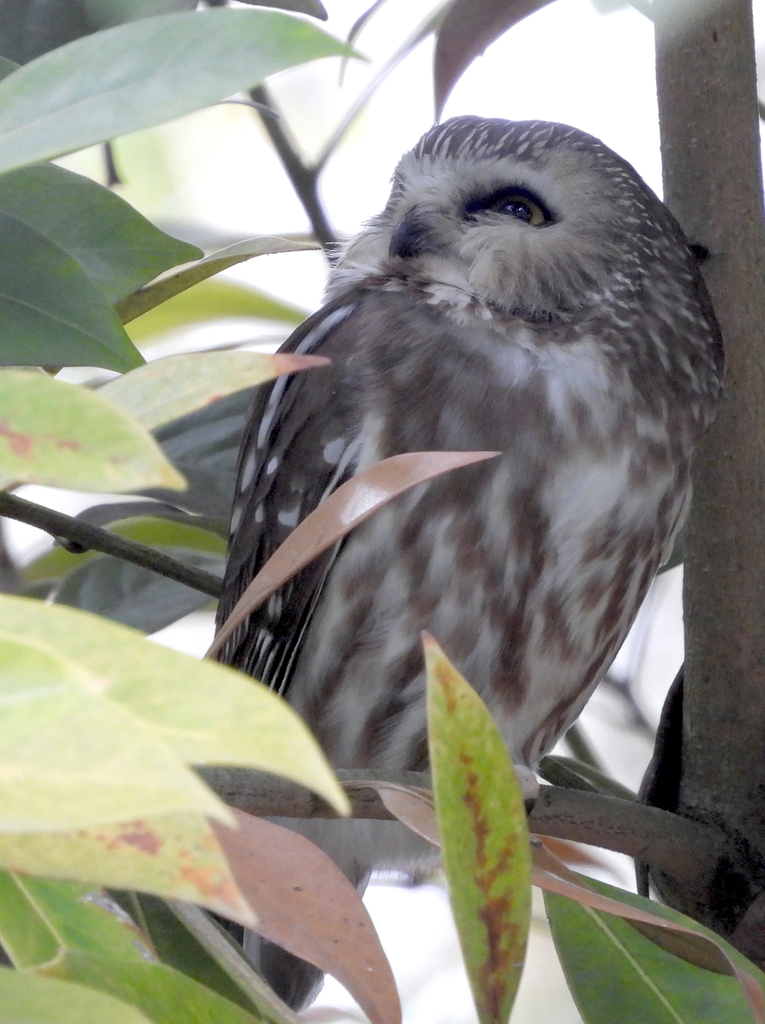
(c) Rudyard, some rights reserved (CC BY) · licence
Family: Strigidae · Class: Aves · Order: Strigiformes
Aegolius acadicus (Northern Saw-whet Owl) is a California animal in the Strigidae family.
The Northern Saw-whet Owl (Aegolius acadicus) is one of North America's smallest owl species, measuring 17 to 22 cm (6.7 to 8.7 inches) in length with a wingspan of 42 to 56 cm (16.5 to 22 inches). Adults weigh between 54 and 151 grams (1.9 to 5.3 ounces), with females significantly larger than males. The species exhibits distinctive facial features including prominent yellow eyes, a rounded facial disc with white eyebrows, and a dark bill. The upperparts are brown with white spots, while underparts are white with reddish-brown streaking. Juveniles display chocolate-brown plumage with a distinctive white V-shaped marking above the eyes. The Northern Saw-whet Owl has a broad distribution across North America, extending from southern Alaska and central Canada south through the United States. In California, the species occurs primarily in mountainous regions including the Sierra Nevada, Cascade Range, Coast Ranges, and scattered locations in the Transverse and Peninsular Ranges. Populations are present year-round in suitable habitat above 1,200 meters (4,000 feet) elevation, with some seasonal movement to lower elevations during winter months. This owl inhabits dense coniferous and mixed forests dominated by fir, pine, spruce, and hemlock. The species shows preference for mature stands with dense canopy cover and abundant cavity trees. In California, typical habitat includes Douglas-fir, white fir, and red fir forests between 1,200 and 3,000 meters (4,000 to 9,800 feet) elevation. Northern Saw-whet Owls require suitable nesting cavities, typically old woodpecker holes, and nearby open areas for hunting. Northern Saw-whet Owls are primarily nocturnal hunters, feeding almost exclusively on small mammals. Their diet consists mainly of deer mice, voles, shrews, and small squirrels, with prey typically weighing 10 to 30 grams. The species hunts from low perches, using exceptional hearing to locate prey beneath snow or leaf litter. Breeding occurs from March through July, with peak activity in April and May. Females lay 4 to 7 white eggs in tree cavities, typically 3 to 18 meters (10 to 60 feet) above ground. The female incubates eggs for 26 to 28 days while the male provides food. Young fledge after 27 to 34 days but remain dependent on parents for several additional weeks. The Northern Saw-whet Owl is not federally listed and maintains stable populations across most of its range. However, the species faces habitat pressures from logging, forest management practices, and fire suppression that reduces cavity availability. Climate change may affect high-elevation populations through altered forest composition and increased fire frequency. In California, the species benefits from forest management that maintains mature stands with adequate snag density for nesting sites.
Classification
Class: Aves · Order: Strigiformes · Family: Strigidae
Frequently asked questions
How is Aegolius acadicus classified?
Aegolius acadicus belongs to class Aves, order Strigiformes, family Strigidae.
What family does Aegolius acadicus belong to?
Aegolius acadicus is in the Strigidae family.
What is Aegolius acadicus?
The Northern Saw-whet Owl (Aegolius acadicus) is one of North America's smallest owl species, measuring 17 to 22 cm (6.7 to 8.7 inches) in length with a wingspan of 42 to 56 cm (16.5 to 22 inches).
Is Aegolius acadicus found in California?
Yes. Aegolius acadicus is recorded in California in The California Species Project's catalogue.
Related species
Other California species in the same genus, family, or bioregion.
Data from The California Species Project — 14,000+ California species with verified data from CNPS, CDFW, USFWS, and more.