Aellopos clavipes
Clavipes sphinx
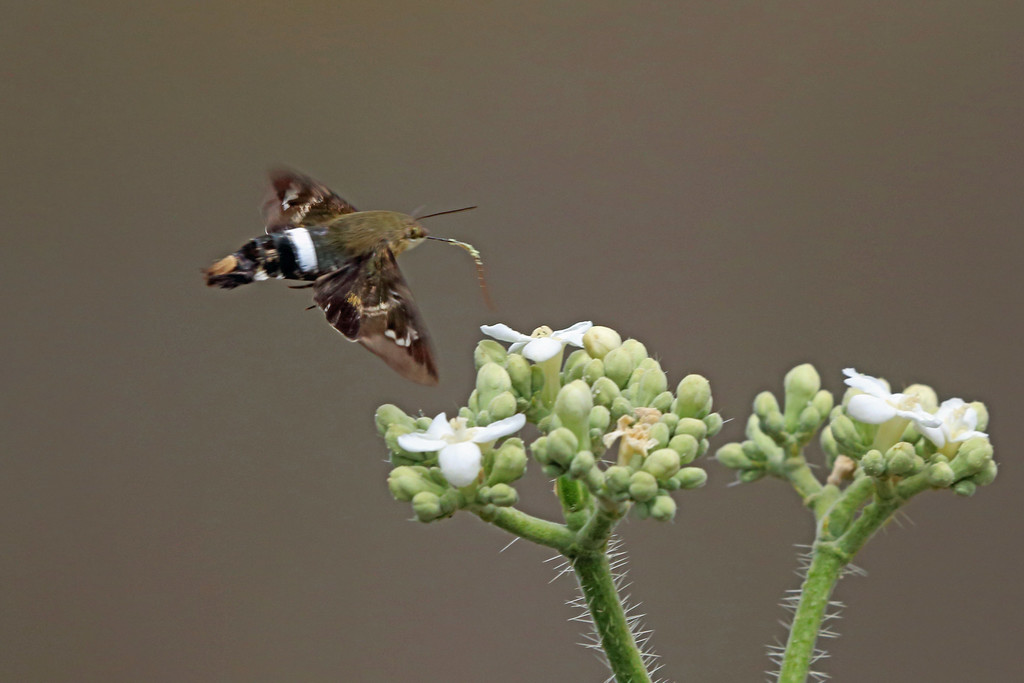
(c) Nigel Voaden, some rights reserved (CC BY) · licence
Family: Sphingidae · Class: Insecta · Order: Lepidoptera
Aellopos clavipes (Clavipes sphinx) is a California animal in the Sphingidae family.
The clavipes sphinx (Aellopos clavipes) is a medium-sized hawkmoth in the family Sphingidae. Adults have a robust, streamlined body characteristic of sphinx moths. The forewings display a mottled pattern of browns and grays with darker crosslines, while the hindwings are typically lighter with orange or reddish patches near the base. The thorax is densely covered in scales that match the wing coloration, and the abdomen shows alternating light and dark banding. Like other sphinx moths, the species has a prominent proboscis used for nectar feeding and large, prominent eyes. The clavipes sphinx has an extensive distribution spanning from northern Argentina northward through Central America, Mexico, and Jamaica to the southwestern United States, including Texas, Arizona, and southern California. This broad range indicates the species' adaptability to various climatic conditions across tropical, subtropical, and warm temperate zones. In California, the species represents the northern extent of its range and is likely limited to the southernmost counties where suitable host plants and climatic conditions persist year-round. The species inhabits areas where flowering plants provide nectar sources for adults. Adults are typically found in gardens, woodland clearings, and riparian corridors. The larvae develop on various plant species, though specific host plant relationships for this species require further documentation. Suitable habitat includes areas with diverse vegetation that can support both larval development and adult nectar feeding. Clavipes sphinx moths are active during evening and nighttime hours. Adults feed on flower nectar using their elongated proboscis. The species exhibits strong flight capabilities typical of sphinx moths. Larvae, known as hornworms, feed on foliage of their host plants. In warmer portions of their range, the species likely produces multiple generations annually, while northern populations may have more restricted breeding seasons due to cooler winter temperatures. Adults are attracted to artificial lights and can be observed at illuminated areas in suitable habitat. The clavipes sphinx does not appear on federal or state endangered species lists. Specific population data for California are limited due to the species' presence at the northern edge of its range. The species may face localized threats from habitat loss, urbanization, and pesticide use in agricultural and suburban areas. Climate change could potentially affect the northern limits of its range, though the species' broad geographic distribution suggests considerable ecological adaptability. Conservation of diverse flowering plant communities would benefit this species along with other native pollinators and moths.
Classification
Class: Insecta · Order: Lepidoptera · Family: Sphingidae
Frequently asked questions
How is Aellopos clavipes classified?
Aellopos clavipes belongs to class Insecta, order Lepidoptera, family Sphingidae.
What family does Aellopos clavipes belong to?
Aellopos clavipes is in the Sphingidae family.
What is Aellopos clavipes?
The clavipes sphinx (Aellopos clavipes) is a medium-sized hawkmoth in the family Sphingidae.
Is Aellopos clavipes found in California?
Yes. Aellopos clavipes is recorded in California in The California Species Project's catalogue.
Related species
Other California species in the same genus, family, or bioregion.
Data from The California Species Project — 14,000+ California species with verified data from CNPS, CDFW, USFWS, and more.