Aeronautes saxatalis
White-throated Swift
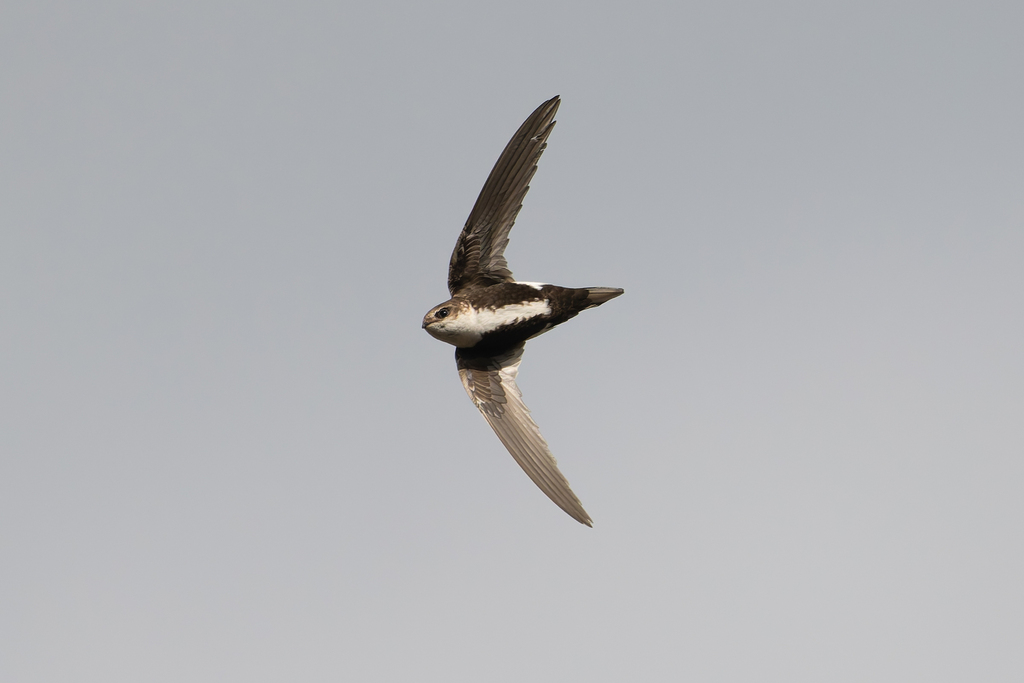
no rights reserved · CC0
Family: Apodidae · Class: Aves · Order: Apodiformes
Aeronautes saxatalis (White-throated Swift) is a California animal in the Apodidae family.
The White-throated Swift (Aeronautes saxatalis) is a medium-sized aerial insectivore measuring 15 to 18 cm (6 to 7 inches) in length with a wingspan of 33 to 36 cm (13 to 14 inches). The species exhibits distinctive black and white plumage with a prominent white throat patch extending down the center of the breast and belly, contrasting sharply with the otherwise dark brown to black dorsal coloration. White patches appear on the flanks, creating a distinctive pattern visible during flight. The wings are long, narrow, and swept back, adapted for high-speed aerial maneuvering, while the tail is slightly forked with white markings on the outer tail feathers. White-throated Swifts range throughout western North America from southern British Columbia south to Honduras. In California, the species occurs primarily in mountainous regions and coastal areas, including the Sierra Nevada, Cascade Range, Coast Ranges, and Transverse Ranges. According to eBird data, breeding populations are documented from sea level to elevations exceeding 3,000 meters (9,800 feet), with highest densities occurring between 1,000 and 2,500 meters elevation. The species is present year-round in much of California, though northern populations may migrate south during winter months. The species inhabits rocky terrain including cliff faces, canyon walls, steep mountainsides, and coastal bluffs. White-throated Swifts require vertical rock surfaces with crevices and cavities for nesting and roosting. They are commonly observed over oak woodlands, chaparral, pine forests, and desert areas adjacent to suitable nesting habitat. The species shows strong fidelity to traditional nesting sites, often returning to the same cliff faces across multiple breeding seasons. White-throated Swifts are exclusively aerial foragers, capturing flying insects during continuous flight. Their diet consists primarily of flying ants, beetles, flies, moths, and other small arthropods. According to behavioral studies, individuals may remain airborne for extended periods, drinking by skimming water surfaces and collecting nesting material while in flight. Breeding occurs from April through August, with pairs constructing shallow cup nests of feathers, grass, and other materials cemented together with saliva in rock crevices. Females typically lay 3 to 6 white eggs, which are incubated for approximately 20 days. Young fledge after 35 to 45 days but may return to the nest cavity for several additional weeks. The species exhibits highly social behavior, often foraging and roosting in flocks that may include dozens of individuals. White-throated Swifts perform aerial courtship displays involving synchronized flight patterns and vocalizations described as sharp, chattering calls. During adverse weather, large numbers may enter torpor in communal roost sites within rock crevices. White-throated Swifts are not currently listed under state or federal endangered species legislation. The species appears to maintain stable populations across most of its range, though local declines may occur due to habitat modification and rock climbing activities at nesting sites. Climate change may affect prey availability and alter precipitation patterns that influence insect abundance. The species benefits from protection of cliff environments and minimal disturbance during the breeding season.
Classification
Class: Aves · Order: Apodiformes · Family: Apodidae
Frequently asked questions
How is Aeronautes saxatalis classified?
Aeronautes saxatalis belongs to class Aves, order Apodiformes, family Apodidae.
What family does Aeronautes saxatalis belong to?
Aeronautes saxatalis is in the Apodidae family.
What is Aeronautes saxatalis?
The White-throated Swift (Aeronautes saxatalis) is a medium-sized aerial insectivore measuring 15 to 18 cm (6 to 7 inches) in length with a wingspan of 33 to 36 cm (13 to 14 inches).
Is Aeronautes saxatalis found in California?
Yes. Aeronautes saxatalis is recorded in California in The California Species Project's catalogue.
Related species
Other California species in the same genus, family, or bioregion.
Data from The California Species Project — 14,000+ California species with verified data from CNPS, CDFW, USFWS, and more.