Aethia cristatella
Crested Auklet
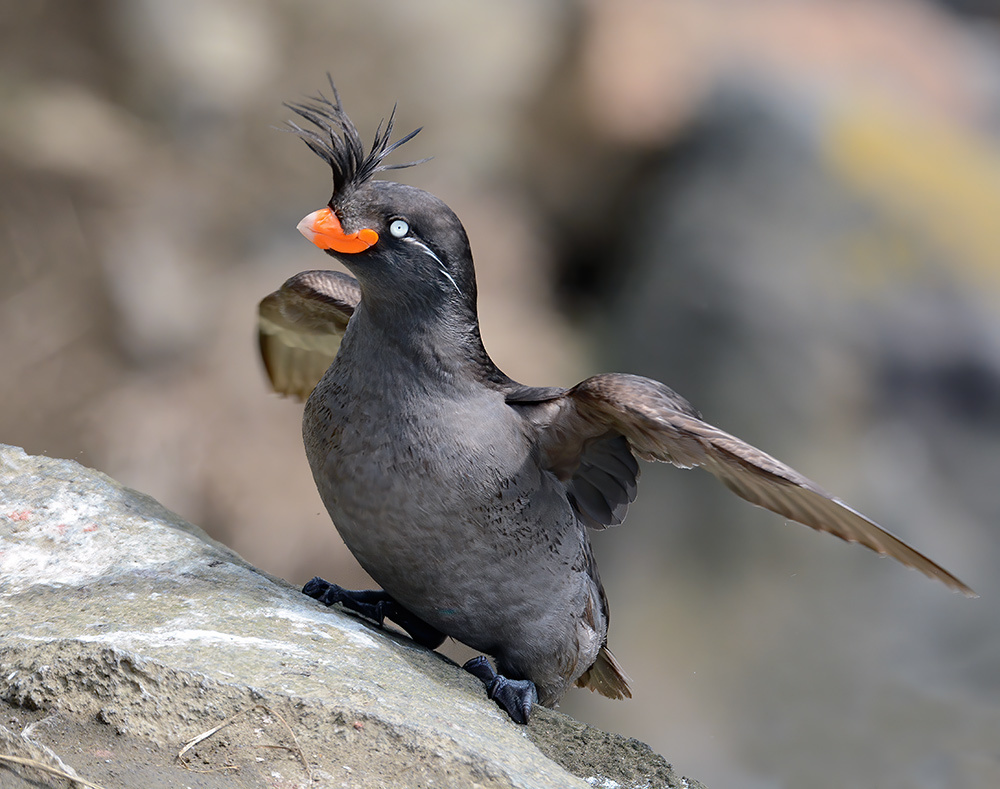
(c) Pål A. Olsvik, some rights reserved (CC BY) · licence
Family: Alcidae · Class: Aves · Order: Charadriiformes
Aethia cristatella (Crested Auklet) is a California animal in the Alcidae family.
The Crested Auklet is a small seabird measuring 23 to 27 cm (9 to 10.5 inches) in length with a wingspan of approximately 43 cm (17 inches). Adults weigh between 250 to 300 grams (8.8 to 10.6 ounces). The species is distinguished by its prominent forward-curving black crest of feathers that extends from the forehead. During breeding season, adults display entirely dark gray to blackish plumage with a distinctive bright orange bill and orange legs. The bill is laterally compressed and features a pronounced curved shape. Non-breeding adults show reduced crest size and duller coloration. Both sexes appear similar, though males typically have slightly larger crests. Crested Auklets breed primarily in the North Pacific, with major colonies in Alaska's Aleutian Islands, Pribilof Islands, and islands in the Bering Sea. The species also nests in the Kuril Islands and Commander Islands of Russia. In California waters, Crested Auklets occur as irregular visitors, primarily during winter months from October through March. Sightings are most frequent in northern California waters, particularly around the Farallon Islands and Monterey Bay, though the species remains uncommon south of Point Reyes. The species inhabits cold, nutrient-rich marine waters and nests colonially on rocky islands and coastal cliffs. Breeding colonies are established on talus slopes, rocky crevices, and boulder fields, typically on islands free from terrestrial predators. During non-breeding periods, Crested Auklets remain pelagic, inhabiting offshore waters over the continental shelf and slope. They prefer areas with strong upwelling currents that support abundant zooplankton populations. Crested Auklets are specialized planktivores, feeding primarily on copepods, euphausiids (krill), and other small crustaceans. They employ pursuit diving, using their wings for underwater propulsion while foraging at depths typically ranging from 10 to 35 meters (33 to 115 feet). The species exhibits highly synchronized breeding behavior, with pairs returning to the same nesting sites annually. Breeding occurs from May through August, with females laying a single white egg in rock crevices. Both parents share incubation duties for approximately 35 days, and chick-rearing continues for 34 to 38 days until fledging. The International Union for Conservation of Nature lists the Crested Auklet as Least Concern globally, with an estimated population of 6 to 7 million individuals. However, the species faces potential threats from climate change affecting prey distribution, marine pollution including plastic ingestion, and oil spills in critical habitat areas. Commercial fishing activities may impact food availability through competition for zooplankton resources. In California waters, the species' irregular occurrence makes population assessment difficult, though warming ocean temperatures associated with El Niño events may influence visitation patterns to state waters.
Classification
Class: Aves · Order: Charadriiformes · Family: Alcidae
Frequently asked questions
How is Aethia cristatella classified?
Aethia cristatella belongs to class Aves, order Charadriiformes, family Alcidae.
What family does Aethia cristatella belong to?
Aethia cristatella is in the Alcidae family.
What is Aethia cristatella?
The Crested Auklet is a small seabird measuring 23 to 27 cm (9 to 10.5 inches) in length with a wingspan of approximately 43 cm (17 inches).
Is Aethia cristatella found in California?
Yes. Aethia cristatella is recorded in California in The California Species Project's catalogue.
Related species
Other California species in the same genus, family, or bioregion.
Data from The California Species Project — 14,000+ California species with verified data from CNPS, CDFW, USFWS, and more.