Aethia psittacula
Parakeet Auklet
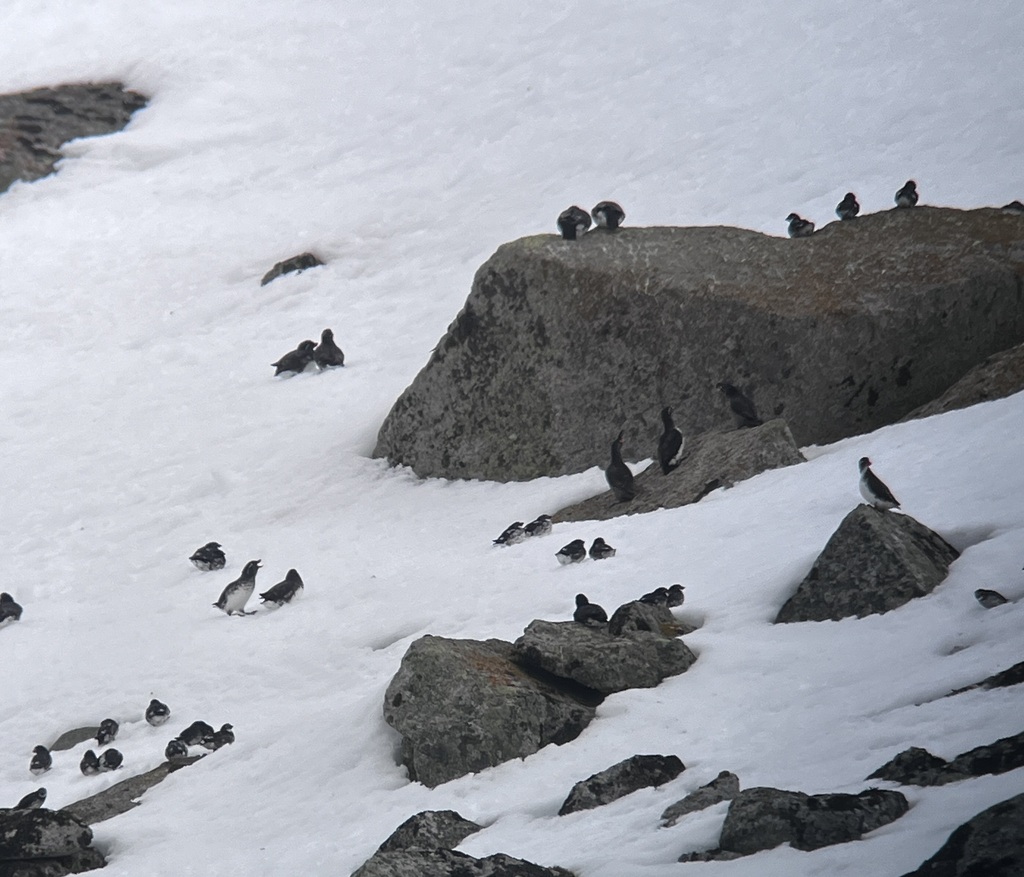
(c) Sandra Keller, some rights reserved (CC BY) · licence
Family: Alcidae · Class: Aves · Order: Charadriiformes
Aethia psittacula (Parakeet Auklet) is a California animal in the Alcidae family.
The Parakeet Auklet is a small, stocky seabird in the family Alcidae. Adults measure 20-23 cm (7.9-9.1 inches) in length with a wingspan of 35-40 cm (13.8-15.7 inches) and weigh 230-310 grams (8.1-10.9 ounces). The species exhibits distinct seasonal plumage differences. During breeding season, adults display entirely black upperparts and white underparts, with a distinctive orange-red bill that curves slightly upward and narrow white plumes extending backward from behind each eye. Non-breeding adults lose the white plumes and develop a duller, brownish-black head and upperparts. The bill becomes darker orange-yellow in winter. Juveniles resemble winter adults but have smaller bills and lack the pronounced bill curvature. Parakeet Auklets breed in the North Pacific, with the global population concentrated in Alaska's Aleutian Islands, Pribilof Islands, and scattered locations along the Alaska Peninsula. The species winters primarily in offshore waters of the North Pacific Ocean. In California, Parakeet Auklets are irregular visitors, typically occurring as rare migrants or storm-driven individuals along the northern coast between September and April. Most California records come from Monterey, San Francisco, Humboldt, and Del Norte counties, with sightings concentrated during winter months when birds disperse southward from breeding areas. Breeding habitat consists of rocky cliff faces, boulder fields, and talus slopes on islands and coastal headlands. Nesting sites are typically located in crevices and cavities among rocks, providing protection from weather and predators. During winter, the species occupies pelagic waters over the continental shelf, generally within 200 km of shore where upwelling creates productive feeding areas. Water depths of 50-200 meters are preferred, corresponding to optimal foraging zones for prey availability. Parakeet Auklets are pursuit divers, using their wings to propel themselves underwater while hunting. The diet consists primarily of small fish, particularly juvenile pollock, herring, and sandlance, supplemented by crustaceans including euphausiid krill, copepods, and amphipods. Breeding occurs from May through August, with peak activity in June and July. Females lay a single white egg in rock crevices, and both parents share incubation duties for 35-36 days. Chicks fledge after 35-40 days and become independent immediately upon leaving the nest. The species forms large, dense colonies during breeding season, with hundreds to thousands of pairs nesting in suitable habitat. Parakeet Auklets are not federally listed and maintain stable populations across their primary range. The global population is estimated at 1.2-1.8 million individuals, with approximately 90% breeding in Alaska. Climate change poses potential long-term threats through altered ocean temperatures and prey distribution. Commercial fishing operations may impact food availability, particularly in areas where fisheries target the same small schooling fish species consumed by auklets. Oil spills and marine pollution represent additional concerns given the species' dependence on marine environments throughout their annual cycle.
Classification
Class: Aves · Order: Charadriiformes · Family: Alcidae
Frequently asked questions
How is Aethia psittacula classified?
Aethia psittacula belongs to class Aves, order Charadriiformes, family Alcidae.
What family does Aethia psittacula belong to?
Aethia psittacula is in the Alcidae family.
What is Aethia psittacula?
The Parakeet Auklet is a small, stocky seabird in the family Alcidae.
Is Aethia psittacula found in California?
Yes. Aethia psittacula is recorded in California in The California Species Project's catalogue.
Related species
Other California species in the same genus, family, or bioregion.
Data from The California Species Project — 14,000+ California species with verified data from CNPS, CDFW, USFWS, and more.