Aethia pusilla
Least Auklet
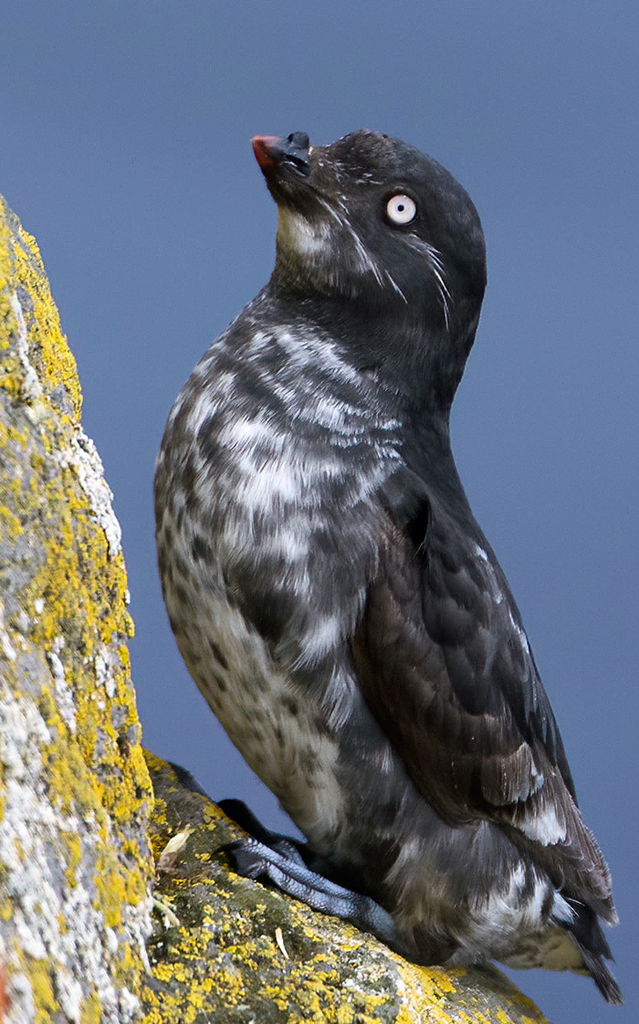
(c) Pål A. Olsvik, some rights reserved (CC BY) · licence
Family: Alcidae · Class: Aves · Order: Charadriiformes
Aethia pusilla (Least Auklet) is a California animal in the Alcidae family.
The Least Auklet (Aethia pusilla) is the smallest member of the auk family (Alcidae), measuring 15-16 cm (5.9-6.3 inches) in length and weighing 85-90 grams (3.0-3.2 ounces). Adults in breeding plumage display dark sooty-brown to blackish upperparts with white underparts. The bill is small, conical, and bright red-orange during breeding season, becoming duller in winter. A distinctive white scapular stripe extends from the shoulder region, and white streaking occurs on the forehead and behind the eye. Non-breeding adults show reduced contrast with brownish-gray upperparts and duller bill coloration. The Least Auklet breeds primarily in the North Pacific, with the largest colonies located in Alaska's Aleutian Islands and Pribilof Islands. According to the U.S. Fish and Wildlife Service, approximately 9 million individuals nest in Alaskan waters, representing roughly 75% of the global population. In California, the species occurs as an irregular winter visitor along the coast, primarily from October through March. Sightings are most frequent in northern California waters, particularly around the Farallon Islands and Monterey Bay, though the species may appear south to Point Conception during years of favorable oceanographic conditions. During the non-breeding season in California waters, Least Auklets inhabit nearshore and offshore marine environments, typically within 50 kilometers of the coastline. The species shows preference for areas with high zooplankton concentrations, often associated with upwelling zones and convergence areas where different water masses meet. Water temperatures between 8-14°C (46-57°F) appear optimal for foraging success. Birds are frequently observed in mixed flocks with other alcids, including Cassin's Auklets and Common Murres, particularly in areas with rocky seamounts and submarine canyons that concentrate prey. Least Auklets are specialized planktivores, feeding almost exclusively on copepods, particularly Calanus and Neocalanus species. During foraging, birds dive to depths of 5-15 meters (16-49 feet) using wing-propelled underwater flight. The species exhibits strong synchronization with prey abundance cycles, with breeding success closely tied to copepod availability. Flight is rapid and direct, with wingbeats reaching 10-12 beats per second. Birds often form large foraging flocks that can number in the thousands. Breeding occurs on remote rocky islands, where pairs nest in crevices and talus slopes. Females lay a single white egg in late May to early June. Both parents incubate for 35-36 days and provision the chick for approximately 28 days. Chicks fledge weighing 75-80% of adult body mass. The species is not federally listed and maintains stable global populations, though climate change poses potential long-term threats through altered prey distribution and ocean temperature changes. Marine heatwaves and shifting currents associated with climate variability may reduce prey availability in traditional foraging areas. In California, irregular occurrence patterns make population monitoring challenging, but the species appears to respond positively to La Niña conditions that enhance nearshore productivity. The North American Bird Conservation Initiative considers the Least Auklet a species of low conservation concern due to its large population size and relatively stable breeding habitat.
Classification
Class: Aves · Order: Charadriiformes · Family: Alcidae
Frequently asked questions
How is Aethia pusilla classified?
Aethia pusilla belongs to class Aves, order Charadriiformes, family Alcidae.
What family does Aethia pusilla belong to?
Aethia pusilla is in the Alcidae family.
What is Aethia pusilla?
The Least Auklet (Aethia pusilla) is the smallest member of the auk family (Alcidae), measuring 15-16 cm (5.9-6.3 inches) in length and weighing 85-90 grams (3.0-3.2 ounces).
Is Aethia pusilla found in California?
Yes. Aethia pusilla is recorded in California in The California Species Project's catalogue.
Related species
Other California species in the same genus, family, or bioregion.
Data from The California Species Project — 14,000+ California species with verified data from CNPS, CDFW, USFWS, and more.