Agapostemon melliventris
Honey-tailed Striped Sweat Bee
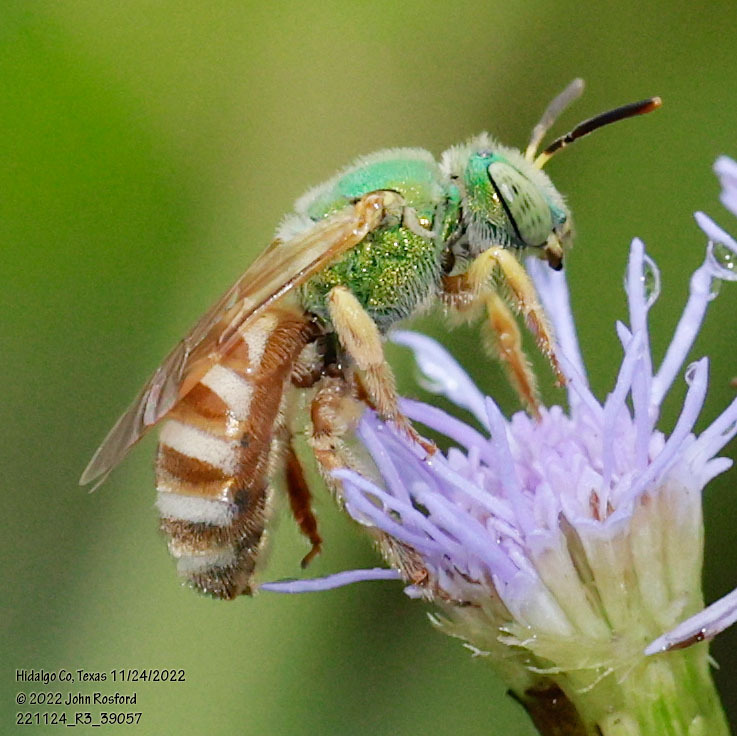
(c) John Rosford, some rights reserved (CC BY) · licence
Family: Halictidae · Class: Insecta · Order: Hymenoptera
Agapostemon melliventris (Honey-tailed Striped Sweat Bee) is a California animal in the Halictidae family.
The Honey-tailed Striped Sweat Bee (Agapostemon melliventris) is a medium-sized halictid bee in the family Halictidae. This species displays the characteristic metallic green coloration typical of the genus Agapostemon, with males exhibiting distinctive yellow and black striped abdomens that give the species its common name. Females are typically metallic green to blue-green with dark abdomens. Body length ranges from approximately 8 to 12 millimeters (0.3 to 0.5 inches). Like other sweat bees, this species possesses specialized branched hairs (plumose setae) for pollen collection and transport. Agapostemon melliventris has a broad distribution across North America, ranging from southern Canada through much of the United States into northern Mexico. According to NatureServe Explorer, this species maintains a Global Conservation Status of G5, indicating it is secure globally with many occurrences. However, the species appears to have experienced local extirpations in some areas, with some taxonomic databases listing certain populations as presumed extinct in specific regions. This species typically inhabits open areas including prairies, meadows, fields, and disturbed habitats where flowering plants are abundant. They are commonly found in agricultural landscapes, gardens, and natural grasslands. Honey-tailed Striped Sweat Bees demonstrate a preference for areas with diverse floral resources and suitable nesting sites in well-drained soils. The species constructs underground nests, with females excavating burrows in sandy or loamy substrates. Agapostemon melliventris exhibits typical halictid social behavior, with females being either solitary or forming small aggregations. Nesting occurs in spring and early summer, with females creating branched underground galleries where they provision cells with pollen and nectar for their developing larvae. The species is polylectic, meaning it collects pollen from a wide variety of flowering plants including members of the Asteraceae, Fabaceae, and Rosaceae families. Adults are active from late spring through early fall, with peak activity during summer months when floral resources are most abundant. Males typically emerge slightly before females and can be observed patrolling territories near nesting sites. While not currently listed under any federal or state conservation programs, Agapostemon melliventris faces potential threats common to many native bee species. Habitat loss due to agricultural intensification, urban development, and conversion of native grasslands represents the primary conservation concern. Pesticide use, particularly neonicotinoids and other systemic insecticides, may impact both adult bees and developing larvae. Climate change could affect the synchronization between bee emergence and peak flowering of host plants. The species' adaptability to disturbed habitats and diverse floral resources provides some resilience, but continued monitoring is important given documented declines in many native bee species across North America. Conservation efforts focusing on habitat preservation, reduction of pesticide use, and maintenance of diverse floral resources would benefit this species and other native pollinators.
Classification
Class: Insecta · Order: Hymenoptera · Family: Halictidae
Frequently asked questions
How is Agapostemon melliventris classified?
Agapostemon melliventris belongs to class Insecta, order Hymenoptera, family Halictidae.
What family does Agapostemon melliventris belong to?
Agapostemon melliventris is in the Halictidae family.
What is Agapostemon melliventris?
The Honey-tailed Striped Sweat Bee (Agapostemon melliventris) is a medium-sized halictid bee in the family Halictidae.
Is Agapostemon melliventris found in California?
Yes. Agapostemon melliventris is recorded in California in The California Species Project's catalogue.
Related species
Other California species in the same genus, family, or bioregion.
Data from The California Species Project — 14,000+ California species with verified data from CNPS, CDFW, USFWS, and more.