Agapostemon subtilior
Fine striped sweat bee
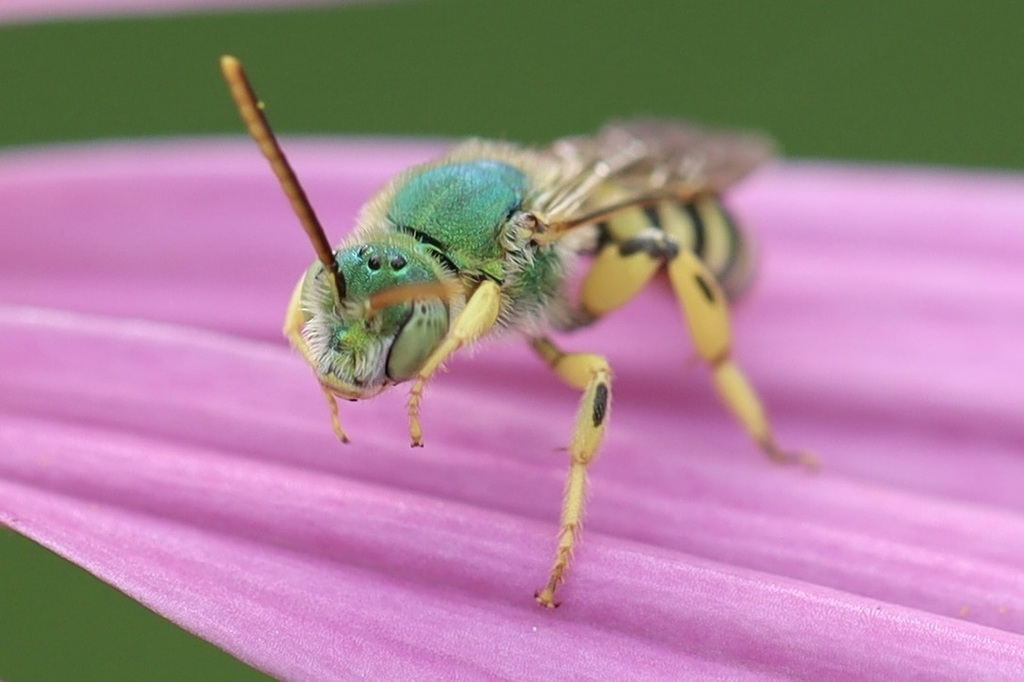
(c) eebee, some rights reserved (CC BY) · licence
Family: Halictidae · Class: Insecta · Order: Hymenoptera
Agapostemon subtilior (Fine striped sweat bee) is a California animal in the Halictidae family.
Agapostemon subtilior, known as the fine striped sweat bee, is a small to medium-sized native bee in the family Halictidae. Females measure approximately 6-10 mm (0.24-0.39 inches) in length and display entirely metallic green coloration on both the head, thorax, and abdomen. Males are distinguished by their iridescent green head and thorax contrasting with a black abdomen marked by pale yellow or white bands (BugGuide 2025). The species name "subtilior" refers to the fine striping pattern, though this is most prominent in males. Like other sweat bees, this species may be attracted to human perspiration for its salt content. This widespread species exhibits a transcontinental distribution, ranging from British Columbia east to Quebec, Canada, and occurring coast to coast across northern and central United States (NatureServe 2025). In California, A. subtilior has been documented in various counties including Orange County, where specimens have been observed foraging on daisies in coastal areas (BugGuide 2025). Fine striped sweat bees occupy diverse habitat types including urban parks, gardens, agricultural areas, and natural grasslands. The species demonstrates considerable habitat flexibility, occurring in both disturbed and undisturbed environments. They are commonly found in areas with abundant flowering plants that provide nectar and pollen resources throughout their active season. Agapostemon subtilior exhibits typical halictid bee behavior patterns. Females are solitary ground-nesters, excavating burrows in bare or sparsely vegetated soil where they provision brood cells with pollen and nectar. Males emerge earlier than females and may be observed patrolling territories near nesting aggregations. The species is polylectic, visiting flowers from multiple plant families for foraging. Documented foraging behavior includes collecting pollen from composite flowers such as daisies (Asteraceae), where females can be observed with visible pollen loads (BugGuide 2025). Flight periods typically extend from spring through fall, with peak activity varying by geographic location and local climate conditions. Like many native bee species, A. subtilior faces potential conservation challenges from habitat modification, pesticide exposure, and climate change effects on flowering plant communities. However, the species' widespread distribution and apparent habitat flexibility suggest relatively stable populations across most of its range. The species benefits from pollinator-friendly landscaping practices that maintain diverse native and non-native flowering plants throughout the growing season. Urban environments can support populations when adequate nesting sites and floral resources are available, as demonstrated by observations in developed areas of southern California. The ecological importance of A. subtilior extends beyond its role as a pollinator of wild plants to include potential contributions to crop pollination in agricultural systems. As with other native bees, maintaining habitat connectivity and reducing pesticide inputs supports population stability for this widespread but ecologically valuable species.
Classification
Class: Insecta · Order: Hymenoptera · Family: Halictidae
Frequently asked questions
How is Agapostemon subtilior classified?
Agapostemon subtilior belongs to class Insecta, order Hymenoptera, family Halictidae.
What family does Agapostemon subtilior belong to?
Agapostemon subtilior is in the Halictidae family.
What is Agapostemon subtilior?
Agapostemon subtilior, known as the fine striped sweat bee, is a small to medium-sized native bee in the family Halictidae.
Is Agapostemon subtilior found in California?
Yes. Agapostemon subtilior is recorded in California in The California Species Project's catalogue.
Related species
Other California species in the same genus, family, or bioregion.
Data from The California Species Project — 14,000+ California species with verified data from CNPS, CDFW, USFWS, and more.