Agathymus stephensi
California Giant-Skipper
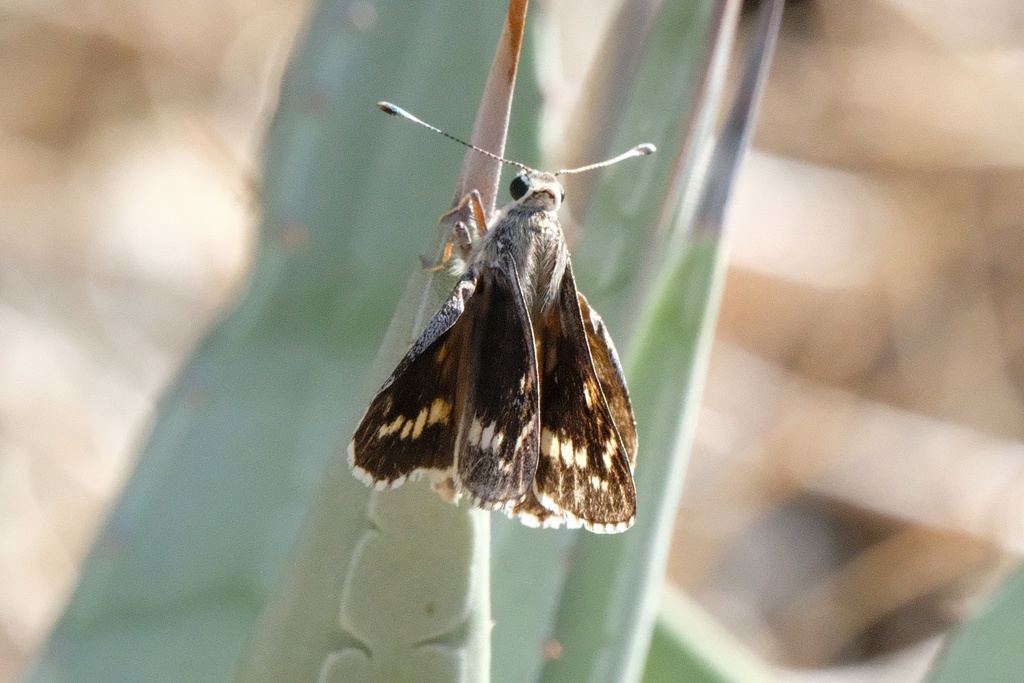
(c) Madeleine Claire, some rights reserved (CC BY) · licence
Family: Hesperiidae · Class: Insecta · Order: Lepidoptera
Agathymus stephensi (California Giant-Skipper) is a California animal in the Hesperiidae family.
The California giant-skipper is a large, robust butterfly endemic to the Colorado Desert region of southern California and Baja California Norte. Adults have a wingspan of 51 to 64 mm (2.0 to 2.5 inches), making them among the largest skippers in North America. The wings are dark brown to blackish-brown with distinctive white or cream-colored spots and bands. Males typically display more pronounced white markings than females, with prominent white patches on the forewings and smaller spots on the hindwings. The body is thick and muscular, covered in dense brown scales, with a large head and prominent eyes characteristic of the Hesperiidae family. The California giant-skipper occurs exclusively in the Colorado Desert of Riverside and San Diego counties in California, extending south into Baja California Norte, Mexico. This represents one of the most restricted ranges of any North American skipper species. Within California, populations are documented from the Coachella Valley, Anza-Borrego Desert State Park, and adjacent desert areas. The species' distribution closely follows that of its obligate host plant, desert agave. This species inhabits arid desert environments at elevations ranging from below sea level to approximately 1,200 meters (4,000 feet). The habitat consists of rocky slopes, washes, and flat desert areas where desert agave (Agave deserti) grows naturally. Desert agave typically occurs in well-drained soils on bajadas, rocky hillsides, and canyon bottoms. The climate is characterized by extremely hot summers, mild winters, and minimal annual precipitation of 75 to 200 mm (3 to 8 inches). California giant-skippers have an obligate relationship with desert agave, with larvae developing exclusively within the plant's root crown and stem base. Adult females locate suitable host plants and deposit eggs singly on or near the base of agave plants. Larvae bore into the root crown, creating galleries where they feed and develop over multiple years. The larval stage typically lasts two to three years, during which the caterpillar may reach 50 mm (2 inches) in length. Pupation occurs within the host plant in a chamber lined with silk and plant material. Adults are active during daylight hours and are strong, rapid fliers. Flight period occurs primarily from September through November, coinciding with seasonal rains. Males exhibit territorial behavior, perching on elevated positions to locate mates. The California giant-skipper lacks formal state or federal conservation status but faces significant conservation concerns due to its extremely limited range and habitat specificity. Urban development, recreational activities, and climate change pose primary threats to desert agave habitats. Off-road vehicle use and foot traffic can damage both adult habitat and host plants. Prolonged drought conditions may stress agave populations, potentially affecting skipper reproduction and survival. The species' dependence on a single host plant species and restricted geographic range make it particularly vulnerable to environmental changes and habitat loss.
Classification
Class: Insecta · Order: Lepidoptera · Family: Hesperiidae
Frequently asked questions
How is Agathymus stephensi classified?
Agathymus stephensi belongs to class Insecta, order Lepidoptera, family Hesperiidae.
What family does Agathymus stephensi belong to?
Agathymus stephensi is in the Hesperiidae family.
What is Agathymus stephensi?
The California giant-skipper is a large, robust butterfly endemic to the Colorado Desert region of southern California and Baja California Norte.
Is Agathymus stephensi found in California?
Yes. Agathymus stephensi is recorded in California in The California Species Project's catalogue.
Related species
Other California species in the same genus, family, or bioregion.
Data from The California Species Project — 14,000+ California species with verified data from CNPS, CDFW, USFWS, and more.