Agelaius phoeniceus aciculatus
Kern Red-winged Blackbird
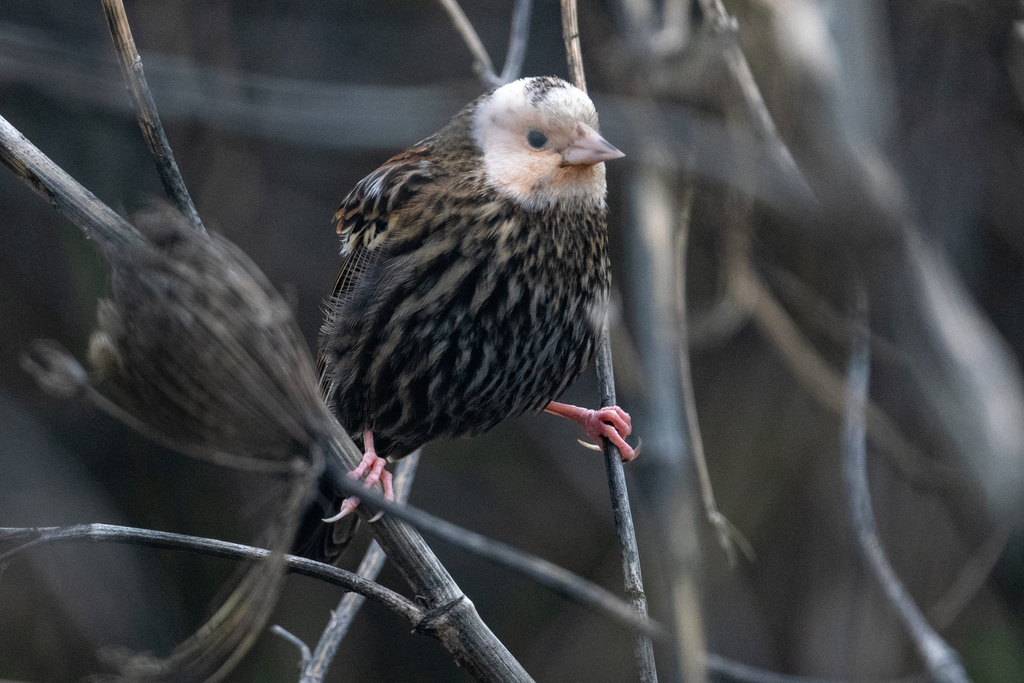
(c) Jonathan Eisen, some rights reserved (CC BY) · licence
Family: Icteridae · Class: Aves · Order: Passeriformes
Conservation status: G5T1 S1
Agelaius phoeniceus aciculatus (Kern Red-winged Blackbird) is a California animal in the Icteridae family.
The Kern Red-winged Blackbird is a subspecies of the widespread Red-winged Blackbird, distinguished by subtle morphological characteristics that differentiate it from other regional populations. Males display the characteristic jet-black plumage with bright red shoulder patches (epaulets) bordered by yellow or buff, while females exhibit heavily streaked brown plumage with lighter underparts. This subspecies was first described by Mailliard in 1915 and represents one of seven recognized subspecies of Red-winged Blackbird found in California (Grinnell & Miller 1944). Historically, the Kern Red-winged Blackbird was endemic to the Central Valley of California, specifically the San Joaquin Valley region including Kern County. The subspecies' range was centered in the southern portion of the Central Valley, where it inhabited freshwater marsh systems and associated wetland habitats. Current distribution is severely restricted compared to historical range, with remaining populations confined to small, isolated wetland fragments. The subspecies requires freshwater marsh habitats with emergent vegetation, particularly cattails (Typha species) and tules (Scirpus species) for nesting. These wetlands historically occurred throughout the valley floor, supported by natural flooding cycles and groundwater discharge. Adults also utilize adjacent upland habitats including grasslands and agricultural areas for foraging, particularly during the non-breeding season when insects and seeds become primary food sources. Breeding behavior follows the typical Red-winged Blackbird pattern, with males establishing territories in suitable marsh habitat from March through July. Males are polygamous, defending territories that may contain multiple female nests. Females construct cup-shaped nests woven among emergent vegetation stems, typically 0.5 to 2 meters above water surface. Clutch size ranges from 3 to 5 eggs, with incubation lasting approximately 11 to 13 days. Diet consists primarily of insects during breeding season, shifting to seeds and grains during fall and winter months. Like other Red-winged Blackbird subspecies, individuals may join large mixed-species flocks during winter. NatureServe ranks the Kern Red-winged Blackbird as G5T1 (Critically Imperiled Subspecies), reflecting its extremely restricted range and small population size. The subspecies faces continuing threats from habitat loss due to agricultural conversion, urban development, and groundwater extraction that has eliminated much of the Central Valley's historical wetland habitat (NatureServe 2023). Remaining populations are small and isolated, making them vulnerable to stochastic events and local extinctions. The dramatic reduction in Central Valley wetlands, estimated at over 95% loss since the mid-1800s, has eliminated most suitable habitat for this subspecies. Current conservation efforts focus on protecting and restoring remaining wetland fragments, though the subspecies' long-term viability remains uncertain given continued habitat pressures and climate change impacts on California's water resources.
Classification
Class: Aves · Order: Passeriformes · Family: Icteridae
Conservation status
G5T1 S1
Frequently asked questions
How is Agelaius phoeniceus aciculatus classified?
Agelaius phoeniceus aciculatus belongs to class Aves, order Passeriformes, family Icteridae.
What family does Agelaius phoeniceus aciculatus belong to?
Agelaius phoeniceus aciculatus is in the Icteridae family.
Is Agelaius phoeniceus aciculatus protected or of conservation concern?
Agelaius phoeniceus aciculatus carries the following status: G5T1 S1.
What is Agelaius phoeniceus aciculatus?
The Kern Red-winged Blackbird is a subspecies of the widespread Red-winged Blackbird, distinguished by subtle morphological characteristics that differentiate it from other regional populations.
Is Agelaius phoeniceus aciculatus found in California?
Yes. Agelaius phoeniceus aciculatus is recorded in California in The California Species Project's catalogue.
Related species
Other California species in the same genus, family, or bioregion.
Data from The California Species Project — 14,000+ California species with verified data from CNPS, CDFW, USFWS, and more.