Agelaius tricolor
Tricolored blackbird
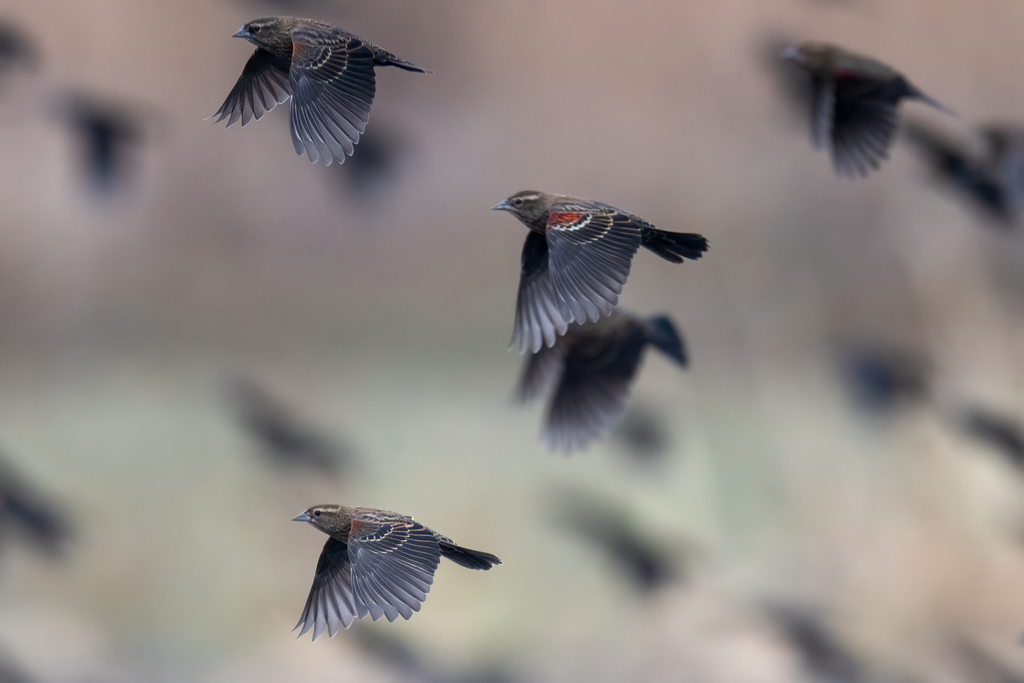
(c) Jonathan Eisen, some rights reserved (CC BY) · licence
Family: Icteridae · Class: Aves · Order: Passeriformes
Conservation status: ST · G1G2 S2
Agelaius tricolor (Tricolored blackbird) is a California animal in the Icteridae family.
The tricolored blackbird (Agelaius tricolor) is a medium-sized passerine bird endemic to western North America, with the vast majority of the population residing in California. Males measure 21-24 cm (8.3-9.4 inches) in length with a wingspan of 30-35 cm (12-14 inches), while females are slightly smaller at 18-20 cm (7.1-7.9 inches). Breeding males display glossy black plumage with distinctive red shoulder patches bordered by white wing bars, giving the species its common name. Non-breeding males and females are brownish-black with streaked underparts and lack the prominent shoulder markings. Historically, tricolored blackbirds ranged from southern Oregon through California to Baja California, Mexico. The current range has contracted significantly, with over 95% of the global population now concentrated in California's Central Valley. Smaller populations persist in coastal California, the Sierra Nevada foothills, and isolated areas of southern California. The species also maintains limited populations in Oregon, Washington, and northwestern Baja California. Tricolored blackbirds inhabit open grasslands, agricultural areas, and freshwater marshes. During breeding season, they require areas with dense, tall vegetation such as cattail marshes, tule beds, or thick-stemmed herbaceous plants for nesting. Outside breeding season, flocks forage in agricultural fields, particularly those growing rice, corn, and other grains, as well as in cattle pastures and grasslands. The species shows strong preference for areas within 5 km of suitable nesting habitat. This highly social species forms some of the largest breeding colonies in North America, with historical records of colonies containing over 200,000 individuals. Breeding occurs from March through August, with peak activity in April and May. Females construct cup-shaped nests woven into marsh vegetation or dense shrubs, typically 0.3-3 meters above ground or water. Clutches consist of 2-4 pale blue eggs with dark markings. Males are polygynous, often mating with multiple females within their territory. The species exhibits strong site fidelity, often returning to successful breeding locations across multiple years. Tricolored blackbirds are omnivorous, with diet varying seasonally. During breeding season, they consume primarily insects including beetles, caterpillars, and grasshoppers, which provide essential protein for developing young. Outside breeding season, flocks feed extensively on seeds from grasses and agricultural crops, particularly rice and other grains. California listed the tricolored blackbird as threatened in 2014, with the species receiving additional protection under the California Endangered Species Act. Population surveys indicate a decline from an estimated 370,000 individuals in 2008 to approximately 178,000 in 2017, representing a 52% decrease over nine years. Primary threats include habitat loss from agricultural conversion and urban development, pesticide use that reduces insect prey availability, and human disturbance at breeding colonies. Climate change poses additional risks through altered precipitation patterns affecting marsh habitat availability.
Classification
Class: Aves · Order: Passeriformes · Family: Icteridae
Conservation status
ST · G1G2 S2
Frequently asked questions
How is Agelaius tricolor classified?
Agelaius tricolor belongs to class Aves, order Passeriformes, family Icteridae.
What family does Agelaius tricolor belong to?
Agelaius tricolor is in the Icteridae family.
Is Agelaius tricolor protected or of conservation concern?
Agelaius tricolor carries the following status: ST · G1G2 S2.
What is Agelaius tricolor?
The tricolored blackbird (Agelaius tricolor) is a medium-sized passerine bird endemic to western North America, with the vast majority of the population residing in California.
Is Agelaius tricolor found in California?
Yes. Agelaius tricolor is recorded in California in The California Species Project's catalogue.
Related species
Other California species in the same genus, family, or bioregion.
Data from The California Species Project — 14,000+ California species with verified data from CNPS, CDFW, USFWS, and more.