Agelenopsis aperta
Desert Grass Spider
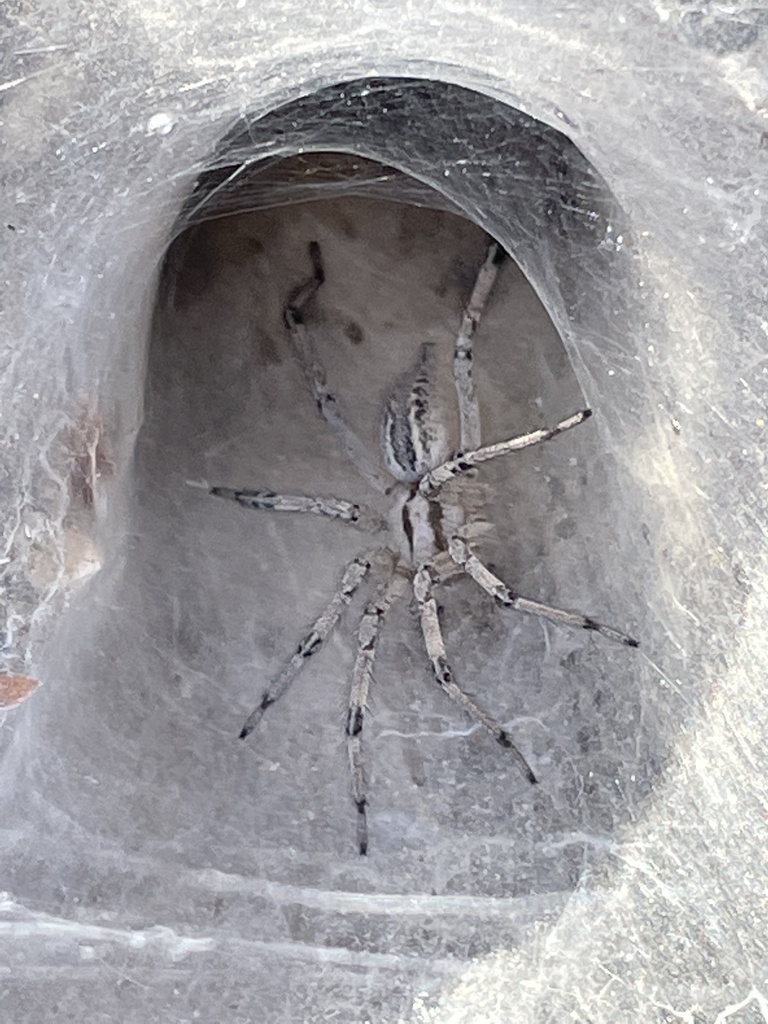
(c) Bobby McCabe, some rights reserved (CC BY) · licence
Family: Agelenidae · Class: Arachnida · Order: Araneae
Agelenopsis aperta (Desert Grass Spider) is a California animal in the Agelenidae family.
The Desert Grass Spider is a medium-sized funnel weaver spider belonging to the family Agelenidae. Adults typically measure 10-15 mm (0.4-0.6 inches) in body length, with females generally larger than males. The species exhibits brown to grayish-brown coloration with darker markings on the cephalothorax and abdomen. Like other Agelenopsis species, A. aperta has relatively long legs and prominent spinnerets, which are used to construct their characteristic funnel webs (BugGuide 2025). Agelenopsis aperta has a broad distribution across the western United States and extends into Mexico. According to BugGuide, the species ranges across Arizona, California, Colorado, Nebraska, New Mexico, Nevada, Oklahoma, Utah, and Texas. This extensive range reflects the species' adaptability to various arid and semi-arid environments throughout the southwestern and western regions of North America. The Desert Grass Spider inhabits a variety of dry habitats including grasslands, desert scrublands, and open woodlands. The species shows particular association with areas containing suitable substrate for web construction, often utilizing rock crevices, fallen logs, or dense vegetation as anchor points for their funnel webs. They prefer locations with moderate ground cover that provides both hunting opportunities and protection from predators and extreme weather conditions. As a funnel weaver, A. aperta constructs distinctive sheet webs with a funnel-shaped retreat at one end. The spider positions itself at the narrow end of the funnel, waiting for prey to become entangled in the horizontal sheet portion of the web. When vibrations indicate captured prey, the spider rapidly emerges from the funnel to subdue its victim. The diet consists primarily of ground-dwelling insects, including beetles, flies, and other small arthropods that walk across or fall onto the web surface. Mating typically occurs in late summer and fall, with males seeking out females by following pheromone trails. Females produce egg sacs that overwinter, with spiderlings emerging the following spring. The genus Agelenopsis contains 14 species in North America, and identification to species level often requires examination of genitalial structures due to morphological similarities between species (BugGuide 2025). A. aperta can be distinguished from closely related species through careful examination of palpal structures in males and epigyne characteristics in females. The species shows no apparent conservation concerns and maintains stable populations throughout its range. Its broad distribution and habitat adaptability suggest resilience to environmental changes, though localized impacts from habitat modification and urban development may affect some populations. The species likely benefits from its generalist feeding habits and ability to exploit various microhabitats within its preferred arid environments.
Classification
Class: Arachnida · Order: Araneae · Family: Agelenidae
Frequently asked questions
How is Agelenopsis aperta classified?
Agelenopsis aperta belongs to class Arachnida, order Araneae, family Agelenidae.
What family does Agelenopsis aperta belong to?
Agelenopsis aperta is in the Agelenidae family.
What is Agelenopsis aperta?
The Desert Grass Spider is a medium-sized funnel weaver spider belonging to the family Agelenidae.
Is Agelenopsis aperta found in California?
Yes. Agelenopsis aperta is recorded in California in The California Species Project's catalogue.
Related species
Other California species in the same genus, family, or bioregion.
Data from The California Species Project — 14,000+ California species with verified data from CNPS, CDFW, USFWS, and more.