Aglais milberti
Milbert's Tortoiseshell
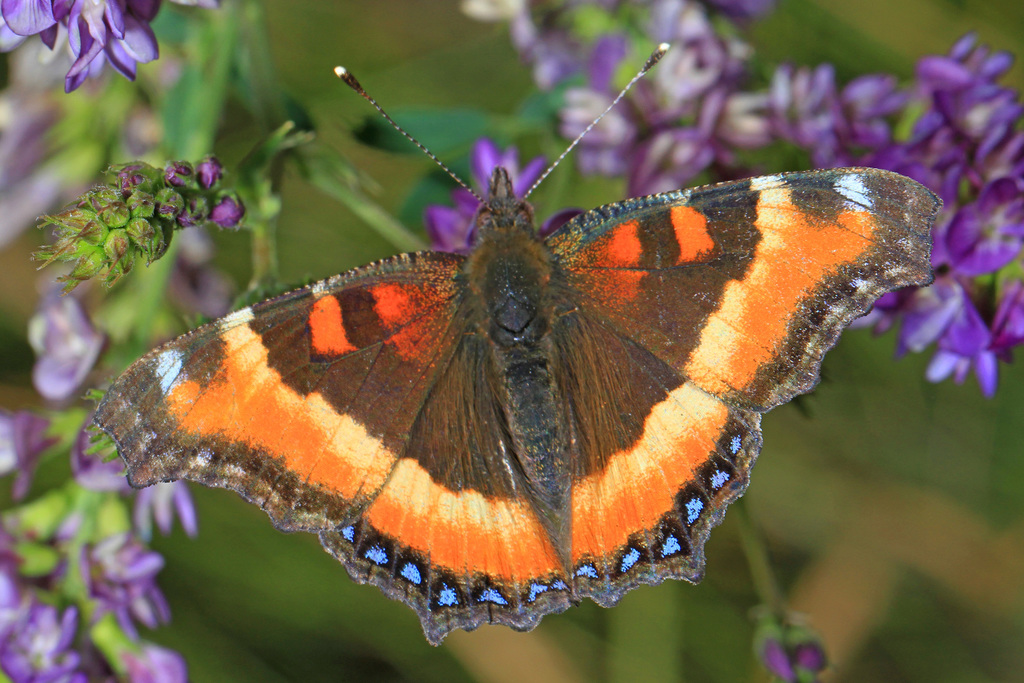
(c) Judy Gallagher, some rights reserved (CC BY-SA) · licence
Family: Nymphalidae · Class: Insecta · Order: Lepidoptera
Aglais milberti (Milbert's Tortoiseshell) is a California animal in the Nymphalidae family.
Milbert's Tortoiseshell is a medium-sized butterfly with distinctive orange and black wing patterns. Adults measure 45 to 60 mm (1.8 to 2.4 inches) in wingspan. The forewings display bright orange patches bordered by black margins, while the hindwings feature a broad orange band with blue spots along the outer edge. The undersides are mottled brown and gray, providing effective camouflage when wings are closed. Males and females appear similar, though females are typically slightly larger. The species can be distinguished from similar tortoiseshells by its smaller size and the prominent blue spotting on the hindwing margins. Milbert's Tortoiseshell has a broad distribution across boreal North America south of the taiga, ranging from southern Alaska south to California, Nevada, and New Mexico, and extending east to Newfoundland and West Virginia. In California, the species occurs primarily in the northern counties and mountainous regions, including the Sierra Nevada and Cascade Range. Populations are typically found at elevations from 1,200 to 3,000 meters (4,000 to 10,000 feet), though they occasionally occur at lower elevations in suitable habitat. The species inhabits open woodlands, meadows, stream corridors, and forest clearings where nettle plants are abundant. Adults are commonly observed in riparian zones, mountain meadows, and disturbed areas such as logging clearings and roadsides. The butterfly shows a strong association with areas containing its host plants and typically remains within several hundred meters of nettle patches. Habitat requirements include access to nectar sources such as asters, goldenrod, and other late-season wildflowers. Milbert's Tortoiseshell larvae feed exclusively on nettles, primarily stinging nettle (Urtica dioica) and tall nettle (U. procera). Females lay clusters of 50 to 200 yellowish eggs on the undersides of nettle leaves, typically in May through July depending on elevation and latitude. Larvae are gregarious in early instars, feeding together in silk webs before dispersing as they mature. The caterpillars are black with white spots and branched spines. The species produces one to two broods per year, with adults from the final brood overwintering in protected locations such as tree bark crevices, woodpiles, or buildings. Adults are strong fliers and exhibit territorial behavior, with males establishing perches on hilltops or along ridgelines to intercept females. The species demonstrates notable population fluctuations, with some years producing abundant numbers followed by periods of scarcity. Migration patterns have been documented, with some populations moving to lower elevations for overwintering. Milbert's Tortoiseshell is not federally or state-listed and appears to maintain stable populations across most of its range. However, local populations may face pressure from habitat modification, particularly the removal of nettle patches during land management activities. Climate change may affect the species' montane populations by altering the distribution of suitable habitat and host plants. The butterfly benefits from conservation of riparian corridors and maintenance of natural disturbance regimes that support nettle growth.
Classification
Class: Insecta · Order: Lepidoptera · Family: Nymphalidae
Frequently asked questions
How is Aglais milberti classified?
Aglais milberti belongs to class Insecta, order Lepidoptera, family Nymphalidae.
What family does Aglais milberti belong to?
Aglais milberti is in the Nymphalidae family.
What is Aglais milberti?
Milbert's Tortoiseshell is a medium-sized butterfly with distinctive orange and black wing patterns.
Is Aglais milberti found in California?
Yes. Aglais milberti is recorded in California in The California Species Project's catalogue.
Related species
Other California species in the same genus, family, or bioregion.
Data from The California Species Project — 14,000+ California species with verified data from CNPS, CDFW, USFWS, and more.