Aglossa cacamica
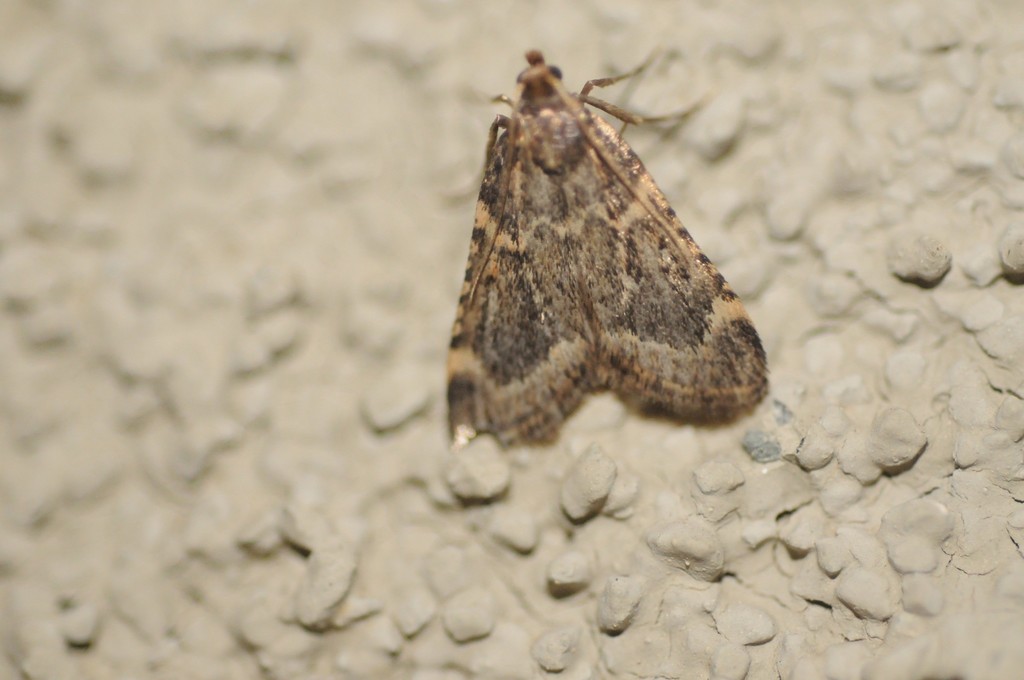
(c) Hawk T., some rights reserved (CC BY) · licence
Family: Pyralidae · Class: Insecta · Order: Lepidoptera
Aglossa cacamica is a California animal in the Pyralidae family.
Aglossa cacamica is a small moth in the family Pyralidae, a diverse group of pyralid moths commonly known as snout moths. Adults typically measure 12 to 20 mm in wingspan, with forewings displaying muted brown and gray coloration that provides effective camouflage. The forewings often exhibit subtle banding patterns and darker scaling along the wing margins. Like other members of the genus Aglossa, this species has relatively narrow wings and prominent labial palps that extend forward from the head, giving the characteristic snout-like appearance that defines the family. Aglossa cacamica occurs across a broad range of western North America, extending from southern Oregon southward through California and eastward to Utah and northern Arizona. In California, the species is distributed throughout much of the state, though specific county-level occurrence data remains limited in published literature. The geographic range encompasses diverse ecological zones from Mediterranean-climate regions to more arid intermountain areas. The habitat requirements of A. cacamica are closely tied to the presence of suitable microenvironments for larval development. Adults are found in areas supporting mammalian populations, particularly small rodents whose nesting activities create the specialized conditions required for reproduction. These habitats include oak woodlands, chaparral, mixed coniferous forests, and semi-arid shrublands where rodent populations maintain active burrow systems and nest sites. The larvae of Aglossa cacamica exhibit unusual ecological associations compared to many lepidopteran species. Rather than feeding on living plant material, larvae develop in association with vegetative detritus accumulated in rodent nests. This detritivorous behavior represents a specialized feeding strategy that takes advantage of the organic matter collected by small mammals for nest construction and food storage. The decomposing plant material provides both nutrition and shelter for developing larvae. Adult flight periods and reproductive timing likely correspond with peak rodent nesting activity, though specific seasonal patterns require further documentation. The species undergoes complete metamorphosis typical of Lepidoptera, with eggs laid in or near rodent nest sites where larvae can access appropriate food sources. Pupation presumably occurs within the nest environment or in adjacent soil. Adults are likely active during warmer months when both rodent activity and vegetation growth support optimal breeding conditions. No formal conservation status has been assigned to Aglossa cacamica at federal or state levels. The species appears to maintain stable populations across its range, benefiting from the widespread distribution of suitable rodent hosts. However, like many specialized species, A. cacamica could be vulnerable to habitat modifications that affect small mammal populations or alter the availability of appropriate nesting substrates. Urban development, intensive agriculture, and changes in fire regimes that influence rodent habitat quality represent potential long-term concerns. The species' dependence on healthy small mammal communities makes it an indirect indicator of ecosystem integrity in western North American habitats.
Classification
Class: Insecta · Order: Lepidoptera · Family: Pyralidae
Frequently asked questions
How is Aglossa cacamica classified?
Aglossa cacamica belongs to class Insecta, order Lepidoptera, family Pyralidae.
What family does Aglossa cacamica belong to?
Aglossa cacamica is in the Pyralidae family.
What is Aglossa cacamica?
Aglossa cacamica is a small moth in the family Pyralidae, a diverse group of pyralid moths commonly known as snout moths.
Is Aglossa cacamica found in California?
Yes. Aglossa cacamica is recorded in California in The California Species Project's catalogue.
Related species
Other California species in the same genus, family, or bioregion.
Data from The California Species Project — 14,000+ California species with verified data from CNPS, CDFW, USFWS, and more.