Aglossa pinguinalis
Large Tabby
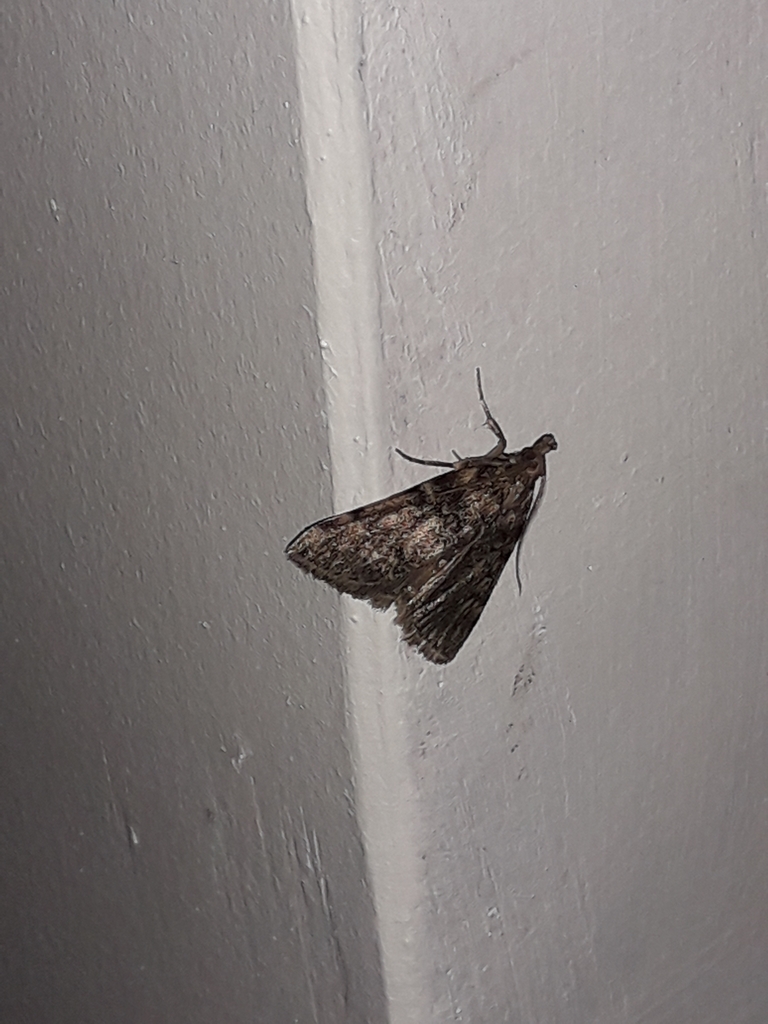
(c) Acer, some rights reserved (CC BY) · licence
Family: Pyralidae · Class: Insecta · Order: Lepidoptera
Aglossa pinguinalis (Large Tabby) is a California animal in the Pyralidae family.
The Large Tabby (Aglossa pinguinalis) is a small moth in the family Pyralidae, introduced to North America from Europe. Adults typically measure 12-16 mm in wingspan, with forewings displaying distinctive tabby-like markings of alternating light and dark brown bands. The hindwings are pale gray to whitish with darker veining. At rest, the moth holds its wings in a triangular tent-like position over the body. Introduced from Europe, the Large Tabby has established populations across much of North America. In California, the species occurs throughout suitable habitats from the coast to inland valleys. The moth has also been documented in other western states and provinces, with records from Alberta, Canada indicating its northern range extension (News of the Lepidopterists' Society 2010). The species appears to be expanding its North American distribution, with new regional records continuing to be documented. The Large Tabby inhabits diverse environments including urban areas, gardens, agricultural lands, and natural habitats where organic matter accumulates. Adults are commonly found around human structures, particularly areas with stored organic materials, compost, or decaying plant matter. The species shows considerable adaptability to various elevations and climate zones across its introduced range. Adults are primarily nocturnal and attracted to artificial lights. The species exhibits multiple generations per year in warmer climates, with flight periods extending from spring through fall. Larvae feed on decaying organic matter, including dried plant materials, stored grains, and organic debris. This detritivorous feeding behavior allows the species to thrive in human-modified environments. Females deposit eggs in clusters on suitable substrate, and larval development occurs within the organic matter where feeding takes place. The species overwinters in various life stages depending on local climate conditions. As an introduced species, the Large Tabby is not afforded special conservation status and is considered naturalized in North America. The moth appears to be well-established and potentially expanding its range, as evidenced by continuing documentation of new records in various regions. In some areas, including New York, the species has been included in Species of Greatest Conservation Need assessments, though this designation for introduced species typically reflects monitoring needs rather than conservation concern (BugGuide 2016). The species' ability to utilize human-modified habitats and diverse organic substrates has likely contributed to its successful establishment. Population trends suggest stability or potential increase across its introduced range, with no apparent conservation issues. The Large Tabby represents a successful example of lepidopteran establishment in North America, demonstrating the adaptability of certain European moth species to New World environments.
Classification
Class: Insecta · Order: Lepidoptera · Family: Pyralidae
Frequently asked questions
How is Aglossa pinguinalis classified?
Aglossa pinguinalis belongs to class Insecta, order Lepidoptera, family Pyralidae.
What family does Aglossa pinguinalis belong to?
Aglossa pinguinalis is in the Pyralidae family.
What is Aglossa pinguinalis?
The Large Tabby (Aglossa pinguinalis) is a small moth in the family Pyralidae, introduced to North America from Europe.
Is Aglossa pinguinalis found in California?
Yes. Aglossa pinguinalis is recorded in California in The California Species Project's catalogue.
Related species
Other California species in the same genus, family, or bioregion.
Data from The California Species Project — 14,000+ California species with verified data from CNPS, CDFW, USFWS, and more.