Agonopterix argillacea
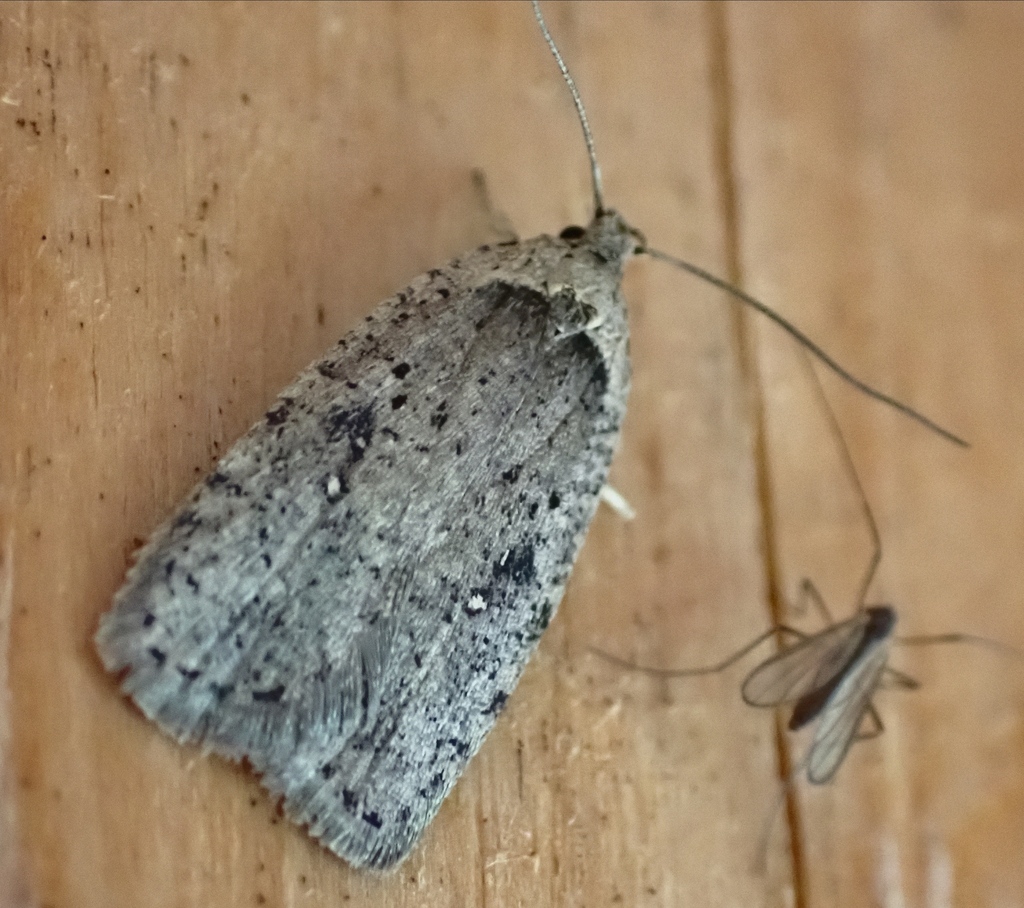
no rights reserved · CC0
Family: Depressariidae · Class: Insecta · Order: Lepidoptera
Agonopterix argillacea is a California animal in the Depressariidae family.
Agonopterix argillacea is a small moth in the family Depressariidae, representing one of the lesser-documented members of the genus Agonopterix in North America. Adult moths typically measure 8 to 12 millimeters (0.31 to 0.47 inches) in wingspan, with forewings displaying a mottled pattern of gray and brown scales that gives the species its name, as 'argillacea' refers to clay-like coloration. The forewings are elongated and narrow, characteristic of the Depressariidae family, with indistinct darker markings along the costa and dorsum. The hindwings are pale gray to white with reduced venation and long fringe scales along the margins. The current distribution of Agonopterix argillacea in California remains poorly documented, with limited collection records available in entomological databases. The species appears to have a restricted range within the state, though specific county-level distribution data is insufficient for precise mapping. Historical records suggest occurrence in coastal and montane regions, but comprehensive surveys are needed to establish current population boundaries. Habitat requirements for A. argillacea are not well-established due to limited ecological research. Based on congeners in the genus Agonopterix, the species likely inhabits areas supporting its larval host plants, which typically include members of the Apiaceae (carrot family) or Rosaceae (rose family). Adults are presumably active during evening and nighttime hours, attracted to artificial light sources as observed in related species. The species likely occupies habitats ranging from sea level to moderate elevations, though specific elevation ranges have not been documented. Larval development of Agonopterix argillacea follows the typical pattern of related species, with caterpillars feeding within folded leaves, leaf mines, or stem galleries of host plants. The life cycle likely includes overwintering as pupae or late-instar larvae, with adult emergence occurring in spring or early summer months. Females presumably deposit eggs on or near host plant foliage, though specific oviposition behavior has not been studied. Adults likely feed on nectar from various flowering plants, contributing to pollination services within their ecosystem. Conservation status for Agonopterix argillacea remains undetermined due to insufficient population data and limited taxonomic research. The species lacks federal or state conservation listing status, and global population trends are unknown. Primary conservation concerns for this and related microlepidoptera include habitat loss from urban development, agricultural conversion, and potential climate change impacts on host plant distributions. The species' apparent rarity in collections may reflect either genuine scarcity, cryptic behavior patterns, or inadequate survey efforts targeting small moths. Comprehensive biological surveys and taxonomic research are needed to assess population status and conservation needs. Without baseline population data, it is difficult to implement effective conservation strategies for this poorly known species.
Classification
Class: Insecta · Order: Lepidoptera · Family: Depressariidae
Frequently asked questions
How is Agonopterix argillacea classified?
Agonopterix argillacea belongs to class Insecta, order Lepidoptera, family Depressariidae.
What family does Agonopterix argillacea belong to?
Agonopterix argillacea is in the Depressariidae family.
What is Agonopterix argillacea?
Agonopterix argillacea is a small moth in the family Depressariidae, representing one of the lesser-documented members of the genus Agonopterix in North America.
Is Agonopterix argillacea found in California?
Yes. Agonopterix argillacea is recorded in California in The California Species Project's catalogue.
Related species
Other California species in the same genus, family, or bioregion.
Data from The California Species Project — 14,000+ California species with verified data from CNPS, CDFW, USFWS, and more.