Agonopterix chrautis
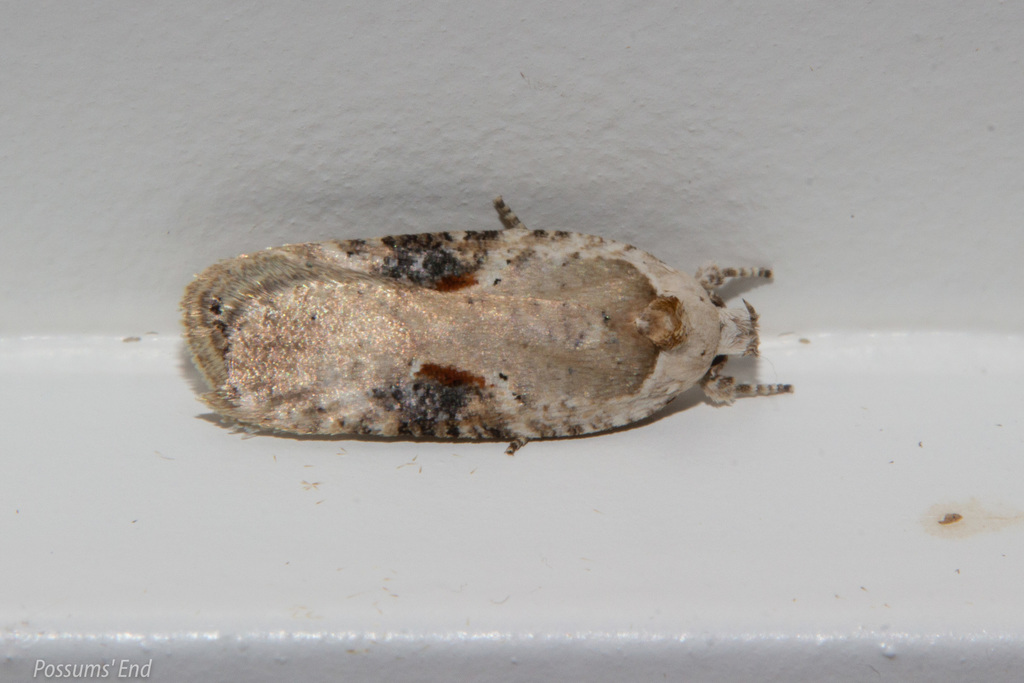
(c) Possums' End, some rights reserved (CC BY) · licence
Family: Depressariidae · Class: Insecta · Order: Lepidoptera
Agonopterix chrautis is a California animal in the Depressariidae family.
Agonopterix chrautis is a small moth in the family Depressariidae (formerly placed in Elachistidae), belonging to a genus of microlepidoptera commonly known as flat-bodied moths. Adults typically measure 8 to 12 mm in wingspan, with narrow forewings and reduced hindwings characteristic of the family. The forewings are generally pale brown to grayish-brown with subtle darker markings, though specific coloration patterns for this species require further taxonomic verification. Like other Agonopterix species, the moths have a flattened appearance when at rest, with wings held close to the body. The distribution and range of Agonopterix chrautis in California remains poorly documented in available literature. The genus Agonopterix contains numerous species distributed across North America, with several species recorded from California's diverse ecosystems. However, specific locality records and county-level distribution data for A. chrautis are not readily available in current taxonomic databases, suggesting this species may be either rarely collected, recently described, or represents a taxonomic entity requiring further study. Habitat preferences for Agonopterix chrautis cannot be definitively stated without additional field data. Other members of the genus typically inhabit areas where their host plants occur, ranging from coastal scrublands to montane forests depending on the species. Many Agonopterix moths are associated with plants in families such as Apiaceae, Asteraceae, and Rosaceae, developing as leaf miners or external feeders during their larval stage. The life history and ecological behavior of A. chrautis follows the general pattern typical of Agonopterix moths. Larvae likely feed on specific host plants, either as leaf miners creating characteristic feeding galleries or as external feeders on foliage. Adult moths are generally nocturnal and may be attracted to artificial lights. Flight periods vary among Agonopterix species but often correspond with host plant phenology and local climatic conditions. Reproductive behavior typically involves pheromone-mediated mate location, with females depositing eggs on or near suitable host plants. The conservation status of Agonopterix chrautis is not established due to limited distributional and ecological data. The species is not listed under federal or California state endangered species legislation, nor does it appear in global conservation databases as of December 2025. The primary challenge in assessing conservation needs lies in the fundamental lack of biological and distributional information. Many microlepidoptera species remain understudied, with population trends and habitat requirements poorly understood. If present in California, potential threats could include habitat loss from urban development, agricultural conversion, or climate change impacts on host plant distributions. Comprehensive surveys focusing on Agonopterix diversity and systematic revision of the genus would be necessary to establish the taxonomic validity, distribution, and conservation status of A. chrautis.
Classification
Class: Insecta · Order: Lepidoptera · Family: Depressariidae
Frequently asked questions
How is Agonopterix chrautis classified?
Agonopterix chrautis belongs to class Insecta, order Lepidoptera, family Depressariidae.
What family does Agonopterix chrautis belong to?
Agonopterix chrautis is in the Depressariidae family.
What is Agonopterix chrautis?
Agonopterix chrautis is a small moth in the family Depressariidae (formerly placed in Elachistidae), belonging to a genus of microlepidoptera commonly known as flat-bodied moths.
Is Agonopterix chrautis found in California?
Yes. Agonopterix chrautis is recorded in California in The California Species Project's catalogue.
Related species
Other California species in the same genus, family, or bioregion.
Data from The California Species Project — 14,000+ California species with verified data from CNPS, CDFW, USFWS, and more.