Agriphila attenuatus
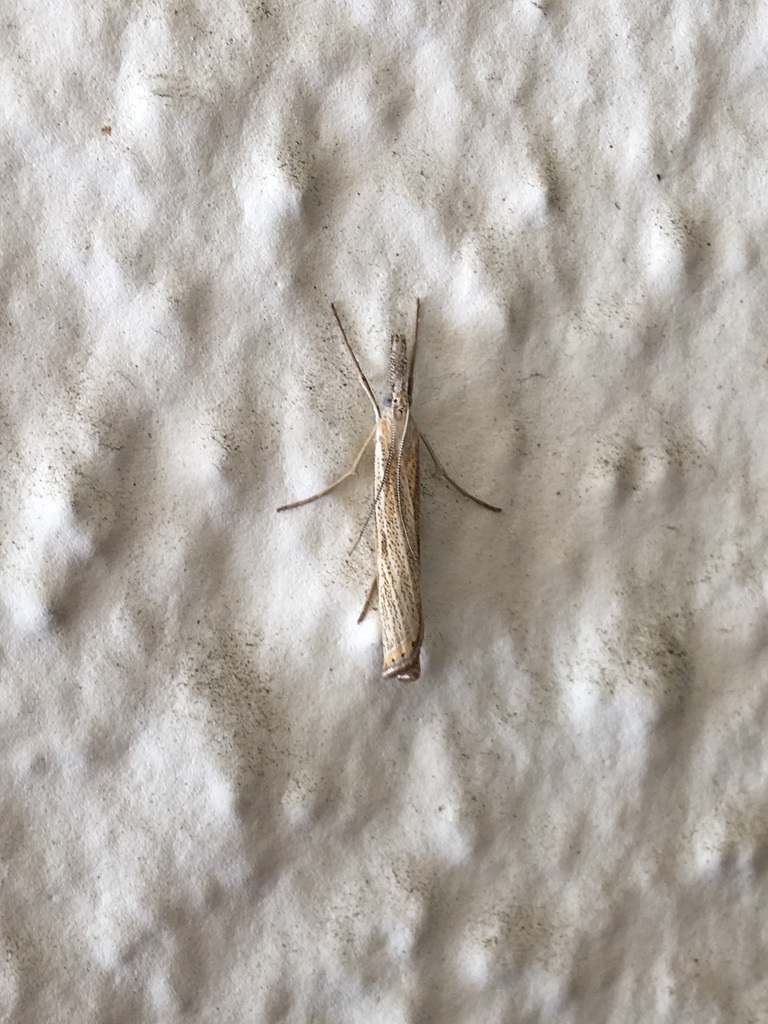
(c) lazarus, some rights reserved (CC BY) · licence
Family: Crambidae · Class: Insecta · Order: Lepidoptera
Agriphila attenuatus is a California animal in the Crambidae family.
Agriphila attenuatus is a species of grass moth in the family Crambidae, subfamily Crambinae. This small moth belongs to a genus of narrow-winged grass moths that are typically associated with grassland habitats throughout North America. Adults display the characteristic elongated, narrow forewings typical of the genus, with wingspan measurements generally ranging from 18 to 25 mm. The forewings are typically pale brown to grayish-brown with subtle darker markings and streaking patterns along the wing veins. The hindwings are lighter, often whitish to pale gray, with reduced markings compared to the forewings. The moth's slender body and narrow wing profile distinguish it from broader-winged moth families. The species occurs across western North America, with documented populations in California, Oregon, Washington, and extending into British Columbia. In California, Agriphila attenuatus has been recorded from various counties, though specific distribution data remains limited due to the challenges of identifying and surveying small moth species. The species appears to favor areas with native grass communities and may occur at various elevations from sea level to montane zones. Agriphila attenuatus inhabits grasslands, prairies, and open areas dominated by grasses and herbaceous plants. Like other members of its genus, this species is closely associated with grass communities where larvae develop. The moths are typically found in areas with native bunch grasses, meadows, and grassland edges. Habitat requirements include areas with appropriate host grass species and relatively undisturbed ground cover where larvae can complete development. Adult moths are primarily nocturnal and are attracted to artificial lights during their flight period. The species likely has one generation per year, with adults emerging during summer months, typically from June through August, though specific flight times may vary with elevation and local climate conditions. Larvae are grass feeders, developing within grass stems or at the base of grass clumps, feeding on root systems and lower stem portions. Females deposit eggs on or near host grass species, and larvae overwinter in the larval stage, pupating in spring before adult emergence. Agriphila attenuatus does not currently hold federal or state conservation status listings. However, like many grassland-associated species, it may face habitat pressures from grassland conversion, urban development, and changes in land management practices. Native grassland ecosystems in California have experienced significant reduction and fragmentation, which could affect populations of specialized grass moths. The species' conservation status would benefit from additional survey work to better understand its current distribution and population trends across its range. Maintaining native grassland habitats and appropriate grazing or fire management regimes would support populations of this and other grassland-dependent moth species.
Classification
Class: Insecta · Order: Lepidoptera · Family: Crambidae
Frequently asked questions
How is Agriphila attenuatus classified?
Agriphila attenuatus belongs to class Insecta, order Lepidoptera, family Crambidae.
What family does Agriphila attenuatus belong to?
Agriphila attenuatus is in the Crambidae family.
What is Agriphila attenuatus?
Agriphila attenuatus is a species of grass moth in the family Crambidae, subfamily Crambinae.
Is Agriphila attenuatus found in California?
Yes. Agriphila attenuatus is recorded in California in The California Species Project's catalogue.
Related species
Other California species in the same genus, family, or bioregion.
Data from The California Species Project — 14,000+ California species with verified data from CNPS, CDFW, USFWS, and more.