Agrius cingulata
Pink-spotted hawkmoth
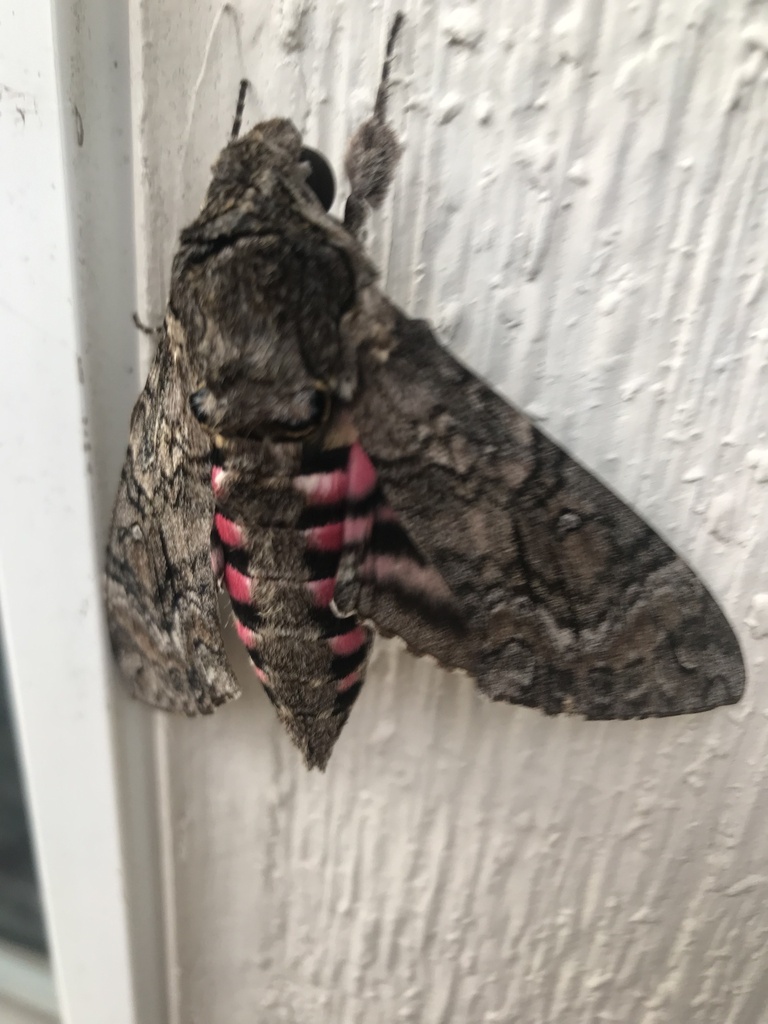
(c) RockCollector, some rights reserved (CC BY) · licence
Family: Sphingidae · Class: Insecta · Order: Lepidoptera
Agrius cingulata (Pink-spotted hawkmoth) is a California animal in the Sphingidae family.
The pink-spotted hawkmoth is a large sphinx moth with a wingspan ranging from 95 to 120 millimeters (3.7 to 4.7 inches). The forewings are mottled gray and brown with intricate patterns that provide effective camouflage against tree bark. The hindwings are gray with distinctive pink or rose-colored bands, which give the species its common name. The abdomen displays alternating pink and dark gray or black bands in a checkered pattern. Adults have a robust body typical of hawkmoths, with a prominent proboscis that can extend up to 100 millimeters to reach nectar deep within tubular flowers. The pink-spotted hawkmoth has an extensive range from Argentina north through Central America, Mexico, and the Caribbean to the southeastern United States, Texas, southern New Mexico, Arizona, and southern California. The species regularly strays northward during summer months, with documented occurrences reaching British Columbia, Colorado, Michigan, and Maine. In California, populations are primarily found in the southern regions, with the species becoming increasingly rare northward. This hawkmoth inhabits a variety of environments including agricultural areas, gardens, desert regions, and disturbed habitats where host plants occur. The species shows strong adaptability to human-modified landscapes and thrives in areas with abundant flowering plants for nectar sources. Adults are most commonly encountered from sea level to moderate elevations, typically below 1,500 meters. Pink-spotted hawkmoths are primarily crepuscular and nocturnal, becoming active at dusk to feed on nectar from deep-throated flowers. Adults are strong fliers capable of hovering while feeding, similar to hummingbirds. The larvae, known as hornworms, feed exclusively on plants in the morning glory family, with sweet potato (Ipomoea batatas) and jimsonweed (Datura) serving as primary hosts. Caterpillars can reach lengths of 100 millimeters and are typically green with diagonal white stripes and a prominent horn at the posterior end. When disturbed, mature larvae may rear up and click their mandibles as a defensive behavior. The species produces multiple generations per year in warmer climates, with continuous breeding possible in southern regions. Females deposit eggs singly on host plant leaves, with larvae developing through five instars before pupating in underground chambers. Adults emerge after 15 to 30 days, depending on temperature conditions. The pink-spotted hawkmoth is not federally or state listed and appears to maintain stable populations throughout most of its range. The species benefits from agricultural cultivation of sweet potato and the widespread distribution of naturalized Datura species. Climate change may potentially expand the northern limits of the species' breeding range as temperatures increase. Primary threats are minimal but may include pesticide applications in agricultural areas and habitat loss in some regions.
Classification
Class: Insecta · Order: Lepidoptera · Family: Sphingidae
Frequently asked questions
How is Agrius cingulata classified?
Agrius cingulata belongs to class Insecta, order Lepidoptera, family Sphingidae.
What family does Agrius cingulata belong to?
Agrius cingulata is in the Sphingidae family.
What is Agrius cingulata?
The pink-spotted hawkmoth is a large sphinx moth with a wingspan ranging from 95 to 120 millimeters (3.7 to 4.7 inches).
Is Agrius cingulata found in California?
Yes. Agrius cingulata is recorded in California in The California Species Project's catalogue.
Related species
Other California species in the same genus, family, or bioregion.
Data from The California Species Project — 14,000+ California species with verified data from CNPS, CDFW, USFWS, and more.