Agrotis ipsilon
Ipsilon Dart Moth
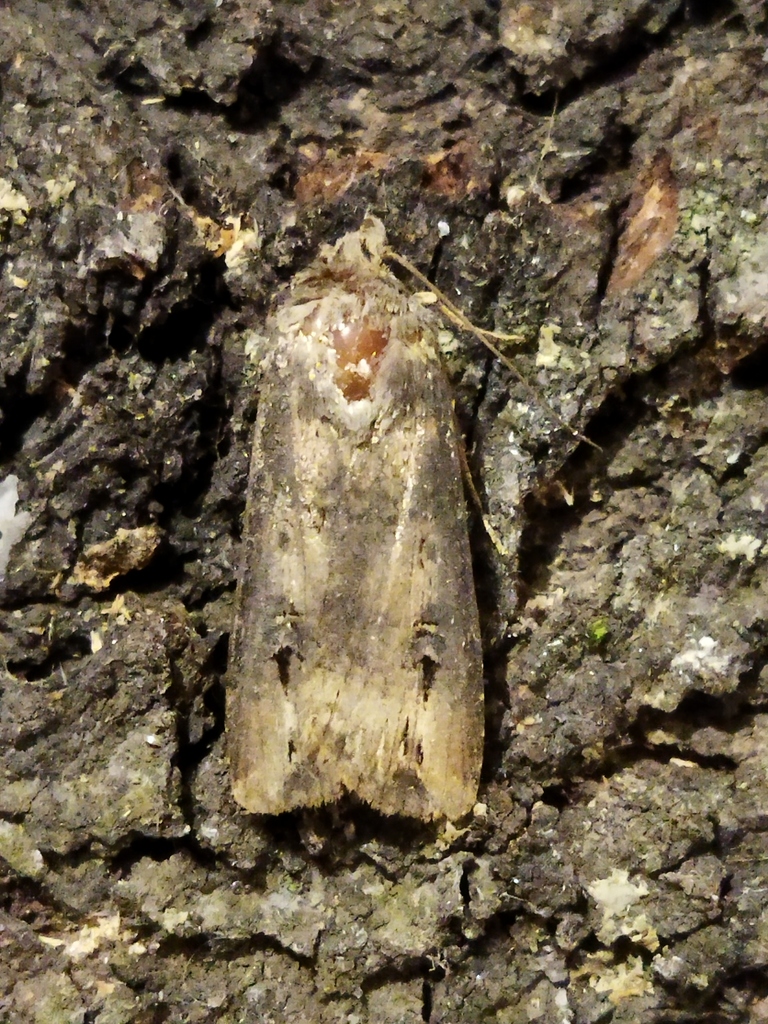
(c) SteveM4560, some rights reserved (CC BY) · licence
Family: Noctuidae · Class: Insecta · Order: Lepidoptera
Agrotis ipsilon (Ipsilon Dart Moth) is a California animal in the Noctuidae family.
The Ipsilon Dart Moth (Agrotis ipsilon) is a medium-sized noctuid moth with forewings measuring 15-20 mm (0.6-0.8 inches) in length. The forewings are typically grayish-brown to dark brown with distinctive markings including a pale-outlined kidney-shaped reniform spot and a dark, dagger-like claviform spot that gives the species its common name. The hindwings are pale gray to white with darker veining and a dark marginal band. Males possess feathery antennae, while females have thread-like antennae. The species exhibits considerable color variation, with some individuals displaying lighter tan or reddish-brown coloration. The Ipsilon Dart Moth has one of the most extensive distributions of any moth species globally, occurring on every continent except Antarctica. In California, the species is found throughout the state from sea level to montane elevations, including the Central Valley, coastal regions, desert areas, and mountain ranges up to approximately 2,400 meters (7,900 feet) elevation. The moth occurs year-round in warmer areas of the state but is most active during spring and fall months. This highly adaptable species inhabits diverse environments including agricultural fields, gardens, grasslands, chaparral, desert scrub, and disturbed areas. Adults are attracted to artificial lights and are commonly encountered in urban and suburban settings. The species thrives in areas with abundant herbaceous vegetation and shows particular association with agricultural landscapes where host plants are cultivated. Adult moths are nocturnal and feed on nectar from various flowers including clover, alfalfa, and other composite plants. The species is multivoltine, producing multiple generations per year in favorable climates. Females lay eggs singly or in small clusters on soil or low vegetation. Larvae, known as black cutworms, are polyphagous and feed on roots, stems, and foliage of numerous plant families including grasses, legumes, crucifers, and solanaceous crops. The caterpillars are notable agricultural pests, particularly damaging to corn, soybeans, cotton, and vegetable crops. They exhibit characteristic behavior of cutting plant stems at soil level, hence the name 'cutworms.' Pupation occurs in earthen cells 5-10 cm below the soil surface. Development time varies with temperature, ranging from 30-60 days from egg to adult. The Ipsilon Dart Moth is not listed under state or federal endangered species legislation and maintains stable populations throughout its range. The species' cosmopolitan distribution and adaptability to human-modified environments have contributed to its conservation security. Climate change may actually benefit this species by expanding suitable habitat in northern latitudes and higher elevations. However, the moth's status as an agricultural pest results in regular control efforts using insecticides and integrated pest management strategies. No specific conservation measures are needed for this widespread and abundant species, though sustainable agricultural practices can help maintain ecological balance in farming systems where the moth occurs.
Classification
Class: Insecta · Order: Lepidoptera · Family: Noctuidae
Frequently asked questions
How is Agrotis ipsilon classified?
Agrotis ipsilon belongs to class Insecta, order Lepidoptera, family Noctuidae.
What family does Agrotis ipsilon belong to?
Agrotis ipsilon is in the Noctuidae family.
What is Agrotis ipsilon?
The Ipsilon Dart Moth (Agrotis ipsilon) is a medium-sized noctuid moth with forewings measuring 15-20 mm (0.6-0.8 inches) in length.
Is Agrotis ipsilon found in California?
Yes. Agrotis ipsilon is recorded in California in The California Species Project's catalogue.
Related species
Other California species in the same genus, family, or bioregion.
Data from The California Species Project — 14,000+ California species with verified data from CNPS, CDFW, USFWS, and more.