Agrotis vancouverensis
Vancouver Dart Moth
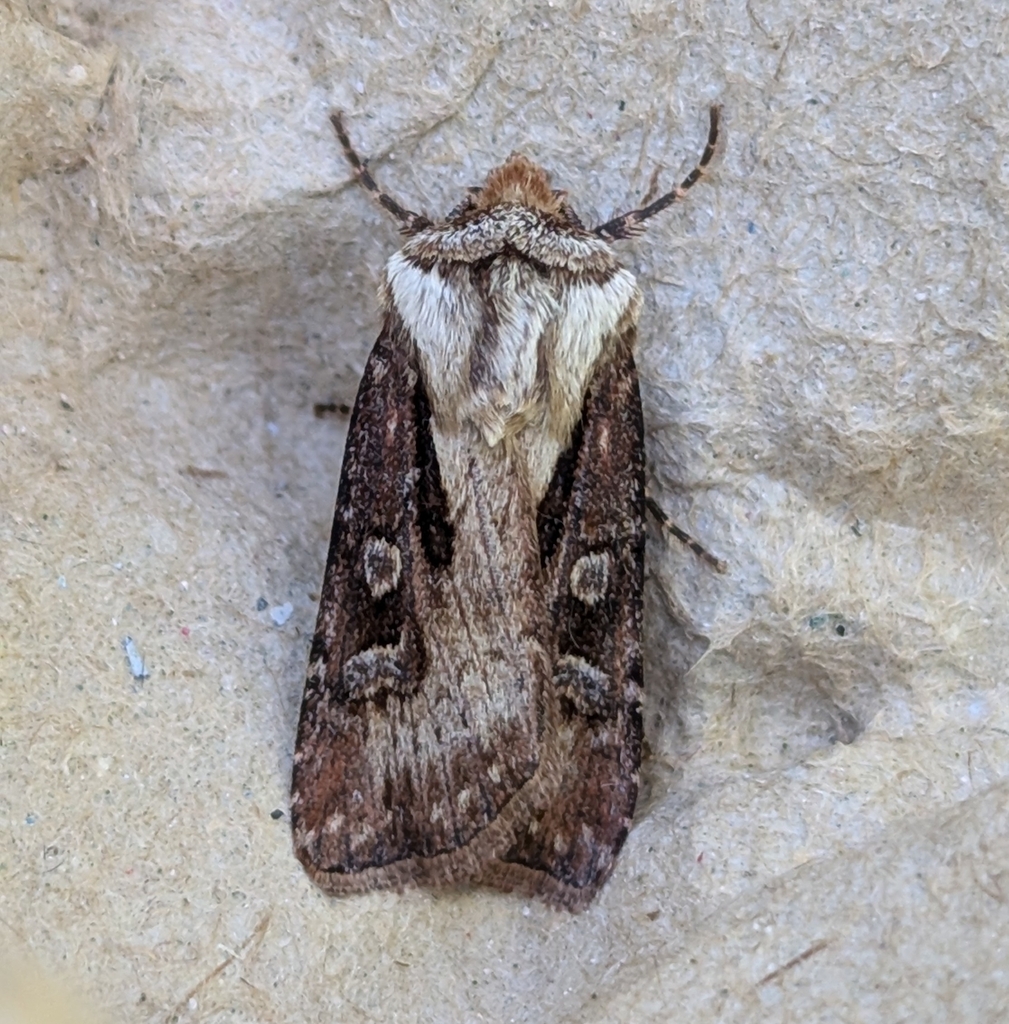
no rights reserved · CC0
Family: Noctuidae · Class: Insecta · Order: Lepidoptera
Agrotis vancouverensis (Vancouver Dart Moth) is a California animal in the Noctuidae family.
The Vancouver Dart Moth is a medium-sized noctuid moth with forewings measuring 13 to 17 mm in length (BugGuide). Adults belong to the diverse family Noctuidae, commonly known as owlet moths or cutworm moths, within the subfamily Noctuinae. The species exhibits the typical robust body structure characteristic of dart moths, with cryptic coloration patterns that provide camouflage during daytime resting periods. Larvae display distinctive gray coloration with diffuse dark oval or diamond-shaped patches on the dorsum of each body segment. A dark gray subdorsal line runs along the body, accompanied by dark gray shading speckled with white along the sides. The spiracles and cervical shield are black, while the head is closely infuscated with black coloration, including both submedial arcs and a close reticulation pattern (BugGuide). Agrotis vancouverensis occurs across a broad geographic range extending from Yukon Territory south through western North America to southern California, with populations documented in eastern Arizona's White Mountains and northern New Mexico (BugGuide). This extensive distribution spans multiple biogeographic zones and elevation gradients, indicating the species' adaptability to diverse environmental conditions. The species inhabits boreal forests and can be found at elevations up to 12,000 feet (3,658 meters) (BugGuide). This high-elevation tolerance suggests adaptation to cooler temperatures and shorter growing seasons typical of montane environments. The moth's habitat preferences align with the distribution of its host plants and the availability of suitable microenvironments for larval development. Vancouver Dart Moths typically fly during May and June in most of their range, with flight periods extending later into July and August in the Sierra Nevada and Rocky Mountains (BugGuide). This phenological variation likely reflects adaptation to local climatic conditions and elevation-dependent temperature regimes. The extended flight period at higher elevations corresponds to delayed snowmelt and shorter growing seasons in montane environments. Larvae feed on low herbaceous plants including clover species (Trifolium) and strawberry plants (Fragaria), as well as grasses in the family Poaceae (BugGuide). This generalist feeding behavior on both forbs and graminoids provides flexibility in habitat utilization and may contribute to the species' wide geographic distribution. The preference for low-growing plants is typical of many cutworm species, whose larvae often feed at ground level. Conservation status information for Agrotis vancouverensis is not well documented in available databases. The species lacks federal or state conservation listings, suggesting populations are considered stable across its range. However, like many high-elevation species, Vancouver Dart Moths may face potential challenges from climate change impacts on montane ecosystems, including shifts in temperature regimes and precipitation patterns that could affect both adult flight periods and host plant availability.
Classification
Class: Insecta · Order: Lepidoptera · Family: Noctuidae
Frequently asked questions
How is Agrotis vancouverensis classified?
Agrotis vancouverensis belongs to class Insecta, order Lepidoptera, family Noctuidae.
What family does Agrotis vancouverensis belong to?
Agrotis vancouverensis is in the Noctuidae family.
What is Agrotis vancouverensis?
The Vancouver Dart Moth is a medium-sized noctuid moth with forewings measuring 13 to 17 mm in length (BugGuide).
Is Agrotis vancouverensis found in California?
Yes. Agrotis vancouverensis is recorded in California in The California Species Project's catalogue.
Related species
Other California species in the same genus, family, or bioregion.
Data from The California Species Project — 14,000+ California species with verified data from CNPS, CDFW, USFWS, and more.