Aimophila ruficeps
Rufous-crowned Sparrow
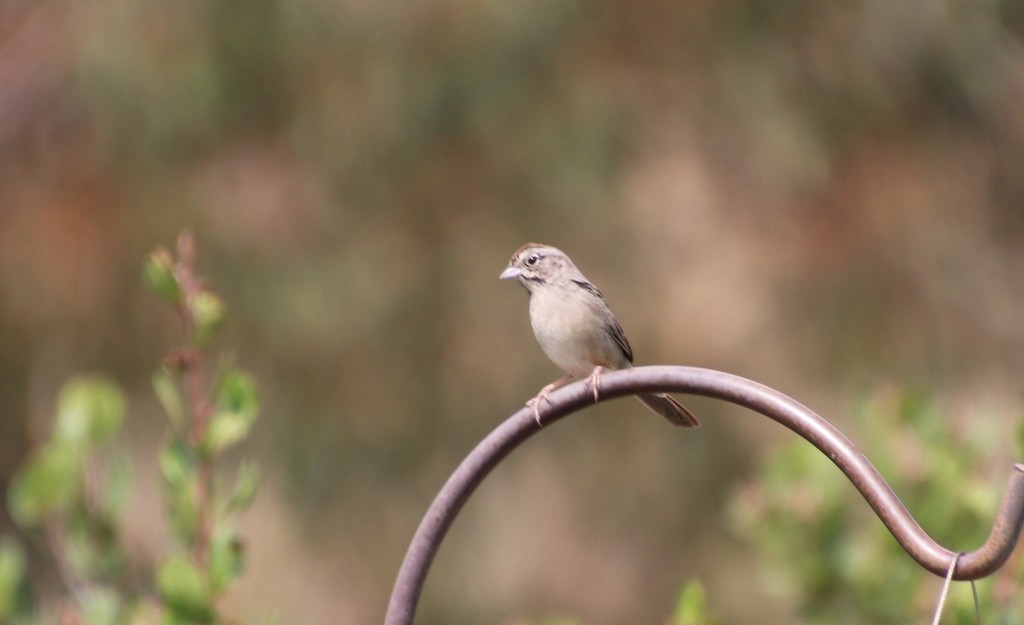
(c) Millie Basden, some rights reserved (CC BY) · licence
Family: Passerellidae · Class: Aves · Order: Passeriformes
Aimophila ruficeps (Rufous-crowned Sparrow) is a California animal in the Passerellidae family.
The Rufous-crowned Sparrow (Aimophila ruficeps) is a medium-sized, round-tailed sparrow with distinctive rusty crown coloration. Adults measure approximately 13-15 cm (5.1-5.9 inches) in length. Sexes are similar in coloration, though males are slightly larger than females. The species displays a rusty-red crown that contrasts with grayish-brown upperparts. The face shows a distinctive pattern with a whitish eyering and a dark malar stripe. Underparts are grayish-white with subtle streaking on the flanks. Rufous-crowned Sparrows are resident throughout much of California, occurring from Mendocino and Glenn Counties south through coastal slopes, foothills, and interior valleys of the Coast, Transverse, and Peninsular Ranges (Birds of the World). The species extends from sea level to elevations approaching 3,000 meters. Multiple subspecies occur within California, including the Southern California Rufous-crowned Sparrow (A. r. canescens), the Santa Cruz Rufous-crowned Sparrow (A. r. obscura) which is endemic to Santa Cruz and Anacapa Islands, and the Yuma Rufous-crowned Sparrow (A. r. rupicola). This species inhabits semiarid grassy shrublands and open woodlands, showing a strong preference for moderate to steep grassy and rocky hillsides and canyons (Birds of the World). Typical habitat includes chaparral, coastal sage scrub, and oak woodland edges with scattered rock outcrops and open areas. The species requires a mosaic of shrub cover for nesting and open grassy areas for foraging. Territory size varies with habitat quality but typically ranges from 0.5 to 2.0 hectares. Rufous-crowned Sparrows are primarily ground-foraging granivores, feeding on seeds of grasses and forbs. During breeding season, they supplement their diet with insects, particularly when feeding nestlings. The species is largely sedentary, maintaining territories year-round. Breeding occurs from March through August, with peak activity from April to June. Clutch size ranges from 2-5 eggs, typically 3-4, with incubation performed by the female for 12-13 days (NatureServe Explorer). Altricial nestlings are tended by both parents for approximately 9-11 days in the nest and continue to receive parental care for several weeks post-fledging. Cup nests are typically constructed in shrubs 0.3-2.0 meters above ground, often well-concealed in dense vegetation. While the species as a whole is not federally listed, several subspecies face conservation concerns due to habitat loss and fragmentation. The Southern California subspecies has experienced population declines due to urban development, fire suppression leading to habitat changes, and invasive plant species. Management recommendations emphasize protecting larger, interconnected blocks of open coastal sage scrub and chaparral habitat (Birds of the World). The Santa Cruz Island subspecies faces additional challenges from past overgrazing, though habitat restoration efforts are ongoing. Fire management that maintains the natural mosaic of shrub and grassland habitats is critical for long-term population viability across the species' range.
Classification
Class: Aves · Order: Passeriformes · Family: Passerellidae
Frequently asked questions
How is Aimophila ruficeps classified?
Aimophila ruficeps belongs to class Aves, order Passeriformes, family Passerellidae.
What family does Aimophila ruficeps belong to?
Aimophila ruficeps is in the Passerellidae family.
What is Aimophila ruficeps?
The Rufous-crowned Sparrow (Aimophila ruficeps) is a medium-sized, round-tailed sparrow with distinctive rusty crown coloration.
Is Aimophila ruficeps found in California?
Yes. Aimophila ruficeps is recorded in California in The California Species Project's catalogue.
Related species
Other California species in the same genus, family, or bioregion.
Data from The California Species Project — 14,000+ California species with verified data from CNPS, CDFW, USFWS, and more.