Aimophila ruficeps canescens
Southern California Rufous- Crowned Sparrow
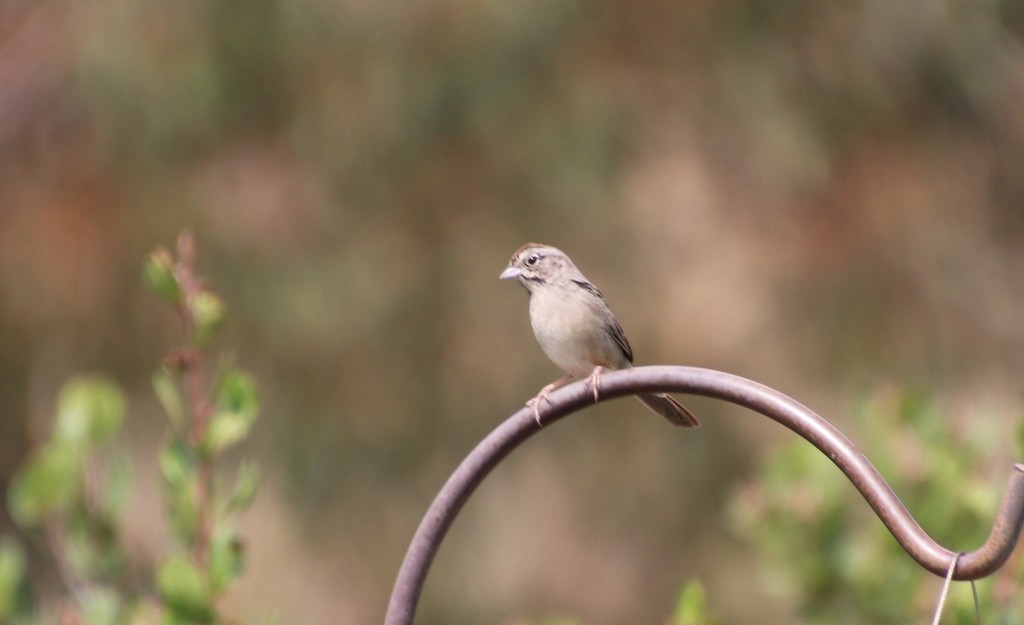
(c) Millie Basden, some rights reserved (CC BY) · licence
Family: Passerellidae · Class: Aves · Order: Passeriformes
Conservation status: G5T3 S4
Aimophila ruficeps canescens (Southern California Rufous- Crowned Sparrow) is a California animal in the Passerellidae family.
The Southern California Rufous-crowned Sparrow (Aimophila ruficeps canescens) is a medium-sized sparrow subspecies endemic to southern California's coastal and interior regions. Adults measure approximately 14-15 cm (5.5-5.9 inches) in length with a distinctive rufous crown that contrasts with gray-brown upperparts and pale underparts. The face shows a prominent white eyebrow stripe and dark eyeline, while the back displays subtle streaking. The tail is relatively long and rounded, and the bill is conical and well-adapted for seed consumption. This subspecies occurs as a resident from Mendocino and Glenn Counties south through coastal slopes, foothills, and interior valleys of the Coast, Transverse, and Peninsular Ranges (Birds of the World). The range extends from sea level to elevations approaching 3,000 meters, encompassing much of central and southern California's Mediterranean climate regions. Populations are distributed across fragmented habitat patches throughout this extensive range. Southern California Rufous-crowned Sparrows inhabit semiarid grassy shrublands and open woodlands on moderate to steep grassy and rocky hillsides and canyons (Birds of the World). Preferred habitats include coastal sage scrub, chaparral edges, and oak woodland margins with scattered shrubs and herbaceous openings. The species requires areas with both shrub cover for nesting and foraging and open ground for seed collection. Habitat connectivity is crucial for maintaining viable populations across the fragmented landscape. Behaviorally, these sparrows are primarily granivorous, feeding on seeds of grasses and forbs collected from the ground surface. They also consume insects, particularly during the breeding season when protein requirements increase. Clutch size ranges from 2-5 eggs, typically 3-4, with incubation performed exclusively by females (NatureServe). Altricial nestlings are tended by both parents until fledging. Nests are typically placed in shrubs or low trees, constructed as open cups of grasses, rootlets, and other fine materials. The species exhibits strong site fidelity and may attempt multiple broods per season under favorable conditions. The subspecies carries a Global Rank of G5T3, indicating the full species is secure globally but this particular subspecies is vulnerable to extinction. It receives a State Rank of S4 in California, suggesting it is apparently secure but may be cause for long-term concern. Primary conservation concerns include habitat fragmentation and loss due to urban development, fire suppression leading to habitat succession, and invasive plant species altering native plant communities. Management recommendations emphasize protecting larger, interconnected blocks of open coastal sage scrub and chaparral habitats (Birds of the World). The species is included in various regional conservation plans, including Multiple Species Conservation Programs, which aim to maintain habitat connectivity and population viability across its fragmented range. Fire management that maintains natural disturbance regimes while preventing catastrophic burns is essential for long-term habitat maintenance.
Classification
Class: Aves · Order: Passeriformes · Family: Passerellidae
Conservation status
G5T3 S4
Frequently asked questions
How is Aimophila ruficeps canescens classified?
Aimophila ruficeps canescens belongs to class Aves, order Passeriformes, family Passerellidae.
What family does Aimophila ruficeps canescens belong to?
Aimophila ruficeps canescens is in the Passerellidae family.
Is Aimophila ruficeps canescens protected or of conservation concern?
Aimophila ruficeps canescens carries the following status: G5T3 S4.
What is Aimophila ruficeps canescens?
The Southern California Rufous-crowned Sparrow (Aimophila ruficeps canescens) is a medium-sized sparrow subspecies endemic to southern California's coastal and interior regions.
Is Aimophila ruficeps canescens found in California?
Yes. Aimophila ruficeps canescens is recorded in California in The California Species Project's catalogue.
Related species
Other California species in the same genus, family, or bioregion.
Data from The California Species Project — 14,000+ California species with verified data from CNPS, CDFW, USFWS, and more.