Aimophila ruficeps ssp. obscura
Santa Cruz Island rufous-crowned sparrow
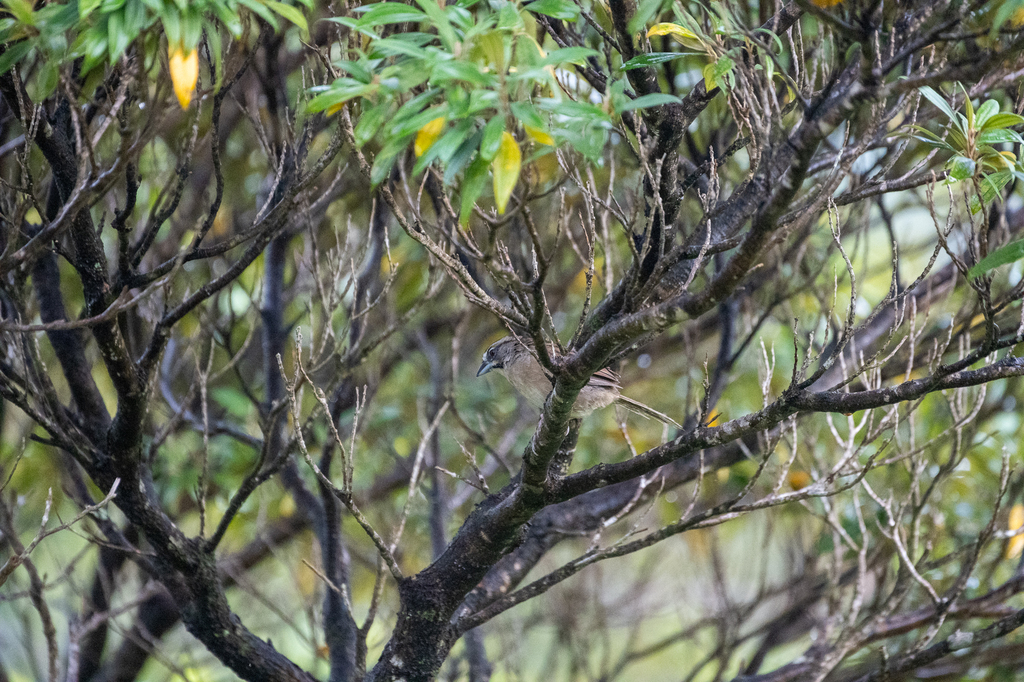
(c) Richard Littauer, some rights reserved (CC BY) · licence
Family: Passerellidae · Class: Aves · Order: Passeriformes
Conservation status: G5T2T3 S2S3
Aimophila ruficeps ssp. obscura (Santa Cruz Island rufous-crowned sparrow) is a California animal in the Passerellidae family.
The Santa Cruz Island rufous-crowned sparrow (Aimophila ruficeps ssp. obscura) is a geographically isolated subspecies of the rufous-crowned sparrow endemic to Santa Cruz Island, California. This medium-sized passerine measures approximately 13-15 cm (5.1-5.9 inches) in length with a wingspan of 18-20 cm (7.1-7.9 inches). Adults weigh between 17-20 grams (0.6-0.7 ounces). The subspecies is characterized by its distinctive rufous crown, gray-brown back streaked with darker markings, and pale gray underparts. The facial pattern includes a prominent white eyering and a dark malar stripe extending from the bill to the neck. Males and females appear similar, though males may show slightly more vibrant crown coloration during breeding season. This subspecies is restricted entirely to Santa Cruz Island, the largest of the California Channel Islands, located approximately 32 km (20 miles) off the coast of Ventura County. Santa Cruz Island encompasses 249 square kilometers (96 square miles) and supports the only known population of this subspecies. The island's isolation has resulted in genetic differentiation from mainland rufous-crowned sparrow populations, with molecular studies indicating subspecies divergence occurred during Pleistocene sea level fluctuations. Santa Cruz Island rufous-crowned sparrows inhabit diverse vegetation communities across the island's elevation gradient from sea level to 750 meters (2,460 feet). Primary habitat includes coastal sage scrub dominated by California sagebrush (Artemisia californica) and coyote brush (Baccharis pilularis), oak woodlands featuring island oak (Quercus tomentella), and chaparral communities. The subspecies shows preference for areas with scattered shrub cover interspersed with open ground and rocky outcrops that provide foraging opportunities and nesting sites. Breeding occurs from March through July, with peak activity in April and May. Females construct cup-shaped nests in low shrubs or grass clumps, typically 0.3-1.2 meters (1-4 feet) above ground. Clutch size ranges from 2-4 eggs, with an average of 3 eggs per clutch. Incubation lasts 11-13 days, and nestlings fledge after 9-11 days. The species is primarily granivorous, feeding on seeds from native grasses and forbs, supplemented with insects during breeding season. Foraging occurs on ground surfaces and low vegetation, with individuals using a distinctive double-scratch technique to uncover food items. The Santa Cruz Island rufous-crowned sparrow carries a global rank of G5T2T3, indicating the subspecies is imperiled to vulnerable despite the widespread distribution of the species complex. Population estimates suggest 1,500-3,000 individuals remain on Santa Cruz Island, representing the entire global population of this subspecies. Historical threats included habitat degradation from introduced ungulates, particularly feral pigs and sheep, which altered native vegetation structure through browsing and rooting. The Nature Conservancy and National Park Service have implemented extensive habitat restoration following ungulate removal programs initiated in the 1980s and completed by 2006. Current threats include potential introduction of Argentine ants, West Nile virus, and climate change impacts on island precipitation patterns. Ongoing monitoring by Channel Islands National Park tracks population trends and habitat conditions to inform conservation management.
Classification
Class: Aves · Order: Passeriformes · Family: Passerellidae
Conservation status
G5T2T3 S2S3
Frequently asked questions
How is Aimophila ruficeps ssp. obscura classified?
Aimophila ruficeps ssp. obscura belongs to class Aves, order Passeriformes, family Passerellidae.
What family does Aimophila ruficeps ssp. obscura belong to?
Aimophila ruficeps ssp. obscura is in the Passerellidae family.
Is Aimophila ruficeps ssp. obscura protected or of conservation concern?
Aimophila ruficeps ssp. obscura carries the following status: G5T2T3 S2S3.
What is Aimophila ruficeps ssp. obscura?
The Santa Cruz Island rufous-crowned sparrow (Aimophila ruficeps ssp.
Is Aimophila ruficeps ssp. obscura found in California?
Yes. Aimophila ruficeps ssp. obscura is recorded in California in The California Species Project's catalogue.
Related species
Other California species in the same genus, family, or bioregion.
Data from The California Species Project — 14,000+ California species with verified data from CNPS, CDFW, USFWS, and more.